


Review: Eddie Shields Excels in BREAKING THE CODE
The production runs through May 3 at Central Square Theater.
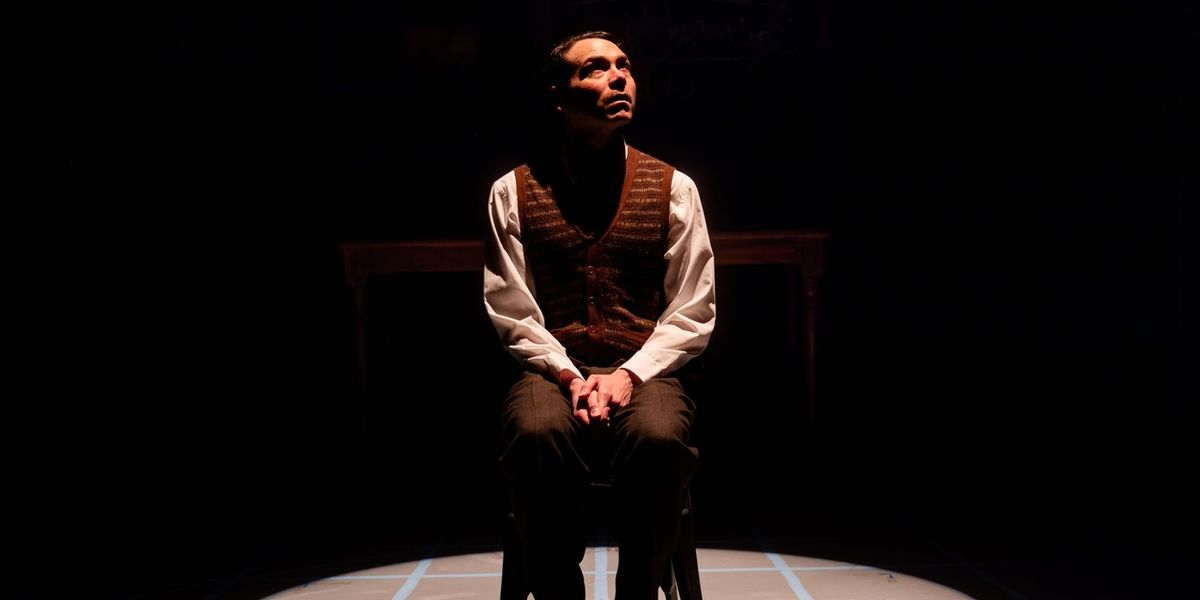
Eddie Shields is doing it again.
With his deeply affecting turn as physicist Alan Turning in “Breaking the Code,” now in a Catalyst Collaborative @ MIT Production at Central Square Theater (CST) through May 3, he further varnishes his status as one of the best in Boston at putting his indelible mark on a range of complex characters.
In the just the past decade, Shields has proven impossible to look away from - in shows including the Bedlam production of “Angels in America” at CST, and SpeakEasy Stage Company’s “Casa Valentina,” “The Inheritance,” and “A Man of No Importance,” which have earned the actor numerous Elliot Norton Award and IRNE nominations, and his IRNE winning turn in SpeakEasy’s “Significant Other.”
In “Breaking the Code,” the 1986 British play by Hugh Whitemore, Shields plays British mathematician, logician, theoretical biologist, and philosopher Alan Turning (1912-1954), whose work was central to the breaking of the German Enigma Code in World War II, and whose pioneering of computer science led him to be known as the father of theoretical computer science.
The two-act drama premiered in London’s West End in October 1986, before transferring to Broadway’s Neil Simon Theatre in November 1987. Both productions starred Derek Jacobi, whose portrayal of Turning earned him a Tony nomination for Best Actor in a Play. Whitemore could have written a play focused entirely on Turing’s professional achievements, but instead linked his cryptographic pursuits with the challenges he faced as a self-described “queer man,” to tell a fuller tale of his life.
If Turing were achieving his successes today, he might simply be known as a genius. But in England in 1952, when Turing was arrested and prosecuted for homosexual acts during the investigation of a break-in at his home, sexual acts between two men, were criminalized as “Gross Indecency.” Turing accepted chemical castration to avoid imprisonment. He would die from cyanide poisoning two years later, at age 41.
As Elliot Norton Award-winning director Scott Edmiston wrote in the CST program, “When the play opened in 1986, the name Alan Turing was essentially unknown. AIDS was sweeping the globe, and gay men were dying by the tens of thousands. This had awakened both panic and intense homophobia. Whitemore’s play can be seen as recognizing the contributions of gay citizens throughout history and advocating for greater compassion and understanding. To borrow a line from Tony Kushner’s ‘Angels in America,’ “We won’t die secret deaths anymore.”
Thanks to his enormous achievements, and to his willingness to come out when it was a criminal act to do so, Turing is still remembered. Under Edmiston’s seamless direction, this production will likely be well-remembered, too. And while many worthwhile productions will have a few stand-outs, this one has an entire company worthy of mention.
Here, of course, there is Shields who fully embodies his character. He maintains Turing’s stutter, facial tics, and nervous manner throughout even when he is not the central focus of a scene – the mark of a true actor. Surrounding him are a peerless company including multi-Elliot Norton and Irne Award-winner Paula Plum as Sara, Turing’s off-beat mother who is trying to understand and accept her son. While Plum’s Sara is humorously nosey, she is also profoundly moving when coming to grips with what it means to love her son, despite his lifestyle.
As Turing’s Enigma colleague and almost bride Pat Green, Josephine Moshiri Elwood is heart wrenching as her character quietly hopes for something more. Matthew Beagan plays all three male romantic interests in Turing’s life – from his childhood friend and first crush Christopher Morcom, young street hustler Ron Miller, and his Greek lover Nikos – each with their own dimension and appeal.
Dom Carter plays officer Mick Ross, who leads the burglary inquiry which revealed Turing’s homosexuality. During his interrogation of Turing, Carter shows that Ross is not just an officer of his era, with predictable opinions, but much more than that. His empathetic questioning of Turing is progressive for its time and portends a better future.
In his CST acting debut, David Bryan Jackson brings humor and warmth to the role of Dillwyn Knox, one of the key figures behind breaking Enigma and a man who broke his own codes, his own way, safely distant from public attention. As he struggles with memory loss, achingly well-realized by Jackson, he is enthralling when sharing his own life lessons with the younger Turin. Jackson is also impressive as the play’s living enigma, John Smith, a likely government operative eager to keep things secret.
Scenic designer Janie E. Howland, lighting designer Karen Perlow, and projections designer SeifAllah Salotto-Cristobal, with credible assist from Costume Designer Chloe Moore, combine forces to give the production just the right look and feel, especially with Audrey Dube's perfectly calibrated sound design.
Photo caption: Eddie Shields as Alan Turing in “Breaking the Code.” Photo by Nile Hawver/Nile Scott Shots.
Sign up for all the news on the Fall season, discounts & more...
|
Bat Boy: The Musical Umbrella Arts (9/25-11/08) |

|
Brian Henson's Puppet Up! Boch Center Shubert Theatre (9/27-9/27) |
|
Covenant SpeakEasy Stage Company (9/25-10/17) |

|
Monty Python's SPAMALOT Boch Center Wang Theatre (10/06-10/11) |
|
The Norwegians Elayne P. Bernstein Theatre (9/04-10/04) |

|
An evening with LaChanze Berklee Performance Center (11/01-11/01) |
|
BOUNCERS by John Godber The Modern Theatre (10/01-10/24) |

|
This Is Your Song: The Elton John Songbook Norton Singers (10/02-10/03) |

|
Unorthodox Huntington Theatre (5/06-6/06) |

|
Rachel Sumner and Travelling Light at Harmony on the Green Harmony on the Green (5/01-5/01) |

Reader Reviews
To post a comment, you must register and login.