

Review: MILLION DOLLAR QUARTET at The Phoenix Theatre Company
The production runs through March 8th at The Phoenix Theatre Company's Hormel Theatre.
By: Herbert Paine Dec. 20, 2025
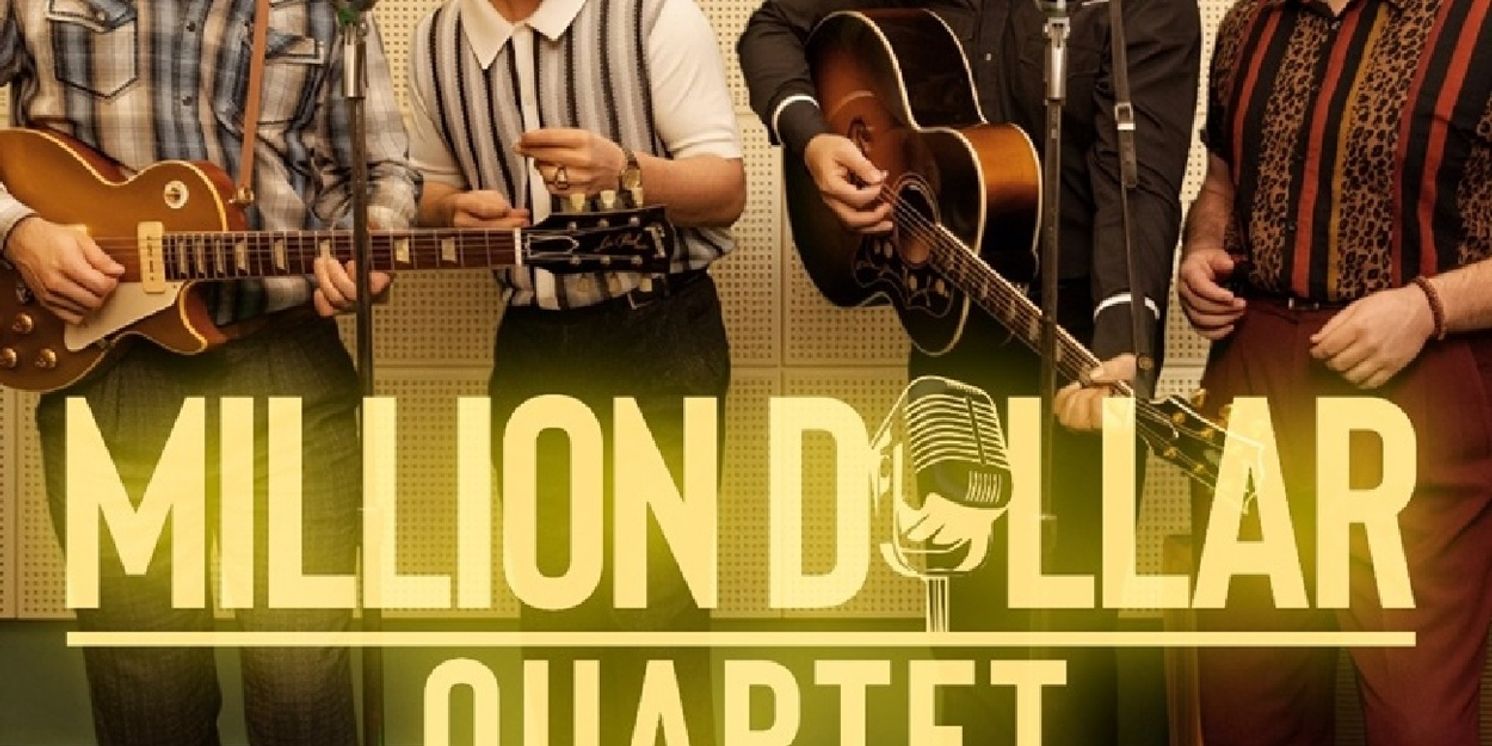
Guest contributor David Appleford’s upbeat review of The Phoenix Theatre Company’s production of MILLION DOLLAR QUARTET.
It really happened, and there are tapes to prove it. Four men, barely out of their twenties, strolled into a Memphis garage-turned-studio on a winter afternoon in 1956 and caught lightning in a bottle.
December 4, 1956, is now reborn nightly in The Phoenix Theatre Company’s Hormel Theatre in MILLION DOLLAR QUARTET under the crackling, kinetic direction of Scott Weinstein. It’s a 2 hour, high-voltage, rock ‘n roll joyride with the founding fathers of rock ‘n’ roll. From the first downbeat of Blue Suede Shoes, you know exactly where you are: a time machine disguised as a jukebox.
The evening is built around a holy localized legend when Sun Records honcho Sam Phillips, who could hear the future in a truck driver's growl, gathered four soon-to-be legends in a studio no bigger than a shoe box. What was actually an impromptu, ragged jam session has been polished here into a sturdy, theatrical, historical dramatization that manages to be both a jukebox blowout and a genuine live concert.
The setup’s true. Carl Perkins was there to record. His career had gone a little limp, and Sam Phillips was trying to light a fire under him with a session. Phillips also tossed in a wild card, an unknown kid with Pentecostal fingers and a devil’s grin named Jerry Lee Lewis. Johnny Cash, already a star, wandered in. Elvis, now recording for RCA, swung by just to hang out. By the time Phillips rolled tape, it was a jam. At the real event (though not in the show) a newspaper man also in attendance was the one who created the idea of a ‘Million Dollar Quartet,’ and like most journalistic hyperbole, he accidentally nailed it.
Kyle Sorrell plays Phillips with a rockabilly preacher’s drawl and a little carnie huckster glint in his eye. He opens the show like he’s whispering a secret. “That night, we made rock ‘n roll history,” and he was right. Phillips guides us through flashbacks and anecdotes like a man still marveling at the thunder he helped bottle. Sorrell doesn’t shout his lines like he’s trying to reach the rafters, he confides, he seduces, like Sam Phillips knew he had to sell you not just the sound, but the myth.
The structure’s breezy: the guys arrive, trade licks, and play the heck out of one classic after another. And there’s just enough drama to hold the thing together. Phillips is about to offer Johnny Cash a new contract, unaware the Man in Black has already signed with Columbia. There’s tension between Perkins and Elvis over Blue Suede Shoes regarding who owns it and who made it famous. And Jerry Lee’s so hopped up on talent and testosterone, you half expect the piano to burst into thunderous flames.
And thunder it is. There’s a tactile joy in seeing these icons humanized. Kurt Jenkins as Carl Perkins slings his guitar like a man with something to prove, and history tells us he did. Brady Wease’s Jerry Lee is a manic delight. He’s equal parts showman, madman, and Southern-fried genius, a chaotic, piano-pounding child who’s deliriously fun to watch and barely legal to let onstage.
Gregg Hammer gives Cash the gravitas of a man who’s peered into the abyss and written a song about it. Nick Voss as Elvis, already a myth in his own lifetime, is less a caricature than a gentle echo, with hips a little looser, a smile a little sadder. He’s drifting towards bigger things with RCA but longs for the dirt-floor intimacy of Phillips’ studio.
And when Alyssa Chiarello as Dyanne slinks her way through Little Willie John’s Fever, she doesn’t just stop the show, she makes you forget who else is on stage. In reality her name was Marilyn Evans, a Vegas dancer later tracked down by journalists while in her seventies to confirm that, yes, that really was her with Elvis that day. But this isn’t journalism, it’s rock ‘n roll mythos, and ‘Dyanne’ sounds more like a girl who’d call Jerry Lee “bashful” just before twisting his brain into a knot.
There’s no attempt to intellectualize the music, and there shouldn’t be. These songs weren’t meant to be studied. They were meant to be played. Loud, fast, and live. It’s a rowdy, sentimental piece of myth-making, and yet the show has a sweetness that disarms you; it’s theater’s love letter to the era before show tunes lost their grip on the American pulse. Writers Colin Escott and Floyd Mutrux have bypassed the sophisticated architecture of Rodgers or Sondheim to get at something more primal, and that’s the scratchy, electrified soul of Sun Records.
However, some jokes land with a thud. Cash’s “I’ve been everywhere” line creaks, and Elvis saying he’ll “never play Vegas again” is the kind of hindsight humor that’ll make you roll your eyes. You half-expect the ghost of Colonel Parker to boo from the back row.
Rock ‘n roll purists might grumble that only a couple of the songs from the actual 1956 tapes made the cut, replaced instead by the hits audiences crave. But when the performances are this electric, it doesn’t matter. The show understands that we aren't there for a documentary; we’re there to see the sparks fly. It may be a jukebox show, but it feels like a wake for the birth of rock and roll, something that’s loud, colorful, and impossible to sit still for. By the time the show hits the finale, the joint is jumpin’ with a fire that’s more than just stagecraft; it’s a reminder of why America fell in love with these boys in the first place.
Daniel Davisson’s lighting design pulses with color, peaking during the glorious post-curtain concert that feels less like an encore and more like a victory lap. Austin Case lays down the bass and Robert Grahmann drives the drums, all of it wrapped in Adriana Diaz’s period-perfect costumes and powered by Matthew Drui’s sound, which boasts more wattage and clarity than most touring bands. And as Sam Phillips reminds us, it ain’t no sound effect. These boys are playing for real, and they’ll be blowing The Phoenix Theatre Company’s roof off nightly until March 8. This quartet at the Hormel Theatre isn't just worth a million; they’re the jackpot.
The Phoenix Theatre Company -- www.phoenixtheatre.com -- 1825 N Central Avenue, Phoenix, AZ -- Box office: 602-254-2151 --
Photo credit to Brennen Russell – L to R: Kurt Jenkins, Nick Voss, Gregg Hammer, Brady Wease
Reader Reviews

Phoenix Awards - Live Stats
Best Musical - Top 3
1.
TOOTSIE (Arizona Broadway Theatre)
14.9% of votes
2.
XANADU (Arts Express Theatre)
11.2% of votes
3.
ANASTASIA: THE MUSICAL (Don Bluth Front Row Theatre)
7.1% of votes
Videos