From the Hills to the Stage to the Screen- A Look Back at THE SOUND OF MUSIC
The Sound of Music is back in movie theatres for its 60th anniversary.
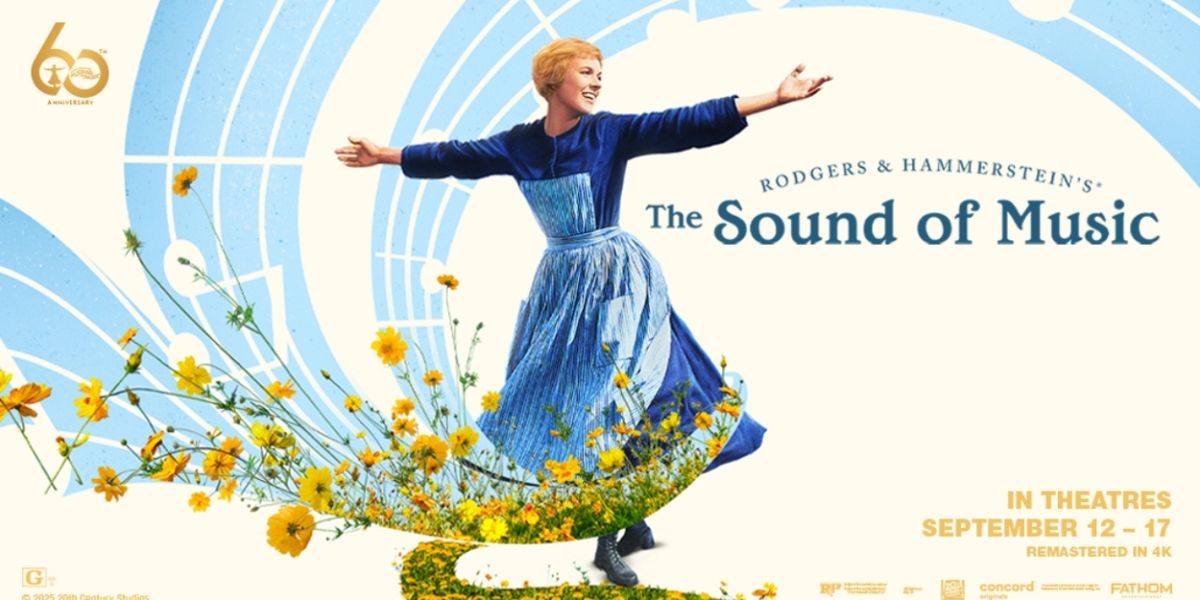
The Sound of Music is mostly based on the real story of the Trapp Family- a family singing group from outside of Salzburg, who fled Austria after the Anschluss.
Maria von Trapp wrote a memoir in 1949, The Story of the Trapp Family Singers, to help promote her family’s singing after the death of her husband, Georg, in 1947. Two West German movies were made about them: Die Trapp-Familie (1956) and Die Trapp-Familie in Amerika (1958). The two films became the most successful post-war productions in West Germany, later achieving widespread popularity across Europe and South America.
Paramount Pictures acquired the U.S. film rights with plans for an English-language version starring Audrey Hepburn as Maria. The project was eventually abandoned, but director Vincent J. Donehue suggested adapting the story for the stage as a vehicle for his friend, Mary Martin.
Producers Richard Halliday and Leland Heyward secured the rights and enlisted playwrights Howard Lindsay and Russel Crouse, winners of the Pulitzer Prize for State of the Union. Initially, Richard Rodgers and Oscar Hammerstein II were asked to contribute just one song, but they believed their style would not blend with Austrian folk music. Instead, they proposed writing an entirely new score once they finished Flower Drum Song.
Before Broadway, The Sound of Music had an out-of-town tryout at New Haven's Shubert Theatre. The original Broadway production, led by Martin and Theodore Bikel, premiered in 1959 at the Lunt-Fontanne Theatre and earned nine Tony Award nominations, winning five—including Best Musical. It ran for three and a half years and played 1443 performances. The musical premiered in London at the Palace Theatre in 1961, and ran for 2,385 performances.
Following the success of the musical, Twentieth Century-Fox purchased the screen rights to the musical in 1960. Filming took place between March and September 1964 in both Salzburg and Los Angeles.
The movie premiered in the U.S. on March 2, 1965, beginning with a limited release. Although early reviews were divided, it quickly became a massive hit, topping the box office within a month and finishing as the highest-grossing film of 1965. By November 1966, it had overtaken Gone with the Wind as the most profitable film ever made, a record it held for five years.
Its popularity was global, setting new box-office milestones in 29 countries. The initial theatrical run lasted four and a half years, followed by two successful re-releases. In total, the film drew 283 million admissions worldwide and grossed $286 million globally.
The Sound of Music earned five Academy Awards, including Best Picture and Best Director. It also won Golden Globes for Best Motion Picture and Best Actress, along with honors from the Directors Guild of America for Outstanding Directorial Achievement and from the Writers Guild of America for Best Written American Musical.
Over the years, the film has come to be celebrated as one of cinema’s all-time classics. In 1998, the American Film Institute ranked it 55th among the greatest American films ever made, and fourth among film musicals. Three years later, in 2001, the Library of Congress chose to preserve the film in the National Film Registry, citing its cultural, historical, and artistic importance.
On both stage and screen, The Sound of Music has influenced generations of audiences, inspired countless productions around the world, and remains a cultural touchstone that continues to introduce new viewers to the magic of musical theatre. Its songs, from “Do-Re-Mi” to “Climb Ev’ry Mountain,” have become part of the popular canon, ensuring that its message of hope and the power of music lives on.