Downstage Center with Howard Sherman: Magic To Do
Jamie Allan's Amaze is running off-Broadway at New World Stages.
In the city where Houdini once extricated himself from a straitjacket while dangling upside down above Times Square, it’s surprising that we don’t get major magic acts on stage more often than we do in New York. This relative paucity is thrown into relief when magic, illusion, escape and the like actually do take up residence on New York stages, as is the case right now with Lord Nil extricating himself from threat of the Seven Deadly Sins at Stage 42 while just eight blocks uptown Jamie Allan is conjuring motorcycles and reams of playing cards at New World Stages with his show Amaze. This mystical doubleheader echoes the pre-pandemic one-two punch of Derek DelGaudio’s In & Of Itself on Union Square overlapping with Derren Brown’s Secret at the Atlantic Theatre Company (and later Broadway).
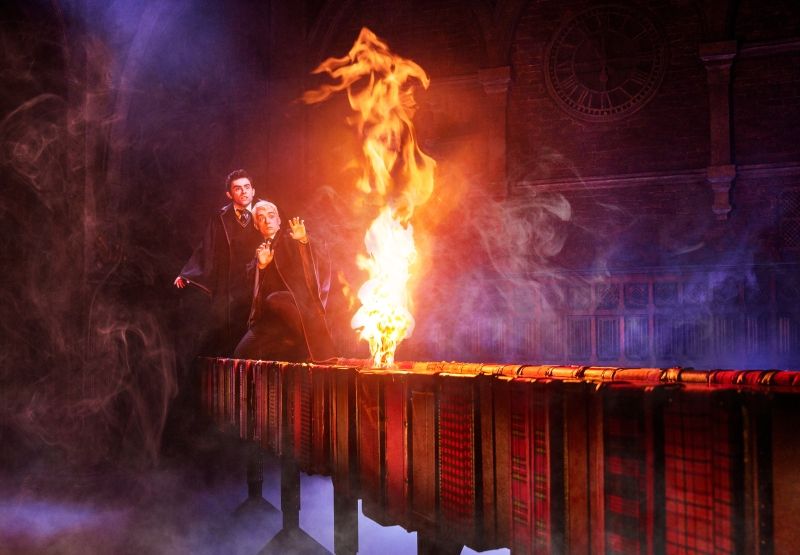
Photo Credit: Matthew Murphy
When magic sets up shop in New York, it tends to be part of a larger construct, such as in service of narrative works like Harry Potter and the Cursed Child or Stranger Things: The First Shadow, both now running just three blocks apart on Broadway. In the former, magic is part of the point – it is about wizards, after all – and in the latter, the techniques are put to use to flesh out a different kind of supernatural story, leaning into outright horror. However, in recent years, only the successive holiday runs of The Illusionists made magic the centerpiece on Broadway for any sustained run, and while it was a hit, relatively few managed to see one of the 19 performances of El Mago Pop two summers ago in a blink and you’ll miss it appearance.
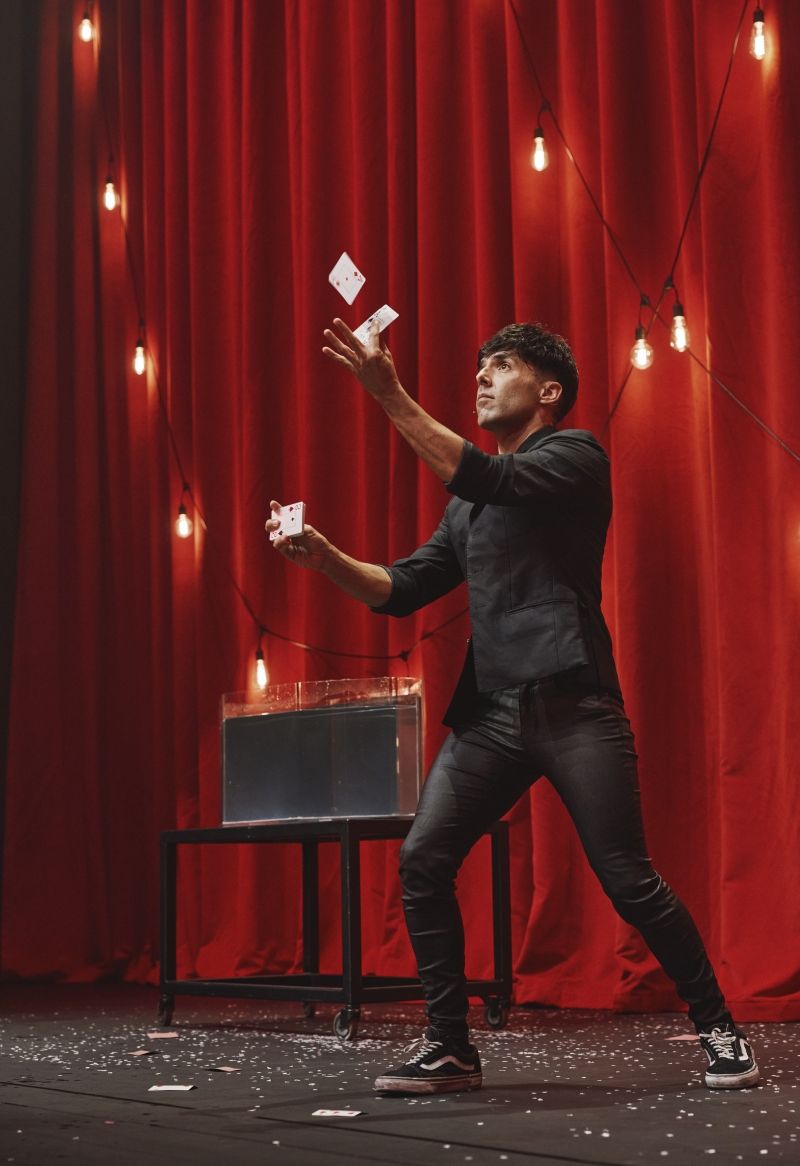
Photo Credit: Emilio Madrid
Perhaps Off-Broadway is better scaled for magic, creating an intimacy that makes the tricks and illusions more effective than in the large halls of Broadway or Las Vegas, the latter being more associated as a home for prestidigitation than the mean streets of Manhattan. DelGaudio’s show at the Daryl Roth Theatre extended multiple times and Asi Wind managed a good run at the Judson Church on Washington Square Park. Going back to the 80s, it’s worth remembering that Penn and Teller burst onto the scene in the smaller of The Westside Theatre’s two stages and in the 90s Ricky Jay was a hot ticket at the 99-seat Second Stage venue on the Upper West Side with Ricky Jay and his 52 Assistants. When Penn and Teller moved to Broadway, their stints have tended to be limited runs; this week they play a single show at the vast Radio City Music Hall.
It's not that magic can’t be the main attraction on the main stem, as Doug Henning and Stephen Schwartz proved 50 years ago with the magic and musical hybrid The Magic Show, not so coincidentally my first Broadway show. Running just under 2,000 performances in the mid-70s, The Magic Show began as a showcase for the hippie-ish Henning to revivify magic for the New York masses while paying homage to Houdini (performing his Metamorphosis trick), but the show wasn’t wholly reliant on Henning, as it continued even after he moved on. Framed as a musical with the prodigious talent of Stephen Schwartz in his first Godspell-Pippin heyday, The Magic Show endured. It’s an unsolved mystery why, so many years later, a revisal version hasn’t rematerialized, especially with songs like “West End Avenue” and “Lion Tamer” just begging to be sung again.
In the 80s, Penn and Teller’s irreverence towards magic tradition was an essential part of their appeal. I remember Penn Jillette, in that low-ceilinged theatre on 43rd Street, decrying greasy haired carnie sideshow magicians at the start of that first show – even though it concluded with an admittedly spooky and somewhat moving display of carny trickery as Penn “ate” fire, the smell of kerosene permeating the small venue. Ricky Jay performed as if delivering a lecture on the magic arts while wowing small audiences with expert card manipulation. This stood in contrast with what we could see on TV most of the time, whether the tragic Siegfried and Roy in their tiger-obsessed prime, David Copperfield disappearing the Statue of Liberty or later David Blaine and Criss Angel with their grunge and goth stylings.
Lord Nil mimics the more grandiose stylings of those latter-day modern magicians with his escapes themed to the seven deadly sins, yet other recent magic in New York has adopted the confessional, memoirist mode. DelGaudio and Allan built their shows around the story of how they discovered magic, the particular youthful obsession and discovery of mentors providing the framework on which to hang their skills. Both serve as affirmations of following your dream, even when it may mark you as an outsider or nerd; that you’re there watching them proves that their obsessions have paid off. Their shows are magic as memoir.
At the top of Amaze, Jamie Allan posits that there are two kinds of people who go to magic shows: the believers, who simply go to be wowed, and the analysts, who are constantly trying to work out how things are done. I happen to put myself in a small third group: the enthusiast, who has read enough to know the basic concepts behind magic and illusion, but go to see masters at work, like seeing prime athletes or dancers displaying their prowess. When the act is well crafted, when the execution is expert, it matters not at all that I may divine the construction, because a) I couldn’t possibly do it myself and b) flawless technique is itself a thing of wonderment.
--1920x1080%20photographer%3DDANNY%20KAAN.jpg?format=auto&width=800)
Photo Credit: Danny Kaan
Why in a city this size have we never had the equivalent of a Magic Castle, the fabled venue in Los Angeles, or something akin to the repeatedly extended stint of The Magic Parlour under the auspices of the not-for-profit Goodman Theatre in Chicago? Magic seems confined to very small rooms, at bars and hotels, to evanesce all too quickly, or be taken for granted within the aforementioned larger narrative shows. Yet it proved incredibly popular when offered online during the pandemic, even at a remove.
As it happens, Lord Nil and Amaze overlapped with a third magic show, albeit a very different one, when WP Theatre brought back Crystal Skillman’s Open for a summer run. Tracing the relationship of a female magician and her partner, Open does something decidedly different: it mimes all of the magic. Appreciating both the distraction and familiarity of magic tricks, Open describes its illusions and in doing so, creates its own illusion, forcing the audience to create the magic entirely in our minds. “Do you see,” importunes the character called only The Magician, “Flowers! How beautiful…don’t you see?” Such is the allure of magic that even when it’s only suggested, it coalesces, functioning as trick and metaphor all at once. If that doesn’t serve to call for, and call forth, magic, then what does.
Whether in a lost relationship, as in Open, or in times when reality can be so distressing that we need something that can, momentarily, allow us to simply gasp in wonder, magic can be a message, taking us away from all this into the realm of amazement. New York’s theatres should conjure more.
Note: After this column was filed, it was announced that Magician Rob Lake and The Muppets would be coming to Broadway for a limited run during the holiday season.
Sign up for all the news on the Fall season, discounts & more...