


Review: KRAPP'S LAST TAPE, Starring Stephen Rea
Stephen Rea gives a standout performance in this Beckett revival
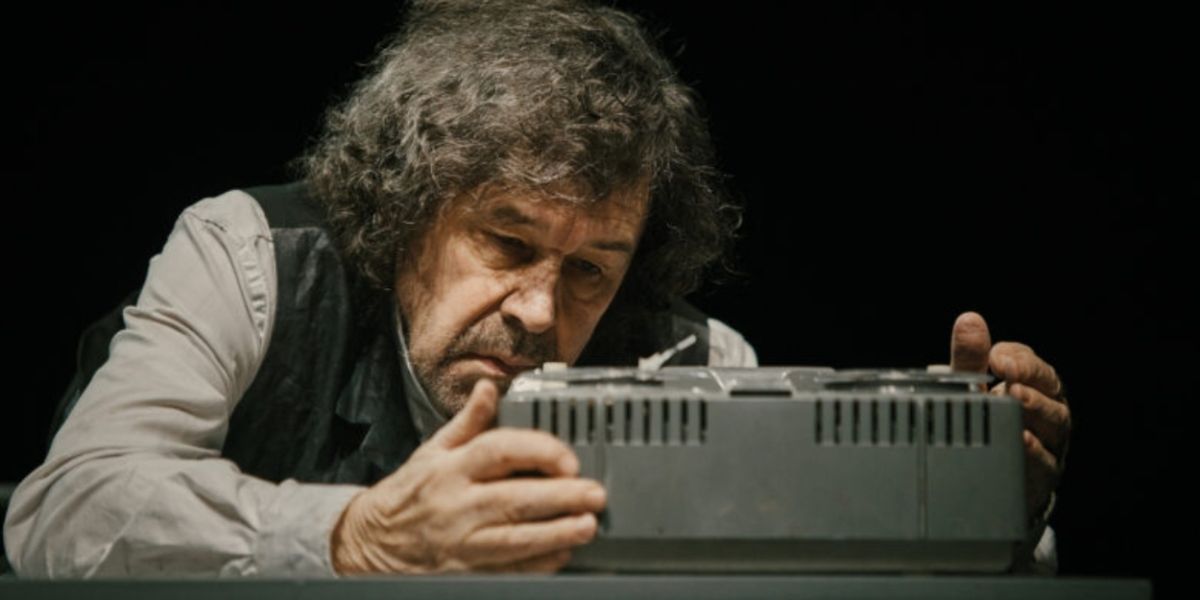
 In this latest revival of Krapp’s Last Tape at the Barbican Centre, it is the silence that speaks the loudest. At times, it’s practically deafening.
Directed by Vicky Featherstone and starring Stephen Rea, this one-hander from Samuel Beckett sees an old man looking back at his life through the tapes he makes on his birthday. It has been a production that has been almost fated to be: Rea recorded in 2009 the lines heard from Krapp’s younger self while Featherstone was considering a version of this play before she left her position as the Royal Court’s Artistic Director.
The short running time of just under an hour belies the dramatic power of this 1958 masterpiece. It can be deeply underwhelming for first-timers as there are few bursts of emotion and has little in the way of a plot or explicit exposition. If Beckett’s more famous work Waiting For Godot is a play where famously “nothing happens, twice”, this could be seen by some as one where nothing of note happens at all.
Instead, Beckett has aimed squarely for the portrait of a man who knows that the road ahead of him is shorter than the onе behind. The tapes he mounts in a stack on his desk are his milestones along life’s paths and, as he prepares to make his next recording, seeks out the words of his 39-year-old self.
Both Rea and Featherstone take the old man’s clowning seriously. The 78-year-old actor is older than his character by almost a decade but can still play the fool with a carefree air and immaculate timing. He stretches out the word “spool”, testing how far it can be elongated before pattering around in his den.
As realised through Jamie Vartan’s bare set design, this is Krapp’s kingdom where he can drop or throw banana skins wherever he likes. His studied over-reliance on the yellow fruit is shown here by having him reach for a key around his neck to unlock a comically long drawer in his desk.
It is when Rea is sat down with his arms around the tape machine, intently listening in on a voice from three decades ago, that this play finds its heart. He mourns the relationship he gave up so that he could embrace a career that petered out long ago, scoffs at the arrogance he displayed at that age and then nods along with his younger self at the naivety he displayed as a twenty-something.
This Krapp is not raging against the dying of the light but accepting his choices and where they led him. Rea effortlessly brings out the dark melancholy felt in the present day; when attempting to convey his most recent achievements in a depressed monotone, he is barely able to find anything to say before he angrily stops and goes back to listening to the older tapes. Beckett’s signature ambiguity means that, at the end, as the lonely oldster wanders away from us into the kitchen, we never find out whether the tape he has recorded is his final one or merely his most recent.
The Irish playwright seems to be flavour of the month. Up in York, Gary Oldman is currently directing and starring in his own Krapp; meanwhile, over in New York, Jamie Lloyd is preparing his vision of Waiting For Godot with Keanu Reeves and Alex Winters in the lead roles. Bill and Ted’s minimalist adventure begins previews on 13 September.
Krapp's Last Tape continues at Barbican Centre until 3 May.
Photo credit: Patricio Cassinoni

|
Powered by

|






Reader Reviews
To post a comment, you must register and login.