


Review: Arts Club’s DIAL M FOR MURDER Delivers Sharp Suspense
A modern adaptation of the 1950s thriller lands at the Stanley BFL Canada Stage
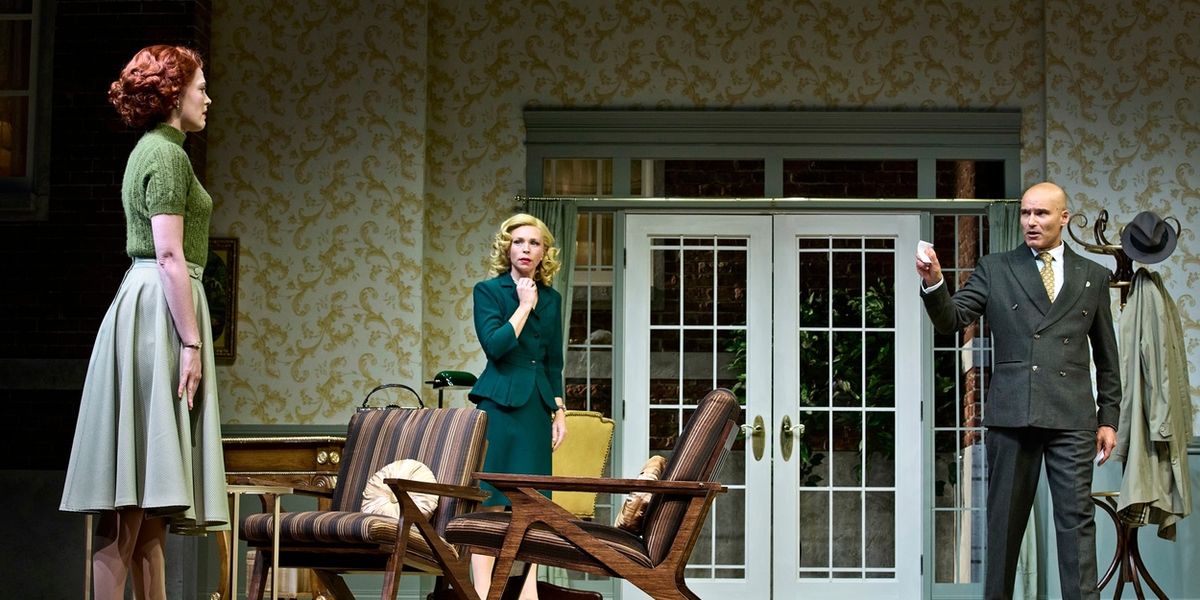
A telephone, a key, and a carefully timed call. DIAL M FOR MURDER wastes no time laying out its stakes. At the Stanley BFL Canada Stage, the Arts Club Theatre Company presents Jeffrey Hatcher’s adaptation of the classic thriller, directed by Jillian Keiley and running February 5 to March 8. Presented in partnership with Theatre Calgary, the production places us inside a sleek 1950s London flat where every look and movement feels intentional and silence carries tension.
The story began in 1952 with playwright Frederick Knott. DIAL M FOR MURDER first appeared on BBC television before moving to London’s West End and then to Broadway, where it ran for more than 500 performances. Two years later, Alfred Hitchcock brought the thriller to the screen, casting Grace Kelly as Margot and cementing the story’s place in popular culture. Since then, the story of a jealous spouse planning the perfect crime has resurfaced across stage and screen.

Tyrell Crews and Emily Dallas in Dial M For Murder. Photo by Trudie Lee for Theatre Calgary
Hatcher’s 2022 adaptation, approved by the Knott estate, keeps the 1950s setting but reshapes the emotional core of the play. Margot’s lover becomes a woman, shifting the stakes and deepening the themes of secrecy and power. The result is a fast moving, dialogue driven thriller that still feels grounded in its setting. We know almost immediately what Tony is planning for his wife, Margot. The suspense does not come from surprise. It comes from watching his carefully built scheme start to crack, and from realizing he may not be the smartest person in the room.
DIAL M FOR MURDER is a story about control. One man believes he has thought through every angle and closed every gap. The satisfaction comes from watching those small cracks appear and widen. In this Arts Club production, the well known title feels sharp again. It’s a reminder of how a tightly built mystery from the 1950s still knows how to hold an audience in its grip.

Tyrell Crews and Stafford Perry in Dial M For Murder. Photo by Trudie Lee for Theatre Calgary
Tyrell Crews carries much of the evening as Tony Wendice. From his first moments on stage, the audience tracks the story through him. His motives are clear and his plan is laid out in front of us. Crews has the command his role demands, holding attention with a steady, confident presence. What makes his performance land is the way he allows the small cracks to show. In moments where Tony’s control begins to slip, Crews does not overplay the panic. He lets the tension build in his posture and voice. It makes the unraveling of his character more satisfying to watch.
As Margot Wendice, Emily Dallas takes on a role that asks for emotional range and restraint at the same time. Margot moves through love, doubt, fear, anger, and frustration in quick succession. Dallas navigates those shifts with control. Nothing feels exaggerated and her transitions are smooth, giving her a sense of stability even when her world is closing in. Opposite Olivia Hutt’s Maxine Hadley, Dallas finds a quiet intimacy that anchors the adaptation’s central change. Their early scenes together draw us into the affair with ease. Their chemistry builds gradually, and by the time the tension enters their relationship, there is enough history between them for the conflict to sting.
Olivia Hutt gives Maxine a sharp intelligence and warmth. She is direct without losing vulnerability. There is a subtle confidence in the way she listens and reacts. The small choices she makes make the character feel lived in. Maxine is meant to be a bit of a mystery, yet Hutt keeps her grounded and present in every scene. It’s easy to get behind her. When the story reaches its final turns, she feels like a crucial part of why it works.

Emily Dallas and Olivia Hutt in Dial M For Murder. Photo by Trudie Lee for Theatre Calgary
Shekhar Paleja introduces a different rhythm to the play as Inspector Hubbard. His approach is measured and observant with a touch of dry humour that lands cleanly. The interactions between Hubbard and the other characters feel fluid, never forced. Rather than overpowering Tony, Paleja plays the long game. His calm, observant approach slowly closes in, and you can see Tony running out of room.
Stafford Perry makes an immediate impression as Lesgate. You can feel the character’s nerves and desperation the moment he steps into the room. Perry lets those anxieties sit close to the surface, while also hinting at the opportunistic side that drives his choices. He finds small moments of dry humour that let the audience breathe without easing the tension too much. Every time he appears, the energy shifts slightly, and the first act gains a sense of unpredictability that keeps you alert.
Director Jillian Keiley maintains a tight pace throughout. The entire play unfolds inside Margot’s apartment, designed by Anton deGroot. The space never feels static. A subtle revolving stage shifts perspective without drawing attention to itself. You might not notice it at first, but when it matters, the change in angle sharpens the focus. Combined with Itai Erdal’s lighting and the sound design by Anton Lipovetsky, the production takes on a cinematic quality while remaining firmly theatrical. Key props and movements are highlighted with precision, guiding the audience’s attention without feeling overstated.

Emily Dallas and Olivia Hutt in Dial M For Murder. Photo by Trudie Lee for Theatre Calgary
One of the most effective choices in this adaptation is opening with Margot and Maxine. We step into their relationship before the larger scheme begins to unfold. The queer storyline feels integrated rather than something that is imposed. Even within the 1950s setting, their connection is portrayed with sincerity. As someone unfamiliar with the original version, the change does not feel like a revision. It feels natural to the world of this production.
DIAL M FOR MURDER is a dialogue driven thriller. The script is dense and every detail matters. If attention drifts, important information slips by. That focus is part of the experience. The play is not spectacle driven. It asks the audience to listen, watch closely, and to piece together what is obvious and what is concealed. Tony presents his plan openly. Margot reveals most of her emotional landscape, while still holding something back. Maxine, Hubbard, and Lesgate each unlock further layers as the story progresses.
By the final moments, the tension has tightened enough to leave the audience both relieved and reflective. The play rewards careful viewing and lingers after the show is over. It prompts the audience to reconsider earlier exchanges and small details that seemed minor at the time. In this Arts Club production, DIAL M FOR MURDER proves that a single set, a handful of actors, and a well built script are more than enough to keep a room on edge.
DIAL M FOR MURDER presented by the Arts Club will play at the Stanley BFL Canada Stage in Vancouver, BC until March 8, 2026. For more information about the show and to purchase tickets, visit the link below.
Top Photo: Emily Dallas, Olivia Hutt, and Shekhar Paleja in Dial M For Murder. Photo by Trudie Lee for Theatre Calgary, 2025
Weekly top stories - unsubscribe anytime.

|
Disney's Beauty and the Beast Queen Elizabeth Theatre (11/24-11/29) |

|
Lunenburg Deep Cove Shaw Theatre (11/12-11/28) |

|
The Reluctant Princess & Her Extraordinary Band of Pirates Anvil Theatre (3/19-3/21) |

|
An EnChor Christmas EnChor (12/12-12/12) |

|
The Reluctant Princess & Her Extraordinary Band of Pirates Surrey Arts Centre (3/12-3/14) |

|
Ruby: The 40th Anniversary Concert Good Shepherd Church (5/16-5/16) |
|
Equus Performance Works (11/18-11/22) PHOTOS |

|
Hamilton (Angelica Company) Queen Elizabeth Theatre (5/26-6/13) |

|
Elf: The Musical Stanley BFL CANADA Stage (11/12-12/27) |

|
Ruby: The 40th Anniversary Concert Christ Church Cathedral (5/15-5/15) |
Reader Reviews
To post a comment, you must register and login.