


Vital Xposure and Z-arts Explore Theatre Accessibility for Youth
New research highlights the impact of accessibility in theatre productions for young audiences.
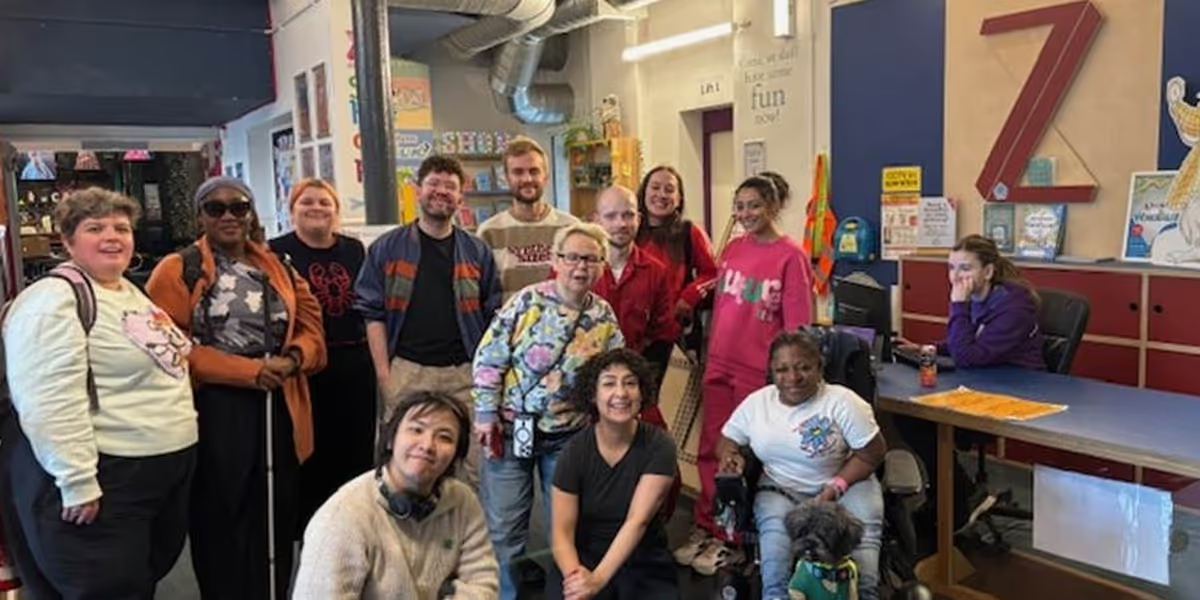
As part of their research and development programme VX Labs, disabled-led theatre company Vital Xposure, in partnership with Z-arts, the UK's only arts centre dedicated to children and families, have released findings from their most recent lab on accessible, disabled-led theatre for “Children and Young People”.
VX Labs are part of a three-year Arts Council England supported research initiative exploring disabled-led performance. This latest lab brought together disabled, d/Deaf and neurodivergent artists, creatives and consultants to explore questions facing the sector when commissioning and producing work for children and young people.
At a time when arts education is shrinking and children's access to cultural experiences is under increasing pressure, the Children and Young People's Lab makes a clear case: accessible, high-quality theatre for young audiences is not optional but foundational to the future of the artform.
The Lab explores the importance of working creatively with those with lived experience and with the inclusion of children and young people, challenges assumptions and affirms that complex, ambitious work belongs on stage for young audiences. It asks how theatre can be made for and with children and young people when accessibility is assumed as a creative opportunity, and how this approach can be embedded as a contractual imperative in the commissioning of all work for young audiences.
Josh Elliott Artistic Director at Vital Xposure explains “This Lab prioritised creating a space for children and young people to share the full arc of their theatre experience from entering the building to leaving it, and in doing so created a clear mechanism through which their wishes, frustrations and responses could directly shape work made for them”
The research was driven by the desire to make the process of creating accessible work for children and young people more transparent and available, reducing the need for repeated learning across the sector. The aim was to develop a practical ‘toolkit ‘ that could be used by venues, artists and theatre makers.
As Liz O'Neill, CEO and Artistic Director Z-Arts explains the intention is “to use this learning ourselves in future commissions, but also to share with artists who come through our development programme and the wider sector”.
Local organisations and artists were consulted months in advance to shape the research with disabled artists recruited early to lead the artistic development. Hosted over four days at Z-arts in Manchester, the lab brought this team together with children and young people to devise an accessible piece of theatre shaped directly by their ideas, tastes and curiosity.
Integrated BSL, creative audio description and captioning were embedded into the artistic language of the work from the outset, not retrofitted at the end. Through introductory workshops, artists and young people explored ideas together in an open, supportive space where everyone could contribute, test ideas and share creativity. Children were not audiences in waiting, but active collaborators.
The lab was met with enthusiasm from all participants and offered valuable insight into a process that challenged assumptions about what accessible theatre for children can be.
Disabled-led theatre devised for and with children and young people is built through equitable collaboration, where ‘what if' questions are encouraged rather than closed down. participants described the lab as a “joyful process” which resulted in “making the work better”, “more playful”, and “more exciting creatively”. With a clear message emerging: “Take it seriously, keep it joyous”.
Findings emphasised the importance of recognising lived experience as central to the work and highlighted the importance of the often-invisible labour around making work (preparation, partnerships, care, and time) arguing that these interstitial spaces or “spaces between structures” are vital.
Crucially, the Lab demonstrated that accessible theatre for children is not a compromise on artistic quality, but a driver of it.
Liz O'Neill, CEO and Artistic Director of Z-arts, says, “This Lab demonstrated what's possible when children's theatre is treated as the most important work we do and when access is valued as creatively enriching rather than burdensome. The children had real ownership of the work, and that showed.”
In response to the findings, the Lead Artists have been commissioned to develop a toolkit for making accessible, inclusive theatre for and with children and young people. Expected within 2026, the toolkit will be designed to inform commissioning processes for new work.
Dr Mandy Precious, author of the report explains, “This Lab provides a practical model for the sector showing how accessibility, co-creation and artistic ambition can coexist, and why theatre for children and young people deserves the same rigour, resources and respect as any other work.”
Building on this research Vital Xposure have commissioned an R&D for When I See Blue, an authentic and affecting story for young people about living with OCD, written by author and mental health activist, Lily Bailey.
Josh Elliott Artistic Director at Vital Xposure shares their excitement about applying the labs learnings into practice during this R&D period and says:
“Our labs are the essential fuel for how we make work. They provide an experimental space for enquiry and play, which result in real life recommendations that we can practically apply to our work. Following The Children and Young People Lab we're able to use these findings not only to create the toolkit to share with the industry but to use this ourselves to inform the R&D of When I see Blue”
“Putting learnings from the Lab into practice, this exciting R&D will explore how to physicalise the interior experience of OCD on stage, and how to make theatre that neurodivergent young audiences can access without the usual barriers, grounded in lived experience in the room and with children feeding into the process, to discover what a Lab-informed production can look like on stage.”
Adapted by Josh Elliott from the Lily Bailey novel, the R&D for When I see Blue will be directed by Nickie Miles-Wildin with dramaturgy by Lu Kemp. It will be hosted by development partner Polka Theatre, and has been supported by The Roald Dahl Story Company.
VX Labs are a three-year research and development programme supported by Arts Council England. Delivered in partnership with the Royal Central School of Speech and Drama and regional theatres, the programme examines disabled-led performance at the cutting edge of access, with the aim of sparking learning and sector-wide change.
Weekly top stories - unsubscribe anytime.
|
Dick Whittington Theatre Royal Bury St Edmunds (11/20-1/17) |
|
Orchestral Qawwali Project The Royal Albert Hall (10/24-10/24) |

|
KATHARINE Peterborough Cathedral (1/21-1/23) |
|
The Elf Factory Jacksons Lane (12/01-12/06) |
|
Home Alone 2: Lost in New York The Royal Albert Hall (12/12-12/12) |
|
Croydonites Festival of New Theatre The Front Room (11/04-11/21) |
|
Negativist Studio 3 (1/28-1/30) |

|
Luther UK Victoria Theatre Halifax (11/15-11/15) |
|
Grow by Highly Sprung Jacksons Lane (11/08-11/08) |

|
World of Warcraft®: 20 Years of Music (12) with the Royal Philharmonic Concert Orchestra The Royal Albert Hall (10/25-10/25) |