


Review: HOUSE OF JOY at Seattle Public Theater
The most accurate title for Seattle Public Theater's latest production
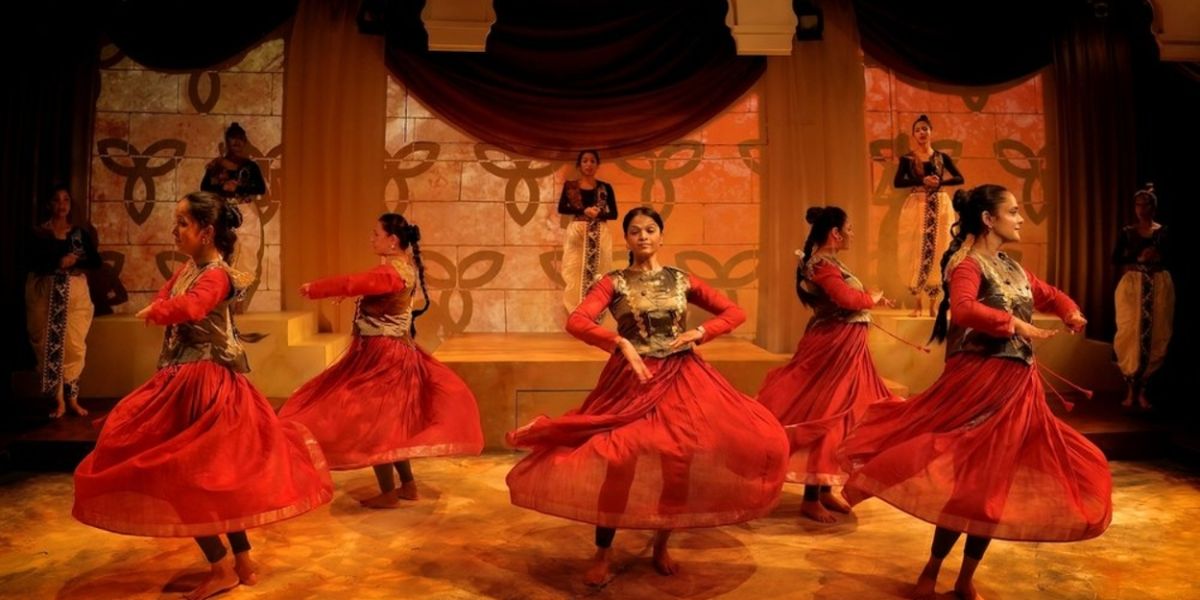
In House of Joy, co-produced by Pratidhwani and Seattle Public Theater, the house is more than just a setting. It listens. It responds. It protects and encourages. It even moves, embodied by the stunning choreography of the guards. These dancers don’t just live in the house. They are the house. This is fantastical escapism at its finest, and with one of the most fitting titles I’ve heard in a long time, the spirit of the house is, quite simply, joy.
Set in a mythical imperial palace in 17th-century India, House of Joy follows Roshni (Esha More), a young woman recruited into the elite all-female guard of the emperor. She arrives at the palace to find a set of strict rules. Women may not leave. Men may not enter. The only exception is Salima (Varun Kainth), a character described as both male and female. Roshni quickly learns she is replacing a former guard who was executed for falling in love with the emperor. So of course, in perfect tragic symmetry, she begins to fall for Mariyam (Guneet Kaur Banga), the emperor’s pregnant wife.
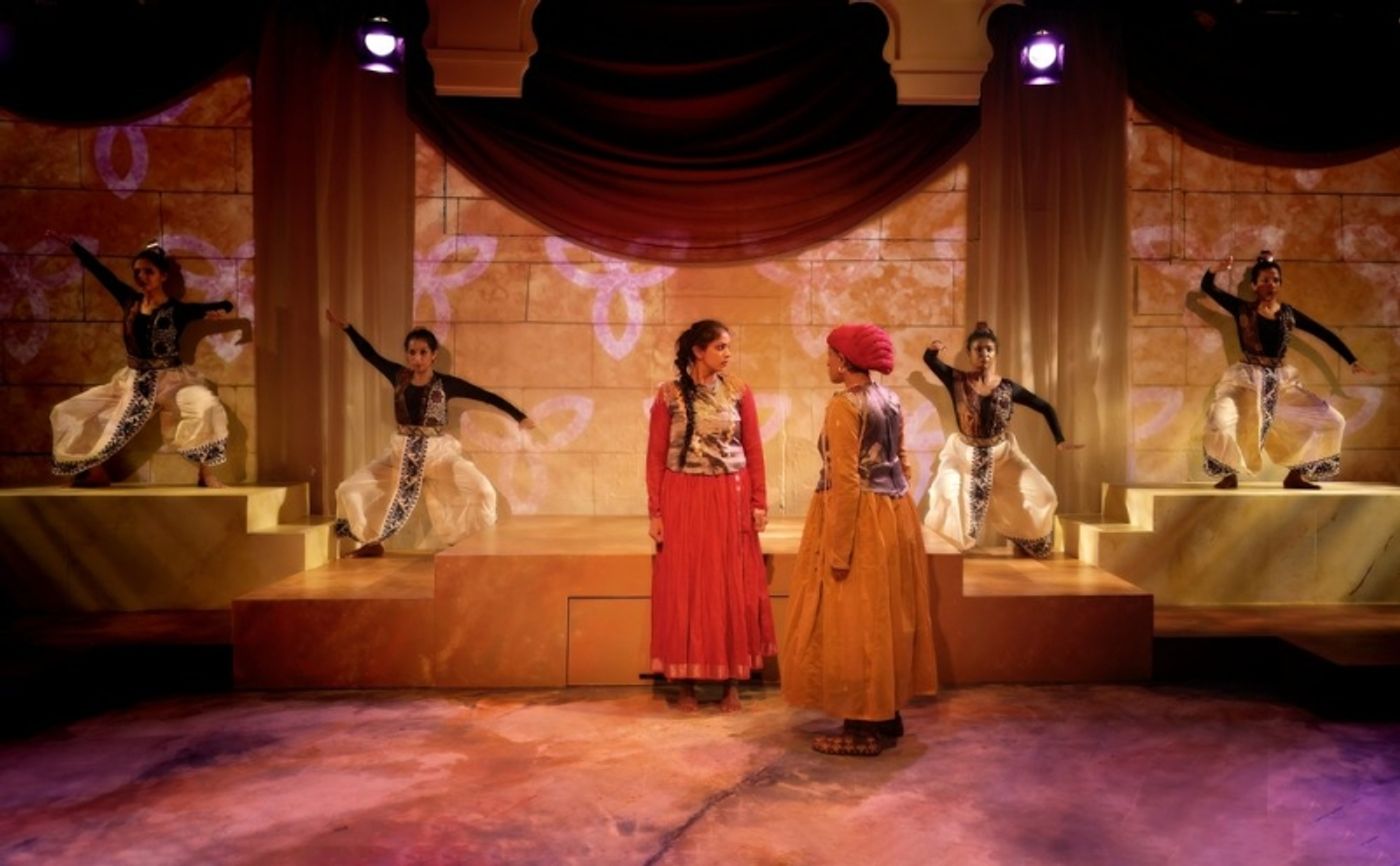
Photo credit: Joe Iano
But this romance is only one strand of the story. Princess Noorah (Aarti Tiwari), the emperor’s daughter, has her own ambitions for power. She sees Mariyam’s unborn child as a threat to her place in the line of succession and begins plotting to ensure her control over the future of the empire. Meanwhile, Roshni navigates shifting alliances, betrayal, and even ghosts. It is a world built on secrets, and every wall has ears.
If that sounds heavy, rest assured that this show is anything but grim. Directors Agastya Kohli and Moumita Bhattacharya keep the tone delightful and mischievous, even as the stakes rise. Anachronisms are sprinkled throughout the dialogue. The guards curse casually, tease one another, and play games like "Marry, F***, Kill." The result is a production that feels untethered from realism, punctuated and elevated with dance sequences throughout.
The storytelling is deeply physical. Bhattacharya’s choreography is the heart of the show. Movement is woven into every scene, whether it is a stylized swordfight, a ripple of silk fans that evoke fire, or the rhythmic stamping of feet that slap like a snare drum. The guard and ensemble dancers often move in unison, transforming the space around them and giving the sense that the house itself is alive and reacting. This personification is not just beautiful, it is central to the story’s tone.
Esha More shines as Roshni is the perfect protagonist; bright eyed, determined, and earnest. She also seamlessly weaves herself into the choreography with the guards that deserves a shoutout. Banga plays Mariyam with a good balance of sorrow and humor, making her feel like a real person rather than just a romantic ideal. Varun Kainth’s Salima brings an excellent energy to Salima; melodramatic, sharp-tongued, and elegant. Kainth commands the room, and keeps the audience guessing what game Salima is playing and with whom. Aarti Tiwari, however, is the standout. Her portrayal of Noorah is sharp and ruthless. She brings dimension to the character’s cruelty, suggesting a lifetime of resentment and political calculation. Tavnee Kale, as Hamida, provides an emotional anchor to the show. Her friendship with Roshni feels honest and lived-in, offering a steady counterweight to the drama around them.
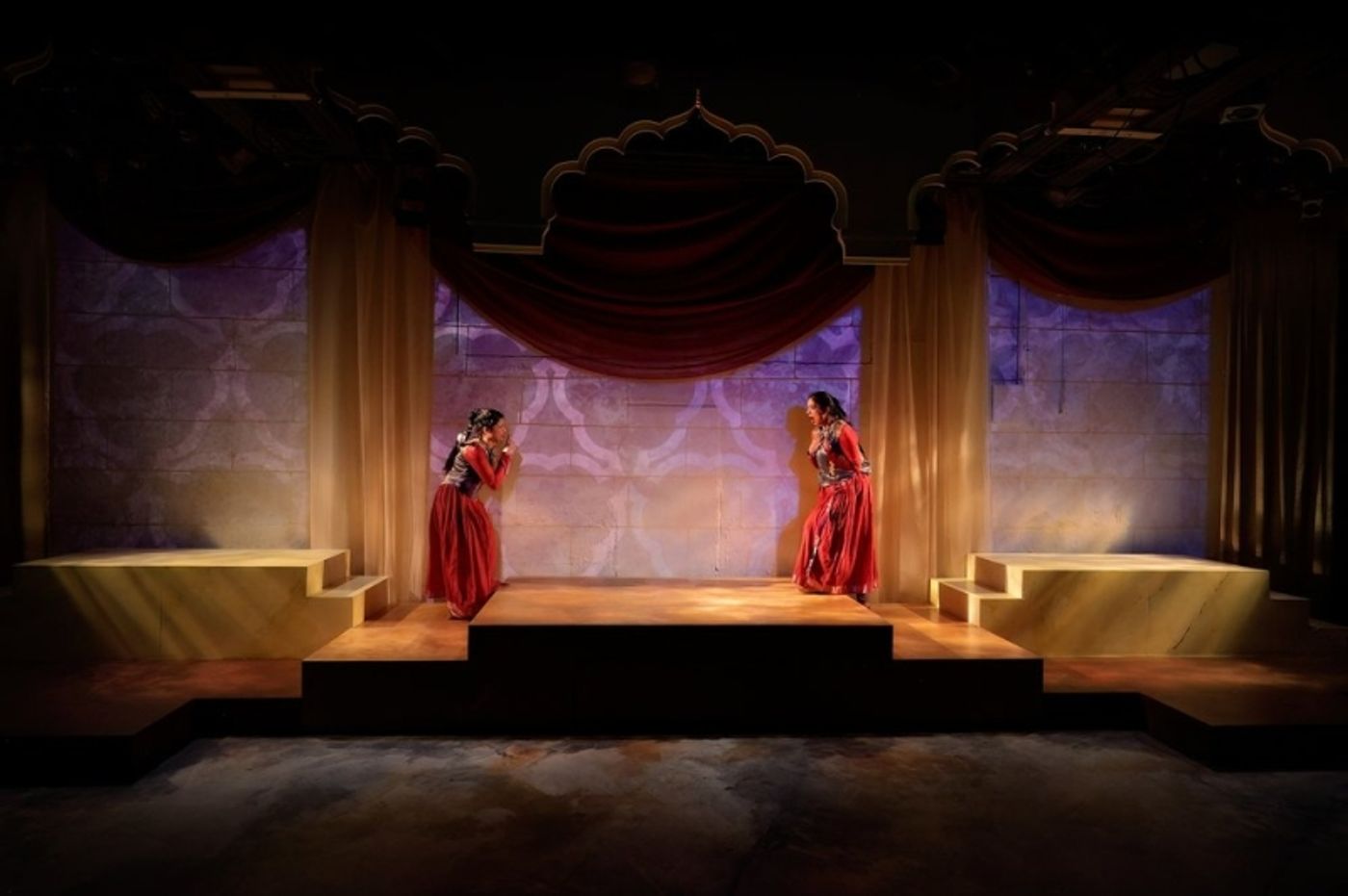
Roshni and Hamida in House of Joy.
Photo credit: Joe Iano
This production of House of Joy feels more about Roshni and Hamida’s relationship than Roshni and Mariyam’s. Hamida welcomes Roshni into the imperial guard with warmth and enthusiasm, without ever undercutting the seriousness of their shared role. These two are very convincing besties. The bond between the guards is full of gossip, teasing, and play, but their sense of duty still runs deep. Even the stern head guard Gulal, played convincingly by Suchita Mohan, allows herself moments of levity—though she’s often the one reminding the audience that this job is still, at its core, dangerous business. Nanda Tweari’s Mehr (the former wife of the emperor) brings a grounded charm in the show’s third act.
Parmida Ziaei’s scenic design brings you into an imaginative space from the get-go. Archways and empty space suggest a sprawling palace without limiting the movement of the performers. Projected geometric patterns and colors create a layered visual texture. Bhattacharya’s costume work is especially stunning. Each outfit bursts with color, sparkle, and character-specific detail. Salima had, impressively, at least eight costume changes. This was not necessary, but it was consistent with this glamorous character. Well done.
My one main complaint about the show is that More’s Roshni and Banga’s Mariyam did not have great romantic chemistry. They had very believable platonic chemistry, but their romantic and sexual dynamic felt a little clunky and forced. It could be a result of the maximalism of the script not leaving much space for these two to convincingly fall in love. It felt sudden, but not in a passionate or sweeping way. It wasn’t a love-at-first-sight situation. The show even devotes a long, dreamy sequence to Roshni and Hamida sharing a moment of intimacy in a boat, surrounded by dancers. It made me wish there had been a romantic dance number for Roshni and Mariyam instead, something to build emotional and physical momentum between them. I still rooted for them as companions, because their friendship chemistry was excellent, but I never fully believed they were lovers.
Even so, the play more than makes up for this gap with its confident storytelling and richly constructed world. For all its magic and mischief, House of Joy is a play rooted in structure. The fantasy elements are always in conversation with the rigid rules of the house and the people trapped within it. Gender, power, and control are the forces driving the story, whether whispered in shadowy corridors or clashed out in stylized swordplay. Yet despite its serious undercurrents, this is not a quiet play. It is big, bold, and bursting with fun. Over the course of three fast-moving hours, audiences are invited into a vibrant world of bright colors, elaborate costumes, dry humor, and jaw-dropping choreography. It’s an escape, a spectacle, and a celebration.
Grade: A-
House of Joy performs at the Seattle Public Theatre through June 8th. For tickets and information, visit https://www.seattlepublictheater.org/.

|
Barefoot in the Park State Theater (8/21-9/06) |

|
Freak The Mighty Seattle Repertory Theatre (7/30-9/06) |

|
Blockbuster Unexpected: An Improvised Disaster Movie Unexpected Productions Improv (7/10-9/19) |

|
Galileo Intiman Theatre (1/10-12/30) |

|
And Then There Were None Village Theatre (2/20-3/14) |

|
Wooden O: Macbeth Union Arts Center (7/09-8/16) |

|
Dear Evan Hansen Village Theatre (5/15-6/06) |

|
disPLACE Theatre Off Jackson (8/21-8/22) |

|
Come From Away Village Theatre (1/02-1/24) |

|
Topdog/Underdog Lakewood Playhouse (2/19-3/07) |
Reader Reviews
To post a comment, you must register and login.