


Review: AMADEUS AT THE MANOR CLUB THEATRE
Through April 27th at The Manor Club Theatre.
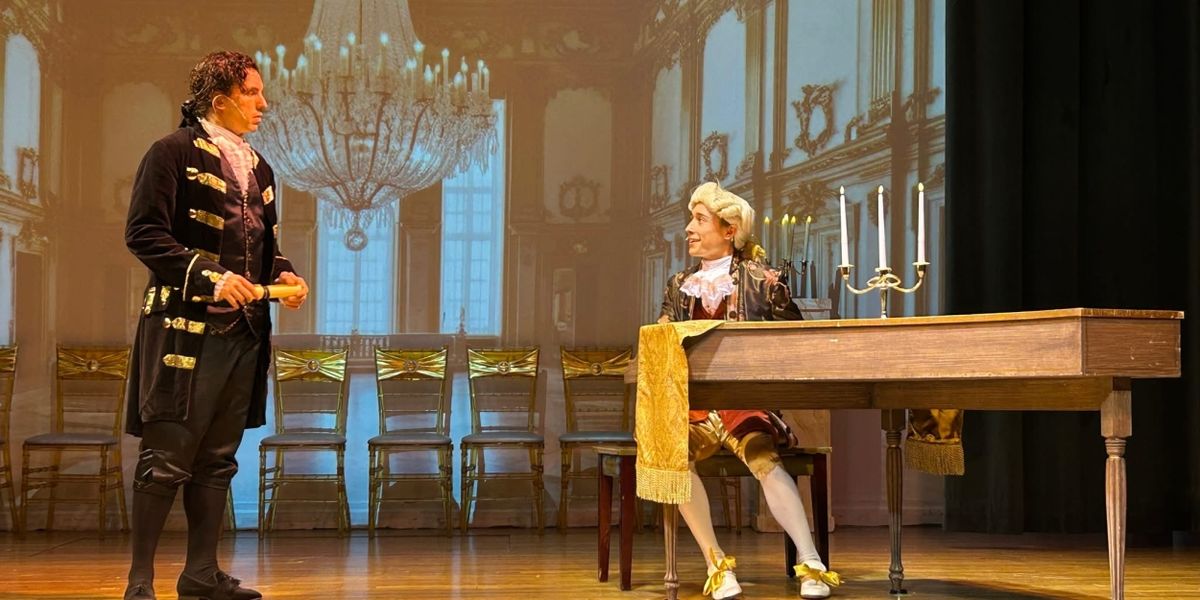
Amadeus was written by Peter Shaffer in 1979 and premiered at the Royal National Theatre in London. The play made its Broadway debut in 1980, running for an impressive 1,181 performances. It earned five Tony Awards, including Best Play, as well as the Drama Desk Award for Outstanding New Play. In 1984, it was adapted into a film, which won eight Academy Awards, including Best Picture.
I took my seat at the historic Manor Club Theatre with great anticipation. Amadeus is a challenging work for any company, and therefore it is not often produced. As the teal curtains parted to reveal shadowy figures in traditional 18th-century dress, the strains of one of Mozart’s compositions began to echo throughout the theatre. The action is set in Vienna in November 1823, with much of the story told in flashbacks to the years 1781–1791.
Amadeus is presented as the fictionalized final confession of Antonio Salieri, who serves as our narrator. We, the audience, are his “last audience” — his “confessors.” We are invited to witness the mutually destructive rivalry between the pious, Italian-born court composer Salieri and the young, vulgar Austrian prodigy, Wolfgang Amadeus Mozart. The elderly Salieri recounts the events he titles “The Death of Mozart, or Did I Do It?” — a tale of envy, sabotage, and guilt. Though Salieri is overwhelmed by the beauty of Mozart’s music, he is simultaneously crushed by the realization of his own mediocrity. To Salieri, a devout Catholic, “music is God’s art,” and he is horrified that such divine sounds could originate from someone as crass as Mozart. Consumed by jealousy, Salieri abandons his religious principles, using his political acumen to orchestrate Mozart’s decline into poverty, madness, and ultimately death. Despite his efforts to destroy him, Salieri alone fully comprehends the magnitude of Mozart’s genius — a bitter irony that haunts him.
Although the play is rooted in historical facts and circumstances, it is ultimately a work of fiction. Shaffer’s masterful storytelling plausibly blends history and human nature, elevating the story beyond its 18th-century setting to confront audiences with timeless moral questions.
The play showcases the music of Mozart, Salieri, and their contemporaries. The premieres of Mozart’s operas — The Abduction from the Seraglio, The Marriage of Figaro, Don Giovanni, and The Magic Flute — serve as key scenes in the narrative, each revisited through Salieri’s recollections.
Jeff Dylan Garrett delivers a commanding performance as Salieri, portraying him as pompous, sly, self-important, and filled with righteous indignation. Whether denouncing Mozart or surrendering to the sublime beauty of his music, Garrett is magnificent, captivating the audience from start to finish.
Julian Zimmer, as Mozart, is an engaging counterpart. He captures Mozart’s crassness and immaturity, making his sublime musical talent all the more striking.
Jessica Rose Beitscher is delightful as Katherina Cavalieri, the famed soprano turned pawn in Salieri’s schemes. Her unexpected live vocal performances were a highlight, perfectly complementing the 18th-century atmosphere. The arias were both well-rehearsed and beautifully delivered.
Bryce Smith and Billy Poorten bring lively energy to the Venticelli (“Little Winds”), spreading gossip and rumors with the ease of 18th-century influencers.
Michael Fanuele shines as Emperor Joseph II, blending humor with an air of stately eccentricity.
Nicole Arcieri delivers a nuanced portrayal of Constanze Weber, Mozart’s wife. She convincingly shows the emotional arc of a woman initially willing to endure Mozart’s childish behavior in hopes of future security, only to later make desperate compromises for her husband’s success.
Kevin Arthur (Count Johann Kilian Von Strack), Tom Weppler (Count Orsini-Rosenberg), and Eric Suben (Baron Gottfried van Swieten) all convincingly embody the disapproving officials of the Empire.
The ensemble — Mauro Contrastano, Leslie Ann Messina, Taj Curtis, Tara Garcia, and Alba Ovalles — adds to the production’s authenticity, managing intricate scene and costume changes with impressive poise, balancing the chaos of court life with the elegance of the era.
Director Donna Bellone, one of the most talented directors in local community theatre, nimbly leads her cast, delivering a production that is intelligent, visually stunning, and emotionally resonant.
The technical aspects were equally impressive. Stage Manager Leslie Ann Lopez and her crew kept the production flowing smoothly.
The lighting design by L2Web Media, featuring flickering candles, created a moody, atmospheric setting that shifted seamlessly with the action.
German Bosquez and Squid Sound & Video provided sound that featured glorious recordings of Mozart’s music; the actors’ microphone work was flawless, clear sound with no disruptive feedback.
Thanks to L2Web Media’s clever use of projections, the set transitioned seamlessly from location to location. The props and antique furnishings were carefully curated, further immersing the audience in the period.
This production of Amadeus was a remarkable achievement — a feast for the senses and a moving exploration of the corrosive power of envy.
The Manor Club, 1023 Esplanade, Pelham Manor, NY 10803
https://tmcofpelham.org/events 914-738-1528

|
Sunday brunch with Peter Janson Jazz On Main (8/30-8/30) |
|
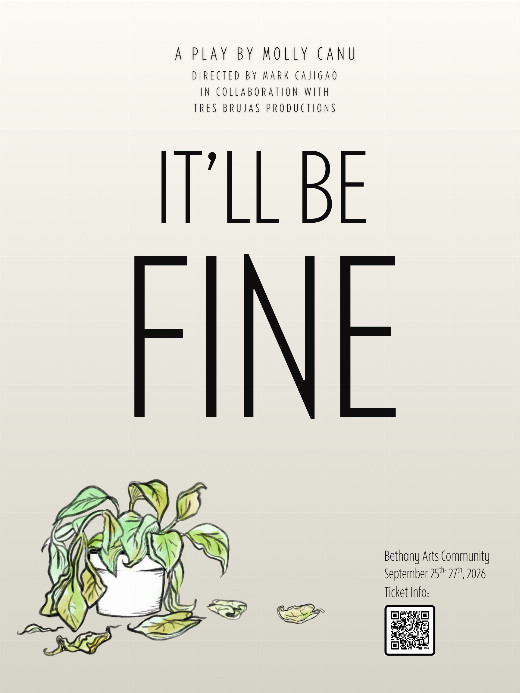
It'll Be Fine Bethany Arts Community (9/25-9/27) PHOTOS |
|
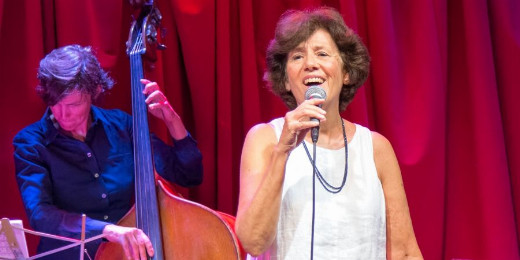
MJ Territo Quartet Jazz On Main (8/29-8/29) |

|
Sunday Jazz Brunch- Host by Ron Drotos Jazz On Main (9/27-9/27) |

|
Eugenie Jones Jazz On Main (10/24-10/24) |
|
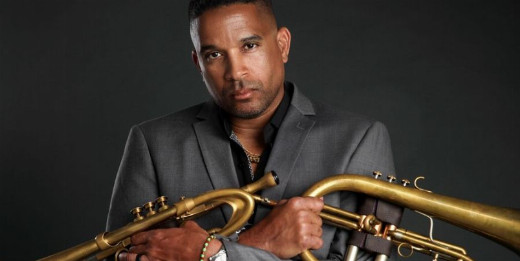
Pete Rodriguez Quartet Jazz On Main (9/26-9/26) |

|
Stan Ayeroff solo Jazz On Main (8/27-8/27) |

|
Miss Maybell and the Jazz Age Artistes Jazz On Main (8/21-8/21) |

|
Sunday Brunch with Maya Shaw Jazz On Main (10/11-10/11) |
|
Hey Rim Jeon & Friends Jazz On Main (10/17-10/17) |
Reader Reviews
To post a comment, you must register and login.