


CLYBOURNE PARK Comes to Farmington Players Barn
The show runs Friday, September 19, through Sunday, October 5.
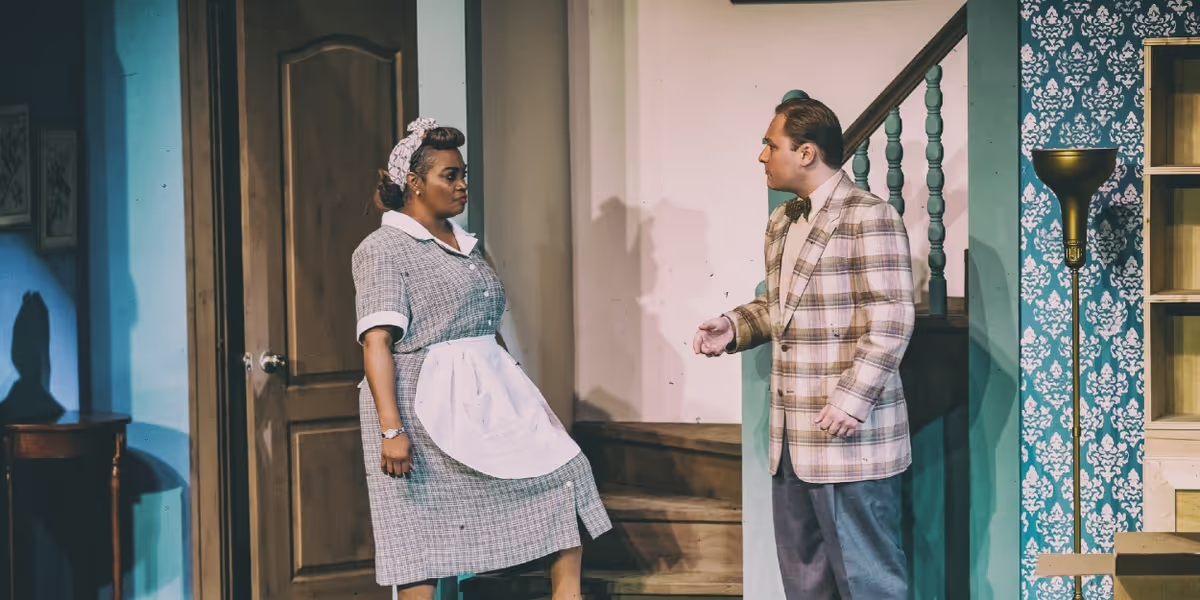
A winner of both the Pulitzer Prize and a Tony Award will soon take center stage at the Farmington Players Barn in Farmington Hills, Michigan. Clybourne Park is described as a “razor-sharp” satire about the politics of race. “It’s a comedic drama that shines the light on changing communities in America, how far we’ve come and just how far we haven’t,” says Director Benjamin Burt of Redford.
The play contains adult themes and language, and is not suitable for children. The show runs Friday, September 19, through Sunday, October 5.
Clybourne Park, written by Bruce Norris, is set in the same bungalow in Chicago, in two acts separated by 50 years. The story begins in 1959 with Russ and Bev moving to the suburbs following the tragic death of their son, and selling their home to the first black family in the neighborhood. It then fast-forwards to 2009, when a white couple buys that same home in what is now a predominately black neighborhood. Both acts illustrate a battle over race and real estate with the home as the focal point. It’s the same modest bungalow that’s featured in the 1959 classic play, A Raisin in the Sun, written by Lorrine Hansberry; the two acts of Clybourne Park serve as bookends to that popular tale.
Director Burt says he was “immediately drawn to Clybourne Park because it’s funny, edgy and touching — and pushes the boundaries of what a lot of community theaters are willing to take on.”
Seven actors explore those boundaries — each playing two different characters, one in each act. Chris Clonts (Troy) and Kelly Eubank (Detroit) play Russ and Bev who are moving out of their Chicago neighborhood. Karl, played by J. Hayward (Sterling Heights), tells the couple in front of their black maid Francine (Camille Jamerson of Southfield) that they are ruining property values by selling to a black family.
Jump ahead fifty years and we find a young white couple — Lindsey and Steve (played by Sarah M. Cooney of Livonia, and Hayward) —who want to build a new house on that same site. They face hostility from black neighbors including the fiery Lena (Jamerson) who want to preserve the cultural significance of their community.
Burt feels this story is vital to the Detroit community. “It mirrors what Detroit has gone through in recent history, and what is still going on,” he says. “The play asks the question: is that a bad thing? A good thing? Or just an inevitability of time?
Burt adds that he hopes audiences will see themselves reflecting the seven characters in the play and he hopes they can connect with at least a part of each character. “It’s a very entertaining and funny play, but it will stay with you after it is over. You’ll laugh, you may even cry, but you will definitely be talking about it on the drive home.”

|
Ghost Light Cabaret Series: One Hit Wonders Flint Institute of Music (8/31-9/02) |

|
A Grand Night for Singing Hill Auditorium (10/04-10/04) |

|
Disney's The Lion King Cobb Great Hall (4/08-4/25) |
|
The Book of Mormon (Non-Equity) Stranahan Theater (2/18-2/21) |

|
Men's Glee Club Spring Concert Hill Auditorium (4/17-4/17) |

|
SIX (Boleyn Tour) Wharton Center [Cobb Great Hall] (12/01-12/06) |

|
Cabaret Gilmore Theatre Complex (3/19-4/04) |

|
Hadestown Flint Institute of Music (4/15-4/15) |
|
Murakami by the Sea Arthur Miller Theatre (4/08-4/11) |
|
The Book of Mormon Flint Institute of Music (3/22-3/22) |