


Review: TROJAN WOMEN MCI at Unicorn Theatre
A powerful and deeply unsettling reimagining of Euripides’ classic, TROJAN WOMEN MCI forces audiences to confront the enduring realities of exploitation and survival.
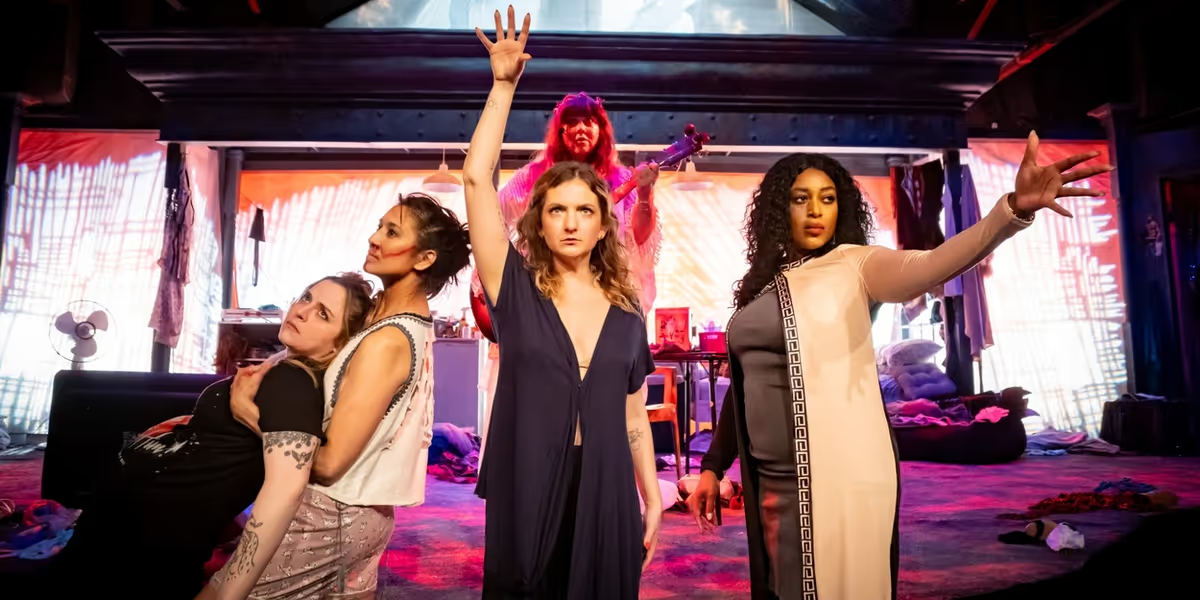
A Haunting Testament to Survival, Silence, and the Brutal Economy of Human Exploitation
Presented now through March 29, 2026, TROJAN WOMEN MCI is a searing new adaptation of one of the oldest and most devastating stories in the theatrical canon. Originally drawn from Euripides’ The Trojan Women, first performed in 415 BCE, the play has endured for centuries because of its unflinching confrontation with what remains after conquest: the suffering of women, the commodification of bodies, and the violence inflicted long after war is supposedly over. In this new production, directed with precision and emotional intelligence by Ernie Nolan, the ancient text is transformed into something immediate, intimate, and deeply unsettling. Featuring original music by Kate Kilbane, this adaptation narrows its focus to four captive women and, in doing so, becomes less a historical retelling than a living reckoning with trauma, coercion, and survival.
What makes this production especially powerful is the way it refuses to let the audience keep its distance. Though rooted in classical tragedy, TROJAN WOMEN MCI lands with disturbing relevance in 2026. It serves as a sobering reminder that while many move through their daily lives assuming freedom and safety, there are still countless women, children, and men trapped behind closed doors in cycles of trafficking, coercion, and systemic neglect. One of the evening’s most haunting lines comes from Amber McKinnon’s Hecuba, who states with devastating clarity that no one ever gets arrested for this crime. The line lands like a spiritual wound. It is not merely dialogue; it is indictment. In a nation that prides itself on law, order, and checks and balances, the play forces us to confront the unbearable truth that entire systems continue to fail the vulnerable while allowing profound violence to remain obscured, ignored, or unpunished.
The production opens with Shanna Jones as the Muse, and from the moment she enters, the atmosphere shifts into something ritualistic, musical, and emotionally charged. Jones commands the stage with one of the show’s most arresting opening musical numbers, her acoustic guitar and disciplined, haunting vocals giving shape to something both celestial and deeply wounded. Her performance captures the spiritual function of the Muse not simply as narrator, but as witness—someone carrying memory, prophecy, and pain in equal measure. Her costuming and stage presence match the force of that journey, creating an opening that feels less like exposition and more like invocation.
As the story settles into the world of the house, the emotional architecture of the play becomes clearer. Amber McKinnon’s Hecuba emerges as the maternal force within it—the woman who has survived long enough to become both protector and enforcer, caretaker and casualty. She holds the fractured ecosystem together with a blend of authority, resignation, and conditioned belief. McKinnon has a masterful grasp of the spoken word, and her command of rhythm, silence, and tonal shifts is among the production’s greatest strengths. She moves fluidly between the reality of a survivor enduring domestic abuse and the reinforced false narrative she offers the younger women—that what they have is sustainable, even normal, even good. It is a deeply layered performance, because McKinnon never plays Hecuba as simply hardened. Instead, she reveals the tragedy of a woman who has survived so much that survival itself has become a kind of prison theology. The audience aches not only for her, but for the entire structure that has taught her endurance at the expense of liberation.
At the center of the play’s emotional progression is Haley Knudsen as Cassandra, the favored girl in the house, protected in strange and troubling ways by the unseen figure known only as HIM. Knudsen gives Cassandra an innocence that never reads as naïveté. Rather, it feels like someone still close enough to her own humanity to sense what others have learned to suppress. As the play unfolds, Knudsen charts Cassandra’s transformation with remarkable finesse, moving from recent arrival and uncertainty into a state of near-clairvoyant understanding. Her ability to convey both fragility and spiritual attunement gives Cassandra a uniquely luminous quality. Musically, she is exceptional. Her duets with Jones are among the production’s most memorable moments—haunting, intimate, and worth experiencing live for their sheer emotional precision.
Emmy Panzica-Piontek brings heartbreaking vulnerability to Andromache, whose trajectory becomes one of the production’s most painful revelations. Constantly entering and exiting the house, dependent upon the power structure around her, Andromache exists in a state of exhausted negotiation—trying to make sense of what survival costs and what little autonomy remains available to her. When it is later revealed that she is pregnant with HIM’s child, the emotional stakes of the production deepen considerably. Panzica-Piontek handles this arc with tenderness and restraint, allowing the fear, confusion, and inevitability of Andromache’s circumstances to unfold without melodrama. Her scenes with McKinnon are especially compelling, revealing the generational repetition of trauma and the way women in impossible conditions sometimes pass down warnings that are themselves born from powerlessness.
The arrival of Helen, played by Karen Lisondra, shifts the energy of the house in fascinating ways. Lisondra brings a rush of vitality, unpredictability, and emotional volatility to the role, but beneath that excitement is something much sadder: a clear dependence on the substances that help keep the women compliant, disoriented, and trapped. Helen’s relationship to addiction is never treated superficially here. Instead, the production shows how even the smallest resources—Tylenol, nail polish, a bag of chips, a Sprite—become instruments of control, turned into rare commodities within a system designed to deny independence and distort desire. Lisondra is outstanding in the physicality of her performance. She moves with acute awareness of the space, of the people around her, and of how manipulation can function as its own form of self-preservation. Her emotional intelligence in the role is striking. Helen understands motivation, weakness, hunger, and leverage, and Lisondra plays all of it with subtle, dangerous brilliance. Her dynamic with Cassandra is especially noteworthy; the two characters intersect and diverge in ways that feel like mirrors warped by different forms of captivity. Knudsen and Lisondra play those yin-and-yang differences with impressive restraint and power.
Kellen Serrano’s Tally serves as the intermediary between the women and HIM, and Serrano does strong work navigating the uneasy terrain of that role. Tally is not merely a messenger; he is part of the machinery that keeps the system intact. At first glance, one might wonder whether the character can fully carry the underworld weight the play demands, but Serrano steadily reveals Tally’s deeper function with clarity and confidence. What emerges is a chilling portrait of how trafficking sustains itself—not only through overt violence, but through psychological manipulation, through repetition, through convincing the trapped that there is no alternative and no one coming to help. Serrano’s performance makes that mechanism visible, showing how control is maintained by destroying a person’s belief in their own worth and in the possibility of escape.
The production’s artistic team provides a richly cohesive framework for this painful material. Director Ernie Nolan deserves enormous credit for guiding such a difficult and present-day story with compassion, control, and dramatic urgency. He understands that this material does not need sensationalism; it needs truth, tension, and room for the audience to sit in discomfort. Nolan delivers exactly that, allowing the play’s classical roots and contemporary echoes to coexist without forcing either.
Set Designer Bethany Elliott creates an environment that captures the oppressive claustrophobia of the house without overexplaining it. The design communicates entrapment, dependency, and decay, while still leaving room for the women’s emotional and spiritual interior lives to fill the stage. Lighting Designer Sally Farrand also does exceptional work, particularly in moments where color becomes language. The use of light in connection with nail polish and its energetic symbolism is especially effective, suggesting that even within confinement, the human spirit continues reaching for meaning, beauty, and expression.
The original music by Kate Kilbane is a vital pulse throughout the production. It sustains both grief and hope at the same time, never allowing the piece to collapse into despair alone. Instead, the score acts as a heartbeat—sometimes mournful, sometimes prophetic, always present. Thomas Newby’s sound design and compositional work help maintain that emotional current with precision, while Matt Snellgrove’s costumes ground each character in a visual world that reflects both identity and circumstance. Paul Molnar’s work as fight and intimacy director is equally important, ensuring that the physical language of power, fear, and survival is handled with control and care. Bee Gradwohl, as stage manager, along with Elise Hawley and Connor Maloney as assistant stage managers, keep the production moving with discipline and clarity, giving the work a cohesion that allows its emotional force to fully land.
TROJAN WOMEN MCI is not merely a retelling of an ancient tragedy. It is a fierce and deeply relevant meditation on human trafficking, coercion, trauma, and the fragile endurance of women forced to survive systems designed to consume them. It asks its audience not only to witness suffering, but to recognize its modern forms—the crimes still happening in silence, the lives still being bartered, the systems still failing those most in need of protection.
To say more would risk taking away from the discoveries the production makes possible in real time, and this is a play best encountered with some of its revelations left intact.
What can be said, without hesitation, is this: TROJAN WOMEN MCI is essential theatre. It is harrowing, beautifully performed, musically rich, and spiritually difficult in all the ways meaningful art should be. It does not offer easy comfort. It offers truth.
TROJAN WOMEN MCI runs March 11 through March 29, 2026 at Unicorn Theatre.
Prefer BroadwayWorld in Google Search?
Add us as a preferred source so our stories show up more often in Top Stories and Google’s AI answers — for you.
Sign up for all the news on the Fall season, discounts & more...

|
'The Who's Tommy' Midwest Trust Center at Johnson County Community College (10/14-10/14) |

|
Clint Black & Midland Ozarks Amphitheater (10/10-10/10) |
|
Red Like Fruit Unicorn Theatre (10/14-10/25) |

|
Angels in America — Part 1: Millennium Approaches Metropolitan Ensemble Theatre at the Warwick (10/23-11/01) |

|
'The Billy Joel Legacy' Midwest Trust Center at Johnson County Community College (10/11-10/11) |
|
Actors From The London Stage 'King Lear' Midwest Trust Center at Johnson County Community College (3/25-3/26) |

|
'What Do You Do With a Problem?' Midwest Trust Center at Johnson County Community College (11/06-11/07) |
|
Owen/Cox Dance Group 'The Nutcracker and the Mouse King' Midwest Trust Center at Johnson County Community College (12/10-12/13) |

|
TBC Truck, Trailer Repair & Diesel Performance TBC Truck, Trailer Repair & Diesel Performance (5/01-12/01) |
|
Ryan & Ryan 'Kickin' the Clouds Away' Midwest Trust Center at Johnson County Community College (10/25-10/25) |

Reader Reviews
To post a comment, you must register and login.