


Review: Dreamlike Voyage, Troubled Undercurrents in MUSIKAL PERAHU KERTAS
This adaptation of Dee Lestari's seminal novel will run from 31 January to 15 February 2026 at Ciputra Artpreneur for a total of 21 shows.
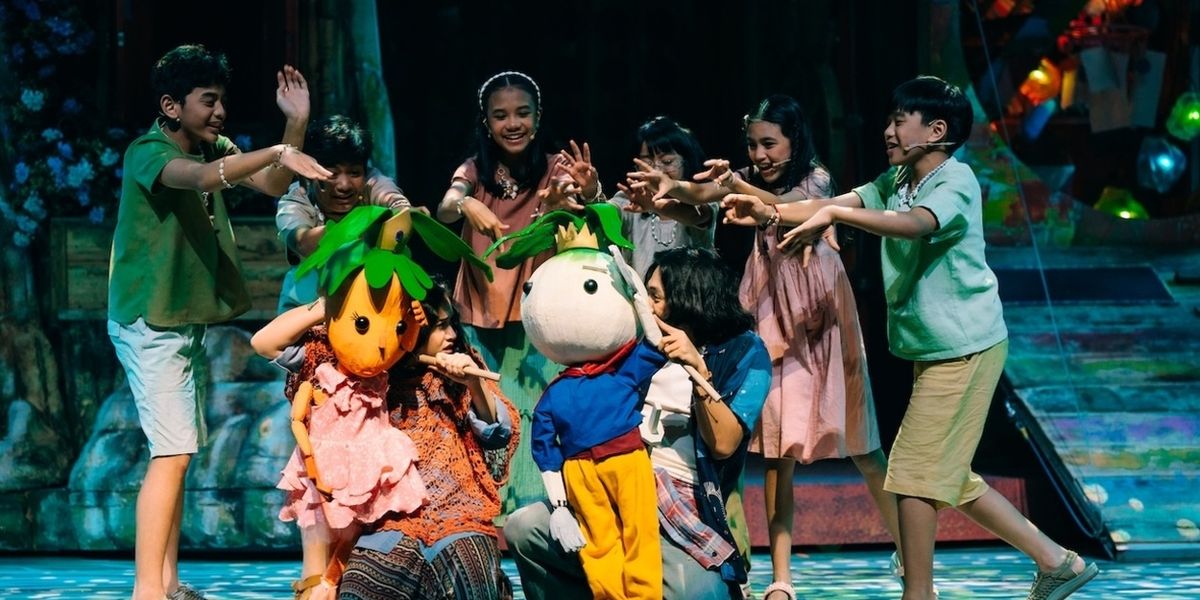
MUSIKAL PERAHU KERTAS, the latest blockbuster musical adaptation of a beloved Indonesian IP, has set sail. The show will run from 31 January to 15 February 2026 at Ciputra Artpreneur for a total of 21 shows. Broadwayworld Indonesia was invited to attend the media preview on January 30th. This adaptation of Dee Lestari’s 2009 novel Perahu Kertas is brought to life by Indonesia Kaya, Trinity Entertainment Network, and TRUST Orchestra.
MUSIKAL PERAHU KERTAS is directed and choreographed by Venytha Yoshiantini (with Bathara Saverigadi Dewandoro as traditional dance choreographer). The script was written by Widya Arifianti, with music by Simhala Avadana, Ifa Fachir, and Dee Lestari. Ivan Tangkulung served as music director and arranger, with Nathana Karina conducting the Trust Orchestra. Bernice Nikki assumed the role of vocal director and assistant director.
The show’s artistic director is Putrera Radhitya, with set design by SKENOGRAFIA. The artistic team also included Misha Baron as puppet designer, Hagai Pakan as Costume Designer, and Alim Jeni as lighting designer and programmer.
As mentioned, MUSIKAL PERAHU KERTAS (lit. Paper Boat the Musical) was adapted from Dee Lestari’s coming-of-age romance novel. The work itself had been adapted into a movie in 2012. A song of the same name was created for the movie’s soundtrack, becoming a considerable hit.
The story of MUSIKAL PERAHU KERTAS revolves around two budding creatives: Kugy (Alya Syahani), a storybook writer, and Keenan (Dewara Zaqqi), a painter. The two met in college and quickly became friends, sharing their love for the arts.

Kugy even opened up to Keenan that she considered herself an Agent of Neptune, a soldier of the sea god, with the purpose of going around saving people and sending reports using the eponymous paper boats. Amused yet charmed by this, Keenan agreed to join Kugy as a fellow agent. They even collaborated on a fairytale, Pangeran Lobak dan Putri Wortelina, which they brought to life with a fun, playful number together with the children cast and a gaggle of adorable puppets.
Romantic undercurrents began to color their friendship; but before the seeds of love could bloom, reality hit. After Keenan told his parents of his intent to drop out of college to pursue painting, Keenan’s father (Renno Krisna) cast him out of their family home. Around the same time, Kugy got an office job, putting her dreams and stories on hold.
With help from Keenan’s mother (Christine Tambunan), Keenan moved to Bali, living with master painter Poyan (Toma Pratama) and his niece, the gentle and soft-spoken Luhde (Marsha Lavinia). Keenan claimed that Luhde managed to inspire him to paint and create again, and they entered a romantic relationship.
Meanwhile, Kugy managed to impress her boss – the ambitious (Christoffer Nelwan) with her creative ideas. The two eventually began dating as well, mirroring Keenan and Luhde.
When his father had a stroke, Keenan dropped everything. He returned to Jakarta to step into his father's shoes and run the family company.
Back in Jakarta, Keenan and Kugy’s friends, the comedic duo of Noni (Putri Indam Kamila) and Eko (Fathur Ojak) were getting married. During the bouquet toss, Kugy and Keenan ran once more into each other.
They talked about their respective experiences, reminiscing about the bond they had. Yet, they didn’t come to the wedding on their own; Kugy came with Remi and Keenan with Luhde. Keenan and Kugy went their separate ways, but not before promising to write another story together.
As it turned out, it was difficult for Kugy and Keenan to balance writing a story with the stress of working at a creative agency and running a business, respectively. Moreover, Remi found a letter for Kugy in an old notebook of hers, realizing that her heart was not his to hold. Luhde also discovered an etching of K.K. on the heart sculpture Keenan had given her – short for Keenan and Kugy. Remi and Luhde both broke things off with Kugy and Keenan, accepting that their respective partner was never truly committed to the relationship.

Kugy decided to resign from her job and once again pursue her dream as a storyteller; Keenan, too, finally received his father’s approval to paint again – his father had been so moved by a painting Keenan made of him. The two reunited, now ready to work toward their dreams together.
MUSIKAL PERAHU KERTAS had a truly admirable message: it encourages the audience to pursue one’s dreams even after putting it on hold for whatever reason. This message of dreams, alongside Kugy and Keenan’s love for stories and paintings, made for a strong foundation on which the artistic team built the show’s mesmerizing visual identity.
From the moment the audience entered the Ciputra Artpreneur theater, we were greeted by an artistic yet tasteful arrangement around the stage. Painted clouds frame the proscenium; stacks of paper and an array of paper boats covered the area below the stage, priming us for a richly imaginative show.
The humongous set served as the impressive centerpiece. With three movable radial layers, the set’s different sides brought the show’s various locales to life: from an art gallery, a wedding party, an idyllic painting workshop in Bali, an office, and so much more.
But the most memorable side of this set was definitely Sakola Alit, an informal school where Kugy (and eventually Keenan) taught less fortunate children. With parts that could pop up and jut out, it evoked images of a pop-up book or toy, bringing a sense of childhood wonder and delight.
This set also had considerable verticality, which allowed the director to get creative and dramatic with the blocking – masterfully crafting moments of longing, triumph, and even loneliness. A very memorable scene towards the end of the show had our leads on different ‘rings’ of the set, trying to grasp each other’s hand as the set rotated them away from each other – both a powerful metaphor and an understated dramatic spectacle.

However, the big size of the set also came with a slight downside; it was hard to take in all the actions going around the stage for audience members seated in the front rows (like I was). The show’s ambitious artistic direction was best appreciated from a distance.
On the other hand, audience members seated in front might come to notice and appreciate the finer details of the set; not content with creating an astonishing – and astonishingly large – work of art, the creatives had also paid attention to the set’s textures and function. The walls of the set’s outermost ring looked plain from afar, but was actually plastered with ripped out pages, imbuing it with additional visual appeal and thematic nod. Looking closer, one could also find the notches and holes where the hard-working stagehands could stick poles in to help them move the surely heavy set (although there were rails built onto the floor to help them with that).
The costume design was likewise both beautiful and thoughtful. The ensemble were largely costumed in pastel colors and similar styles, to help the audience focus on the main and supporting cast. The usage of bold blues and reds made Keenan and Kugy stand out, as well as highlighting the connection between them.
The bold usage of lighting and projection further helped make the show feel dreamlike, imaginative, and bigger than life. This was particularly apparent in the final scene. The whole cast filled the stage, holding paper boats that lit up with a starry yellow glow, before the main duo came out on a giant paper boat that likewise shined like starlight. It was an immediately iconic scene that served as a suitable closing number to the whole musical.

As for the story itself, the book put up a good effort in delivering the show’s message, but came up short in a few ways.
First, it couldn’t quite convey the importance of writing for Kugy and painting for Keenan. We understood that they liked it, of course. But without delving deeper into why they were so precious, so inseparable from both of them, it made the show’s main conflict less emotionally impactful. Perhaps Keenan’s father was right; he could do it as a hobby.
In works that focus on an artist’s desire to create, we often got to see more about what it means to them; in Sondheim’s Sunday in the Park with George, we understood that George had an obsession with his craft, that he knew no other way to live, even to the point of sacrificing his relationships. In Ryan Adriandhy’s Jumbo, we could see that storytelling is the way Jumbo connected with his late parents, reminding him of the safety and happiness he had lost.
If we had gotten to see why their respective craft meant the world to Kugy and Keenan, it would be more heartbreaking to witness them letting go of their dreams – and all the more exuberant when they finally returned to those dreams once more.
Secondly, Kugy and Keenan were perhaps too similar as characters. They were both dreamers who had to take a ‘real’ job for a while. They got into a situationship with another character, but they couldn’t quite fully commit to said relationship. Remi/Luhde chose to break things off with little protestations from Kugy/Keenan. They were both finally free to chase their dreams after resigning (Kugy) or being discharged of his responsibilities (Keenan).
While a shared passion made for a nice launchpad for any relationship, too many similarities made Kugy and Keenan’s dynamics rather monotonous. They were never in any serious personal disagreement; their conflicts came largely from external sources. Anyhow, their relationship didn’t change either Kugy or Keenan very much – it only reinforced ideas that they already believed anyhow. Although still sweet and endearing, there’s potential for their romance to be so much more.
It was also why both Kugy’s and Keenan’s other relationships were more interesting narratively. Remi was a pragmatist and realist, who had to learn to understand Kugy’s more whimsical side. Luhde was reserved and gentle compared to Keenan’s more rebellious and self-assured personality, making it hit twice as hard when she realized that her love was not meant to be.

These deliciously contrasting personalities made it rather disappointing that Remi and Luhde broke things off in just one scene each. They never tried to make things work or talk it out, as adults in a relationship might. Although from a practical consideration it might make the show overly long, it nevertheless made the show’s ultimate conclusion less satisfying dramaturgically. Kugy and Keenan’s reunion felt inevitable and obvious, rather than a happy ending that they had to make difficult choices and put in considerable emotional effort for.
There were also some incongruous details that made the show’s narrative arc rather challenging to follow at times. It started at the very beginning of the show; the first scene had Kugy and Keenan singing a duet number based on the Perahu Kertas song, which I later learned was meant to be a framing device of them retelling the events that led up to this duet moment. Then, the next song was another opening duet by the same characters, this time with Kugy and Keenan narrating their respective background; but, confusingly, the two of them sang on a bare stage, even as Kugy mentioned that she grew up in a big family where she sometimes felt unseen. The visuals, confusingly, did not match the words at all.
After that, we finally got to see Kugy and Keenan in an actual physical location and a specific time setting – their college, during the orientation period for new students. This three-peat opening unfortunately made for a harsh few first minutes, and I found myself only enjoying and understanding the show later on.
Then, at the beginning of the main couple’s friendship, Keenan asked Kugy what her long-term plan was. She said she planned to get a job as it was expected of her; but without a proper build-up, it felt like it came out of nowhere. It would make more sense if Keenan was the one to say it, as he had an argument with his father about it before.
Kugy later sang a song about feeling that she has to suppress her dream. This came after she performed a whole production number about her fairytale of Pangeran Lobak dan Putri Wortelina and freely claiming herself as an Agent of Neptune – seemingly not caring about other’s perception of her. It certainly felt like there were moments cut from the final script where Kugy actually had someone, or anyone, opposing her dream.
Another moment that felt like it came out of nowhere was Keenan’s father coming to accept Keenan’s dream of being a painter. Up until that moment, Keenan’s father had been vehemently opposed to said dream. Yet, he finally relented after Keenan made a painting for him. We didn’t see the process of Keenan painting this painting, nor the final result as I remember it. It felt rather convenient, even contrived.
Similarly, Kugy’s colleagues turned very supportive the moment she had decided to turn in her resignation letter. They sang that work life balance is the most important thing. Yet, in their previous appearance, they chided Kugy for trying to balance her work with her dream of writing another story with Keenan. This sudden, drastic change in outlook was shocking and made me feel I missed a scene or two.

A smaller moment came early in the show, when Keenan managed to get a solo exhibition of his paintings thanks to Wanda (Adifa Nadira), a curator and gallery owner. He was informed that someone had bought his paintings. Yet he was shocked and outraged when a group of workers began to put down his paintings – to, obviously, bring them to the buyer. Wouldn’t a painter expect his purchased paintings to be brought to the purchaser’s house, or gallery?
During his ensuing conversation with one of the workers, he realized that Wanda was the one who bought the paintings. He, understandably, felt betrayed and lied to. After Keenan confronted her, Wanda sang a solo song about how she only did it because she loved him. This came across as a very strange choice to me, as we saw very little of Wanda, her desires, or even her relationship with Keenan before this moment. The heartbreaking song was sung beautifully, but it felt unearned.
Some of the story aspects also felt rather underbaked, such as the titular paper boats themselves (which, if I recall correctly, only came to play twice: during their introduction and the ending), Sakola Alit (which also likewise only showed up twice, where it could’ve been an important part of Kugy’s character development), Keenan’s difficulty in managing his father’s business, and so on.
With adaptation of cherished works, there is a tendency to preserve as many details as possible. Perhaps this is what happened, or perhaps not; writing a musical is always a huge undertaking with many considerations from different parties. Regardless, the process of adaptation is always a chance for the creatives to reinterpret the source work into the medium of theater. A great adaptation can still preserve the story’s message and main story beats while excising or transforming the parts that can’t be fully translated into its new form. Hopefully, we’ll get to see more of this in future works.

Interestingly, I found the show shined the most during the ensemble scenes. Numbers like Asmarastrologi, Agency, and the wedding scene made the stage buzz with energy, despite being less important narratively. Even the quieter moments – when the ensemble filled the nooks and crannies of the set, quietly living their own lives – made the show feel more real and alive.
It’s a similar story with the music. Simhala Avadana and Ifa Fachir’s songs are largely pop inspired with a touch of musical theater. They are always enjoyable to listen to, but I predict that Asmarastrologi will be the runaway hit with the theater crowd – although it remains to be seen if it can match Musikal Keluarga Cemara’s Bahagia Yha.
Almost needless to stay, the live music was exquisite. The collaboration with Trust Orchestra ensured that MUSIKAL PERAHU KERTA’S aural landscape sounded luscious, rich, and immersive.
The soundtrack also, understandably, made extensive use of Perahu Kertas. It was rearranged and recontextualized about a dozen times. Although slightly overused, its beauty and lyrical poignancy allowed the song to retain its charm all the way through the end.
Regarding the performances – Alya Syahrani as Kugy brought an infectious joy to the role. Her Kugy is earnest, fully committed as an Agent of Neptune. Dewara Zaqqi was a solid Keenan, who could portray both the dreamer and conflicted sides of the character well. It’s also worth mentioning that MUSIKAL PERAHU KERTAS is the first time that both Alya and Dewara play the lead roles. They were more than capable to play the roles as written.
As previously mentioned, the lead roles shined the brightest when interacting with their secondary love interest. Christoffer Nelwan’s turn as Remi was interesting, as the character could easily come across as antagonistic and boring as he represents the corporate world. But Christoffer’s acting is subdued, realistic, and even charming when we see him trying to understand and flirt with Kugy. It made me want to root for their relationship instead.
Likewise, Marsha Lavinia’s Luhde is, on paper, a rather one-note character: sweet, meek, and merely a love interest. But Marsha’s naturalistic acting (and well-executed accent) made her feel alive instead of merely a caricature. Luhde might’ve been an uncomplicated young woman, but the way she sincerely wanted an uncomplicated love – from a man who couldn’t provide it – made her both compelling and tragic.
But the actors who often stole the scene were none other than Putri Indam Kamila as Noni and Fathur Ojak as Eko. At this time, Fathur is already a well-established comedy actor in the theater scene; his impeccable comedic timing and delivery always succeeded in making the audience laugh. Putri was every bit his match, bringing a high level of energy that made every scene brighter (being notably more grounded and nuanced than her character in Musikal Keluarga Cemara). This tour-de-force duo was always a crowd pleaser and earned thunderous applause at the curtain call.
The rest of the supporting cast and ensemble also put on wonderful performances full of verve. Everybody sounded great, looked great, and danced great. MUSIKAL PERAHU KERTAS’s choreography employed both modern musical theatre dancing and some Indonesian traditional dances, making for an elevated experience.

MUSIKAL PERAHU KERTAS’s biggest strengths are its artistic design, performances, and scene direction. There were many memorable moments that felt like they came straight out of a dream. The story itself had potential, although not fully realized; a problem that I believe could be solved with a few more editing passes. But, most importantly, the message it carries still rings true: it is never too late to chase your dream. In an era of negativity and the push to pursue a very narrow definition of ‘success’ it’s an important message to remember.
Weekly top stories - unsubscribe anytime.
Reader Reviews
To post a comment, you must register and login.