


Review: CBHS’s TARIAKAN Dances to the Beats of Revolution
The dance musical went on stage on May 1-3 at the Graha Bhakti Budaya, Jakarta
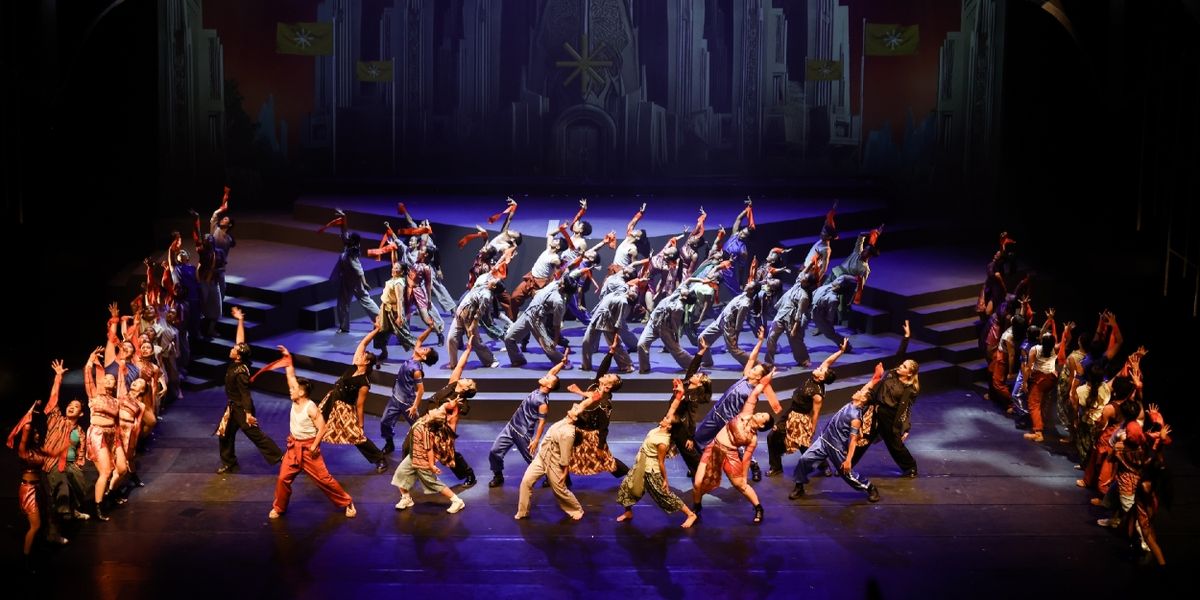
On May 1-3, the performing arts community Cerita Beda Hak Sama (CBHS) staged their latest dance musical at Graha Bhakti Budaya. Tariakan: Gerakan Suara Persatuan is the second entry in the series, following the first installment in 2023 simply called Tariakan.
Tariakan: Gerakan Suara Persatuan is directed by Gerry Gerardo and written by Palka Kojansow. Felita Kezia Chandra serves as composer & music director, alongside Maruf Andi as vocal director.
Dance is at the heart of Tariakan: Gerakan Suaran Persatuan, being its storytelling tool of choice. The show’s overall choreography is headed by Jodie Maran as head choreographer, with Pretty Eugine as the assistant choreographer.
The cast is then divided into seven dance groups, led by different choreographers. The groups are Paradewan (choreographed by Mumu Harmoun), Massa (by Nala Amrytha), Birokrat (by Ara Ajisiwi), Juwita (by Daniel Koesna), Kubu Orang Liar or KOL (by Ben Priadi), Petani (by Ibnu Khadafi), and Buruh (by Stefanus Yefta).

As the show opens, we’re transported into the land of Nusantari, a land where the aforementioned seven groups a.k.a. factions live in harmony. Each group gets a short introductory segment to showcase their identity and dance style, before the main plot kicks into gear: the ruling faction of Paradewan announces a contentious revision to the nation’s law.
The new law will see the people of Nusantari to raise certain state-mandated crops, mandate the building of extravagant monuments, raise taxes, and forbid subversive activities. The effects of this new law are quickly felt throughout Nusantari, making people suffer and discontented.
Eventually, the disgruntled Massa – a faction usually known for their large number and obedience – visits each faction in turn to invite them to a large-scale protest against Paradewan. The law-enforcing faction of Birokrat is then split in two: those who support the upcoming protest and those who still stand with Paradewan.

The masses then clash against Birokrat and Paradewan. Despite the Birokrat’s attempt to uphold order, the united front is too large for them to contain. A representative of the Paradewan eventually declares that they’ve listened to the people’s voice and agree to rescind the revision. Yet, he gives a scheming look toward the audience, hinting that this is merely a concession and not a true change of heart.
Tariakan is the latest big musical to address Indonesian politics, following last year’s rerun of Polarisasi. The issues raised here are drawn from recent political turmoils, particularly the contentious amendments on military law and the rise of censorship. The show ends on an optimistic message, that the united power of the people can overthrow a corrupt system.
Although perhaps rather simple, Tariakan’s message is important and timely. Just like in Nusantari, the Indonesian people are sometimes divided – both due to the inherent differences of different subgroups, or even due to the machinations of the ruling class (which shows up in Tariakan through the bribery of a/KOL representative to subvert and disperse an earlier protest).
However, the world-building presented in Tariakan might be confusing to some audience members. People who haven’t watched the original Tariakan, or follow the social media posts, might find it hard to know who the seven factions are and their relation to one another.

While the gist of it can be understood through the show itself, the different faction costumes, logos, and even dance styles hint at a rich and colorful world. The opening scene also exposits the national ideology of Pandora (panca pedoman rakyat, “five principles of the people”, a play on Indonesia’s Pancasila). Details like these feel like sharp jabs at the current political climate, but don’t directly come into play in the show proper. All these combined invite the viewers to be curious about Nusantari’s people and even governmental system. Sadly, this curiosity is unable to be fully satiated.
Although obviously there is merit in showing and not telling – especially for a dance musical – leaving too much about the setting to the audience’s interpretation might distract them from fully appreciating the show’s main messages. A more detailed depiction of the factions, their roles in society, and their politics, would’ve helped with immersion. This could’ve been accomplished through the show itself or perhaps at least through a program book.

That being said, the different schools of choreography portrayed in the show play a big part in differentiating the factions. Paradewan’s is theatrical, with a notable focus on playing with timing and formations. To portray law enforcement, Birokrat’s numbers integrate marching and prop work. Massa mainly portrays their struggle using impressionist contemporary dance, while Juwita and Buruh focus on sensuous feminine and masculine energy, respectively. KOL’s popping imbues the colorful faction with a youthful energy. And Petani’s choreography stands out by having influences from traditional Indonesian dance culture.
Watching Tariakan is like having a sample platter of various dance styles. Each faction carries their own unique energy. You’re bound to find at least one favorite. For me, my favorite faction is the Kubu Orang Liar or KOL, with their funky, vivacious moves. The climactic moment where the different factions come together to dance as one (with their faction logos also combining into one) is another highlight – the sheer amount of the performers on stage makes for an impressive spectacle.

Still, there’s room for improvement. Graha Bhakti Budaya is a much larger space than the first Tariakan’s Usmar Ismail Hall, making the action harder to see. The set design consists of a simple stage with three levels of platform with small height differences between them. While this stage allows for spread out blockings with some vertical differences,the show never felt really epic due to the constrained sense of space.
The lighting design is colorful with only a few specific, dramatic moments, as it usually needs to shine on the whole faction – or factions – currently on stage. The world of Nusantari is further brought to life by the massive LED screen on the back, displaying the country’s different districts.
Now, as for the performances itself, it’s important to remember that this is a community production first and foremost. The cast members come from different backgrounds, some of them are working as full time performers, while others are still in school. I appreciate this opportunity for them to work and create together as befitting of the story.
Of course, with the different levels of experience and the humongous cast (totalling more than 70), it’s inevitable that some moments are not fully synchronized, with some laggy timings or mismatched details in the movement. This is, however, balanced with the amount of dedication and enthusiasm that the whole cast showed. Although the energy level can still be raised a notch, as a whole, the show is very enjoyable and quite inspiring to watch.

The songs themselves are largely fitting for each dance number, with most of them being uptempo. This time, the show also boasts several original songs with lyrics to help paint a more vivid picture of Nusantari. The sound quality and brisk pace make some of the details hard to catch, however.
Taken altogether, Tariakan is a raw and honest creative expression. It’s born from both a deep frustration that’s surely shared by a lot of Indonesians. But it’s balanced with a sense of hope that things can be better. While the storytelling might’ve felt a bit underexplored, the powerful message behind the show is conveyed admirably by the dedicated cast and passionate creatives. When we return to the land of Nusantari, I hope we’ll get to know it better and get even more inspired.

Broadwayworld Indonesia is a media partner of Tariakan. Photos by Tariakan team.
Reader Reviews
To post a comment, you must register and login.