


REVIEW: The Festival d’Avignon Presents WHEN I SAW THE SEA By Ali Chahrour
When I Saw The Sea celebrates the strength of these women to endure and the transformation of that strength into a path of liberation.
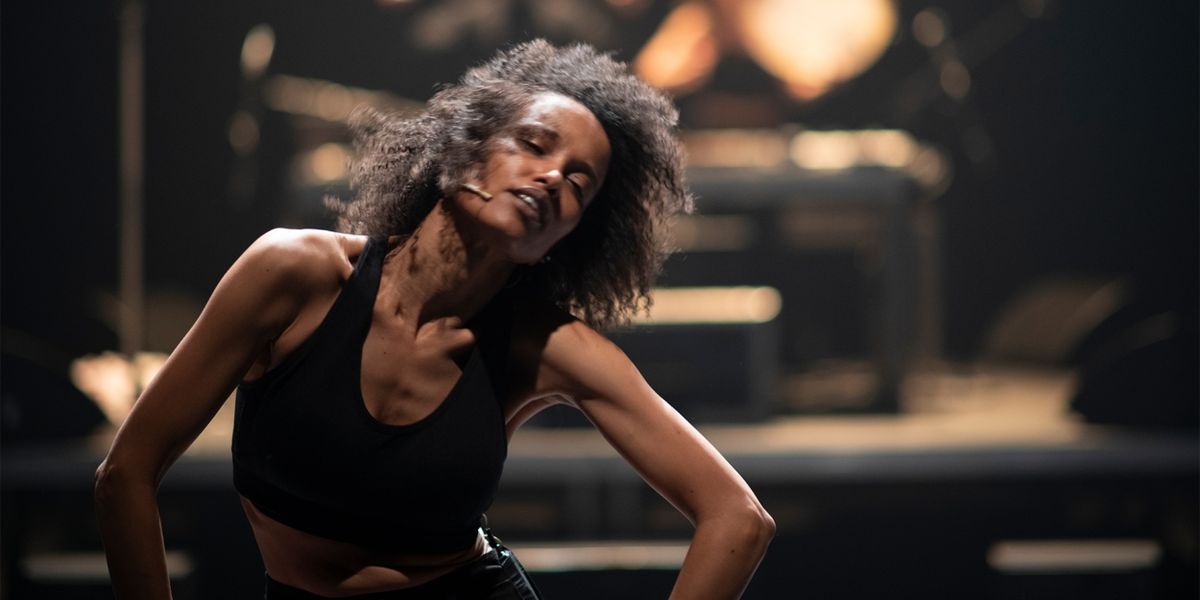
The news can inform us. It can also transform pain into ambient noise. This is particularly true in Lebanon, which has endured revolution, a catastrophic explosion in Beirut, and bombardments from Israel. The news media’s narrative of Lebanese death is often ever-present, unstoppable, and impersonal. Director Ali Chahrour doesn’t shy away from the brutality of the lives lived in the shadow of conflict. At the opening of his piece, When I Saw the Sea, now in performance at the Festival d’Avignon’s La Fabrica, we hear someone speak in Arabic. The translated text reads: “Hello, how are you? No, we are not well.” However, throughout this one-hour ballad, three personal stories rise through the din, offering glimpses of humanity and hope for resistance.
The audience enters the space to find a blinding spotlight pointed toward the house, center stage. At the piece's start, we hear the disembodied voices of those living in Lebanon. Their testimonies are translated into English and French in the upper corners of the proscenium. Then, there’s the sound of a bomb. It rattles the theatre. In the silence that follows, a young woman walks downstage through the light and kneels. Her name is Rania. She faces the audience and recounts the story of her mother, who abandoned her on the side of the road. With compassion, she ponders her mother’s fate and the many tragic possibilities that could have befallen her. She also offers a glimmer of hope for her to have enjoyed happy ending. Perhaps, she suggests, her mother has heard of this play and has come to attend. She looks hopefully into the audience, where singer Lynn Adib stands and sings. Adib walks toward the spotlight, which lifts to reveal a small, raised platform where Abed Kobeissy provides musical accompaniment. In front of this platform, two other women, Tenei and Zena, sit in repose.
The performance follows the stories of these three women: Tenei Ahmad, Zena Moussa, and Rania Jamal. All three fell into the kafala system, a program of migrant exploitation considered modern-day slavery. They recount their stories of struggle and liberation. All three of the women introduce themselves through the etymological root of their names. Tenei explains that her father calls her “Fatimah,” meaning “to wean.” However, she prefers the name given by her mother: “Tenei,” meaning “Force.” She then recounts how, after escaping the kafala system, she had to free herself from her husband. But once she gained this independence, he forbade her from seeing her son for two years. She hatched a plan. She disguised herself as an animal mascot with a theatre troupe. In costume, she danced and played with her son, if only for a day, if only as a stranger. She ultimately regained access to him in the years that followed. “I am ‘Tenei,’” she affirms.
The piece weaves these personal testimonies with haunting ballads and modern dance. Chahrour's movement passages are simple and repetitive. They endure until they become part of the scenography and offer the event the shape of a rite. Lynn Adib and Abed Kobeissy’s composition astounds, blending operatic virtuosity with emotive immediacy. Benoît Rave’s sound design finds poetry in the overwhelming concert bass that shakes the theatre. Similarly, Guillaume Tesson’s lighting lends nuance to bursts of blinding light and shades of amber.
The women’s stories culminate in a moment of musical catharsis. They dance and whip their hair. Then, Zena shrouds herself in a long piece of fabric and mounts the onstage platform. An amber light cascades on Zena, who stands tall, gazing regally at the audience. Rania again recounts her mother’s story, hoping she, too, might find such freedom. Rather than condemn Lebanese society, including those trapped in the kafala system, to a plane of ceaseless tragedy, the performance affirms resistance. When I Saw The Sea celebrates the strength of these women to endure and the transformation of that strength into a path of liberation.
Photo Credit: Kassim Dabaji
Recevez l'actualité de Broadway sur WhatsApp
Recevez les dernières mises à jour, les nouvelles de dernière minute et une couverture exclusive directement dans l’application.

|
MICHAEL HIRSCH Espace Des Arts (11/27-11/27) |
|
ORGUEIL ET PREJUGES...OU PRESQUE RADIANT - BELLEVUE (12/16-12/16) |

|
CLEMENT VIKTOROVITCH ADIDAS ARENA (2/16-2/16) |
|
CELTIC KANAN CASINO PARTOUCHE DE HYERES LES PALMIERS (10/17-10/17) |
|
|
RADIO LIVE : LE JOUR D''APRES TH DU ROND POINT-SALLE RENAUD BARRAULT (5/27-5/29) |
|
|
THE RISE ZENITH NANTES METROPOLE (12/11-12/12) |
|
|
LA RENCONTRE STUDIO DES CHAMPS-ELYSEES (9/15-9/20) |
|
|
RENVERSANTE THEATRE DES MATHURINS (9/15-12/15) |
|
|
POTICHE RADIANT - BELLEVUE (1/14-1/14) |
|
|
RADIO LIVE : NOS VIES A VENIR TH DU ROND POINT-SALLE RENAUD BARRAULT (5/29-5/30) |