


REVIEW: The Festival d'Avignon Presents LE SOMMET By Christoph Marthaler
Le Sommet offers a wry exploration of intra-European relations.
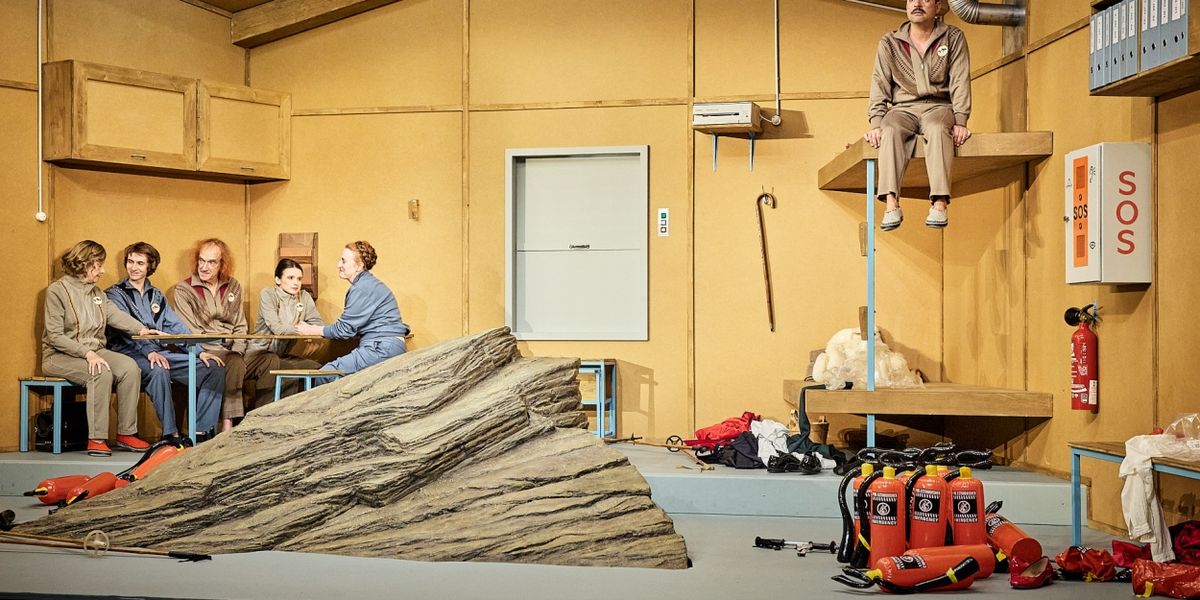
Duri Bischoff’s set for Christoph Marthaler’s Le Sommet, now playing at the Festival d’Avignon’s FabricA theatre, presents a photorealistic cross-section of a chalet. Illuminated by cool fluorescent light, the interior is constructed from natural, practical materials. Rising incongruously from the center of the chalet is a large stone wave. Upstage center, a dumbwaiter dings. Performer Luka Metzenbauer, who has been seated patiently as the audience filters in, sets aside his accordion and opens the dumbwaiter. Upon opening, we see the Mona Lisa. He pauses, closes the compartment, and resumes playing. His musical interlude is interrupted repeatedly, as more cast members emerge from the same portal. Over the following two hours, these performers explore the limits of communication, linguistic, cultural, and emotional, as their disparate languages strain their ability to connect.
Trapped in this alpine refuge, the ensemble drifts through abstract modes of interaction. Unlike No Exit or The Exterminating Angel, the tone rarely falls into dread, though constraints persist. Raphael Clamer, a standout with his comedic charisma, pantomimes needing to use the restroom and rushes to an outhouse stage left. As he opens the door, its walls collapse. Later, the group dons towels and ropes while Clamer pours water on the central stone, transforming the chalet into a sauna. Amid the absurdity, Graham Valentine clutches his chest in what seems to be a heart attack. He stumbles toward the others, finally leaning his chest on Liliana Benini’s upstretched legs, curing him. Afterward, Federica Fracassi self-flagellates with a rope in an unsettling moment of religious symbolism.
The performers sing in chorus, inflate toy fire extinguishers, and pose stiffly for photographs in formal wear. Within this stylized environment, themes emerge. In some cases, the images are religious. Benini, for instance, stretches out her hand in martyr-like fashion at the dinner table. The piece also probes language acquisition. Clamer delivers a rendition of Adriano Celentano’s iconic 1973 hit “Prisencolinensinainciusol,” a song composed of invented gibberish designed to mimic the sound of American English. It was an accidental hit when released fifty years ago and, based on the audience response, remains one today.
Laurent Junod’s lighting design sustains the production’s paradoxical mood: grounded and surreal in equal measure. Charlotte Constant’s sound design, meanwhile, elevates the piece’s hyperrealism. Disembodied voices echo through the theatre, prompting audience members, myself included, to glance around in search of their origins. A helicopter passing overhead registers with such detail and specificity that I half expected one to land on the audience.
Le Sommet offers a wry exploration of intra-European relations. Lederhosen, saunas, and chansons collide with multilingualism to abstract the continental experience. At a time when the Festival is increasingly international, Marthaler chooses to turn inward, playfully excavating Europe’s cultural contradictions with a distinctly European sense of humor. As an American, I sometimes found myself at a distance from the piece’s comedic rhythms, but not so for the audience around me. With Le Sommet, Marthaler blends Pina Bausch-style interpersonal abstraction with the stilted, plastic charm of Wes Anderson. The result is a landscape theatre that infuses clowning with emotional precision and visual imagination.
Photo Credit: Christophe Raynaud de Lage / Festival d'Avignon
Recevez l'actualité de Broadway sur WhatsApp
Recevez les dernières mises à jour, les nouvelles de dernière minute et une couverture exclusive directement dans l’application.

|
LES BEAUX THEATRE DES MATHURINS (9/16-10/07) |
|
|
LE PERE RADIANT - BELLEVUE (1/20-1/20) |

|
DRAG RACE FRANCE LIVE SAISON 4 LE LAPS - PARC DES EXPOSITIONS (11/06-11/06) |
|
VELVET TH DU ROND POINT-SALLE RENAUD BARRAULT (1/07-1/10) |
|
|
LA RENCONTRE STUDIO DES CHAMPS-ELYSEES (9/15-9/20) |
|
|
UNE HISTOIRE DE FRANCE RADIANT - BELLEVUE (11/27-11/27) |
|
|
LA SOEUR DE JESUS CHRIST RADIANT - BELLEVUE (1/31-1/31) |
|
VOLPONE LE BAL DES CRAPULES ORANGERIE DU PARC DE BAGATELLE (8/16-8/16) |
|
|
LES HOMMES VIENNENT DE MARS - LES HOMMES VIENNET DE MARS ET LES FEMMES DE VENUS GRAND PALAIS - THEATRE LOUIS PASTEUR (1/31-1/31) |
|
|
MINOTAURE OU LE LABYRINTHE DE GLACE ORANGERIE DU PARC DE BAGATELLE (8/15-8/30) |