


Review: Cleveland Orchestra’s Splendid VERDI REQUIEM at Carnegie Hall
Ensemble shines under Welser-Most with Grigorian, Uzun, Guerrero, Nazmi and brilliant chorus
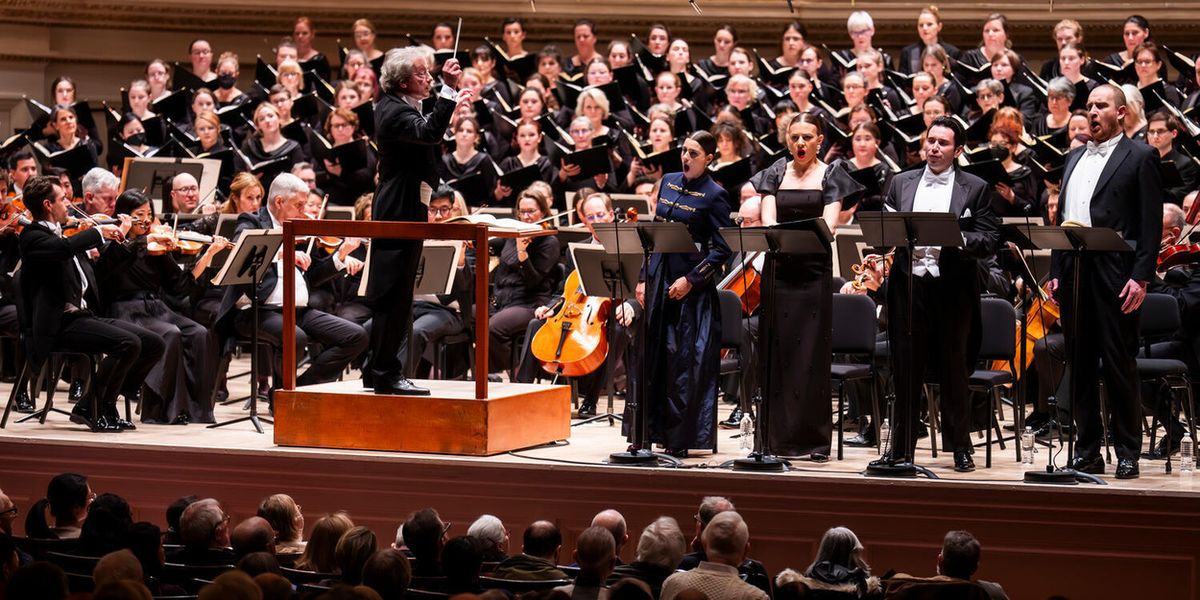
The Verdi Messa da Requiem—better known to English speakers as the Verdi Requiem—featuring the Cleveland Orchestra and its Chorus, with a quartet of soloists, breezed into Carnegie Hall the other night and promptly knocked many concert-goers out of their seats.
While it follows the shape of a Latin requiem mass that might be heard in a church, the composer never meant it for use in a house of worship, but as a memorial to an Italian national hero, the poet Manzoni (though earlier thinking was to make it for the great composer Gioachino Rossini). Some people complain that it’s too operatic; I say it’s as operatic as it needs to be, as Verdi intended it to be.
At this performance, there were many in the audience who clearly knew it from multiple hearings (NB: I’m not a Requiem geek by any means) and could sing along with the brilliant chorus and soloists: soprano Asmik Grigorian, mezzo Deniz Uzun, Joshua Guerrero and bass Tareq Nazmi. The singers are called upon to be so intimate in their interplay that it’s truly amazing when decisions made on paper, when booking the artists, work out as well as they do in a performance like this.
From the opening, barely audible (as intended) under Welser-Most’s baton, to the hushed ending, the Cleveland Orchestra showed us why they are one of the world’s great orchestras.
And the power of the Cleveland Orchestra Chorus was undeniable, starting with the opening of the Dies Irae section (probably its most familiar music, with base drum) which recurs more than once during the 90-minute piece). Its words that translate, in part, as “The day of wrath, that day, will dissolve the world in ashes…” could be a message for our times.
Throughout the work, a notable showpiece for the chorus, the gathered forces did stellar work whenever called upon. They sang like they’d been waiting all their lives for this opportunity and they didn’t disappoint for a second. They were also breathtaking in the “Sanctus, Sanctus, Sanctus” section.
But, ah, the soloists, who were special, right from the Requiem and Kyrie that starts the piece, with Grigorian soaring above the enormous vocal resources of the chorus very early on, yet holding back so that it did not turn into a diva-like performance. Still, her instrument can be so exquisite as to take one’s breath away, as in the “Lacrimosa” or the first (and last) part of the “Offertorio.”
Besides Grigorian, my favorite among the soloists was mezzo Uzun, who was a marvelous interpreter of Verdi’s music, whether singing on her own or with other members of the vocal quartet that are in the spotlight, such as the in the “Lux eterna” (Eternal light). Verdi wrote thrilling music of all dimensions for the mezzo and Uzun took advantage of every opportunity to show her skills.
Tenor Guerrero doesn’t necessarily have the most sumptuous of voices, yet he managed to pull out the stops and thrill in a number of places, like the Intermisco, where he admonishes God to “spare a supplicant.” My reaction to bass Nazmi was similar; yet I found his solo in the “Confutatis maledictus”.gorgeous to listen to and his work with Uzun and Guerrero in the “Lux Eterna” generous and thoughtful.
The Requiem ends with the splendid “Recordare“ (Deliver me) section (though it is interrupted by one more iteration of the “Dies Irae” theme), finishing quietly and touchingly, with Grigorian asking, simply, “Deliver me,” and for consolation.
The Cleveland’s run of the Requiem in New York was a single night at Carnegie Hall and was sold out. But there’s still time to catch it: in Miami. It will be done on January 23 and 24 at the Arsht Center.
Sign up for all the news on the Fall season, discounts & more...

Reader Reviews
To post a comment, you must register and login.