


Review: Hubbard Street Dance Has (Re)Discovered Its Voice
Hubbard Street's playful and eclectic winter program marks the company's return to its American roots.
There’s a surprising amount of talking in Hubbard Street Dance’s program at the Joyce Theatre. In the first act, a Fosse solo concludes with the dancer’s Looney Tunes-esque proclamation: “That’s all, folks!” Post-intermission, a woman’s disembodied voice summons us back to our seats, her cackles and coos reverberating throughout the auditorium. “It’s all about me!” she declares. When the curtain opens to reveal dancer Aaron Choate in drag, the showgirl’s bravado gives way to an undercurrent of existential dread. “Who am I?” she asks before stripping off her robe and stilettos.
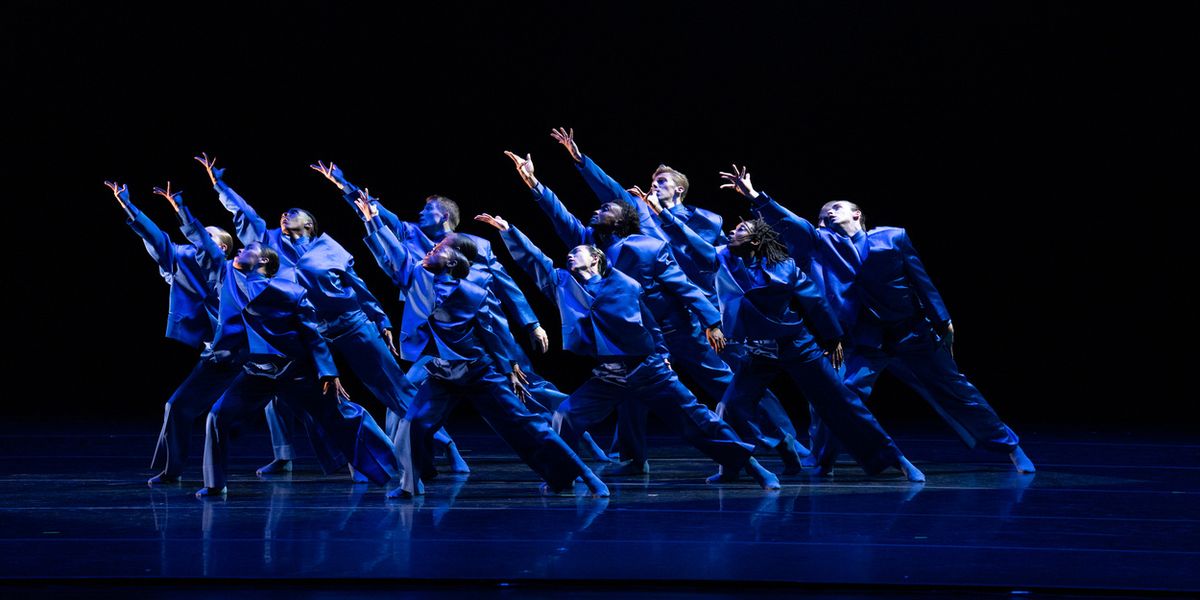
This is the start of “Blue Soup,” the program’s crown jewel and its entire second act. The dance is brimming with voices—including Maya Angelou and Randy Newman—that attempt to answer her question: who is anyone, at their core? What makes you you?
It’s hard not to see this inquiry as a reflection of Hubbard Street’s recent identity crisis. In the 2010s, the company shifted toward an avant-garde, European aesthetic shaped by the previous directors’ relationship with Nederlands Dance Theater. Yet the trendy choreographers they hired alienated their working-class Chicago base. Ticket sales dwindled, the company downsized, and Hubbard Street became indistinguishable from dozens of other repertory troupes programming the same international choreographers.
If this show’s chorus of voices is any indication, however, Hubbard Street may have recovered its own. At first tentative, artistic director Linda-Denise Fischer-Harrell’s post-pandemic leadership has evolved into something more strategic: a reinvention grounded in a return to the company’s American roots.
Take the first piece on the program, James Gregg’s “Within the Frame.” Enclosed by a square of light, four dancers cloaked in black take turns on the dance floor. Bianca Melidor twists into pretzel-like shapes (knee in armpit, leg behind shoulder) before spiraling outward; Elliot Hammans ripples across the stage in loose-limbed sweeps, even as his arms mimic the angular patterns of vogueing. Off-kilter and decentered as it is, Gregg’s interdisciplinary aesthetic appears natural and intuitive, driven by music and momentum. The composer, Ben Waters, is also a professional dancer, and his pulsing track has a synesthetic effect: I felt like I was listening to the dancers’ heartbeats.
What begins as a series of solos gradually evolves into something more communal. The dancers press against one another, probing the boundary where one body ends and another begins. Their interactions are fleeting but intimate, not unlike the connections forged on a night out dancing. They lie atop each other before shoving off; tensions run high before dissolving into buoyant, unguarded motion. Gregg’s quartet captures the competing impulses to merge with another (“I wanted to feel what you felt,” a voice sings) and assert one’s individuality. Such an abstract exploration risks alienating your audience, but Gregg’s approach feels uncanny and fresh. I wouldn’t mind hashing some things out on his dance floor.
Matthew Rushing’s “Beauty Chasers,” another recent Hubbard Street premiere, traces a similar trajectory. Three dancers in flesh-tone briefs and crop tops writhe under isolated cones of light. Rushing cites Christianity’s Holy Trinity as a loose reference point, and the dancers mime the Trinity’s central paradox: they are one essence split between three persons, and the dance doesn’t cohere until they move as one body. The dancers disappear and reappear in increasing amounts of clothing until they’re all wearing palazzo pants and beaded breastplates. Rushing doesn’t rely on Judeo-Christian imagery to animate his trinity; his use of bright, loose clothing and weighted movement grounds his trio in West African dance traditions.
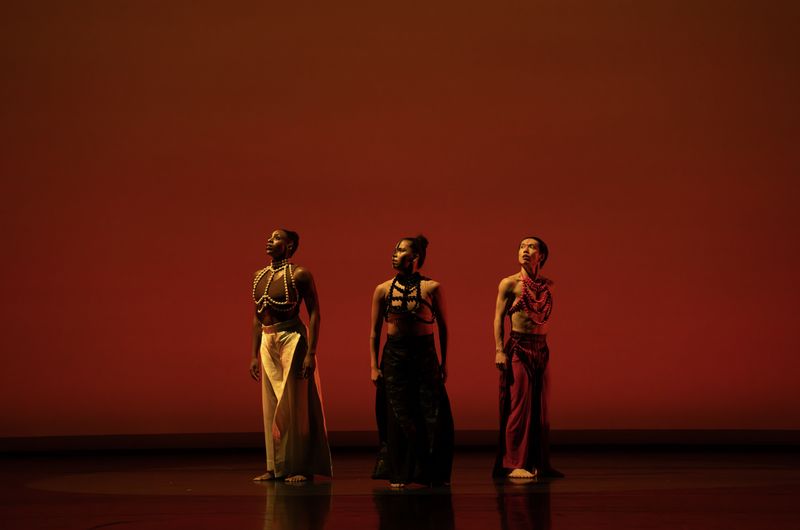
If “Beauty Chasers” is a revisionary trinity, it’s also a new kind of origin myth. The dancers begin in the innocence of the “nude,” guarded only by naturalistic dappled light (expertly designed by Jason Lynch). When they recognize and accept one another, there is an explosion of color and sound. It’s the birth of man, and perhaps more importantly, the birth of culture (Alvin Ailey’s “Revelations,” another one of Rushing’s inspirations, tells this story in an African American context).
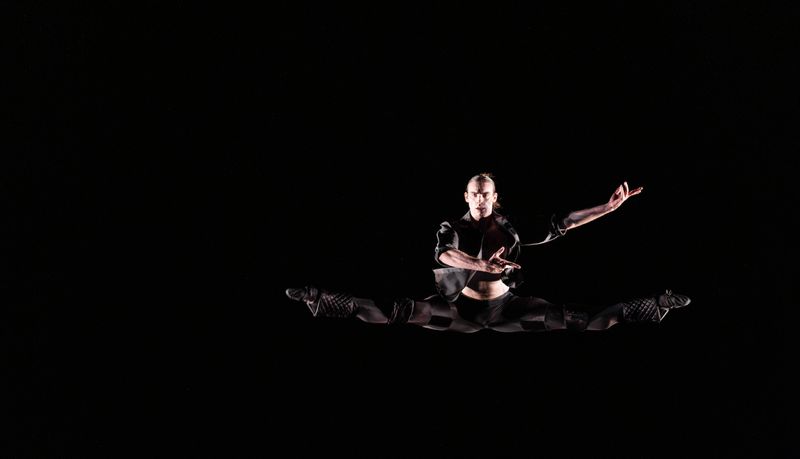
The other pieces on the program might be read as a celebration of the uninhibited individual. Bob Fosse’s Percussion IV, a solo first staged in 1978, is a breezy delight. Aaron Choate inhabits Fosse’s choreography with fluidity and flair, chasséing with equal parts exactness and abandon. The movement is onomatopoeic: drumming invites a shoulder shimmy, whistles call for fouettés. Fosse’s far from out of place in a program of 21st-century choreographers. In fact, his fingerprints are all over it. Aszure Barton’s theatrical behemoth “Blue Soup” feels like one of Fosse’s direct descendants.
It’s corny to say a dance is about embracing one’s contradictions, but bear with me. “Blue Soup,” whose title derives from the dancers’ oversized, shoulder-padded blue suits, is a romp through Barton’s consciousness (it’s no coincidence that her first name means blue). First, there is Choate in drag, lip-syncing The Chords’ “Sh-boom” into the microphone. Choate’s transformation from larger-than-life starlet to naked vulnerability establishes a dialogue between the real and the performed, the serious and the ridiculous. Yet Barton is not interested in reinforcing these binaries but in reshaping them.
When the full company joins, they face upstage in eerie lighting for a few beats too long. It’s unsettling until Angelo Badalamenti’s “Jitterbug” begins. Soon after a poignant rendition of Maya Angelou’s “The Detached,” the dancers slap each other’s butts to Paul Simon’s “Pigs, Sheep, and Wolves.” Barton isn’t just pairing extremes for shock value; she’s showing us that these sensations emerge out of each other. The absurd gives way to the profound, and the artificial becomes unbearably real. David Lynch, one of Barton’s major inspirations, is the master of this dreamlike merger of the beautiful and the strange. Yet while Lynch’s films leave me disturbed and hopeless, “Blue Soup” left me giddy. Where Lynch diagnoses the dark underbelly of human consciousness, Barton is less cynical. She dips us into the soup of her psyche, and that soup is a weird, feral explosion of sound and color. The deepest reality, she suggests, is not outward but internal.
“Blue Soup” might be read as an expression of Hubbard Street’s voice in 2026. That voice is profound as it is playful and as self-aware as it is contradictory. But it’s unique, and it clearly has something to say. I, for one, am ready to listen.
The Joyce Theatre is located at 175 8th Avenue, New York, New York 10011. For tickets to upcoming performances, please visit The Joyce l Performances.
Sign up for all the news on the Fall season, discounts & more...

Reader Reviews
To post a comment, you must register and login.