


Review: COMPAGNIE DYPTIK: LE GRAND BAL at The Joyce Theatre
Breaking the Fever Through Dance
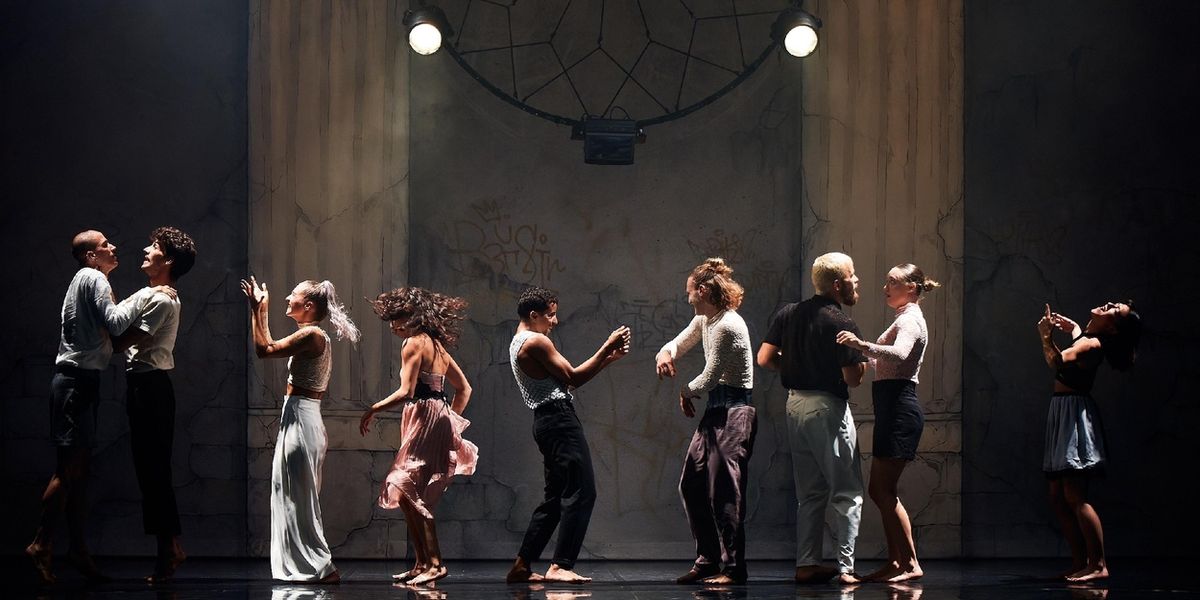
What if dance could transform our feelings of loneliness to those of belonging? Help us forget our own pain, albeit temporarily, and instead allow us to find a sliver of joy? Enable us to feel free and, perhaps, even feel like the most authentic version of ourselves?
Le Grand Bal by Compagnie Dyptik suggests that the answer to all of these questions is: it can.
Under the premise of a choreographic “fever” that spreads and takes hold of the bodies of the dancers in the company, Le Grand Bal is a full sensory immersion into the pursuit of freedom through rapturous, frenzied, and spirited dance. From the moment the lights blaze on to the moment they snap into darkness, the hour-long production unfolds like a fever breaking — relentless, hypnotic, and ultimately cathartic.
The French hip-hop choreographers Souhail Marchiche and Mehdi Meghari have crafted something extraordinary: a multimedia, emotionally charged dance experience that feels at once deeply personal and at the same time, powerfully communal. Each dancer performs with the intensity of someone exorcising their own troubles, taking each audience member along for their wild ride, and the end result is exhilarating.
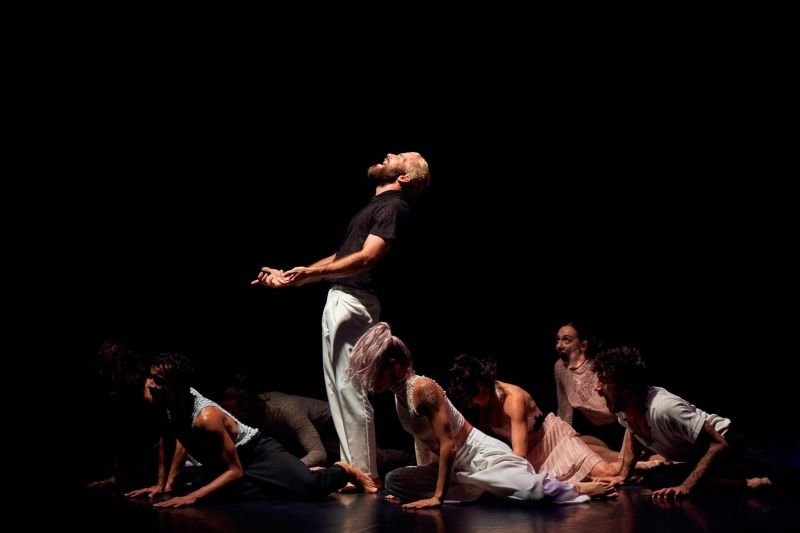
Photo Credit: Romain Tissot
Compagnie Dyptik: Le Grand Bal
Choreographers & Artistic Direction: Souhail Marchiche and Mehdi Meghari
Score: Patrick De Oliveira
Atmospheric Lighting: Richard Gratas and François-Xavier Gallet-Lemaitre,
Scenography: Hannah Daugreilh with painter Loïc Niwa
Costumes: Hannah Daugreilh & Sandra Bersot
Dancers: Mounir Amhlin, Charly Bouges, Yohann Daher, Nicolas Grosclaude, Hava Hudry, Beatrice Mognol, Davide Salvadori, & Alice Sundara
The performance opens with two spotlights, two souls. One dancer stands serene, clothed in white, calm and reflective. The other, draped in black, is hunched and weeping. Their movements teetering between sorrow and surrender. This quiet duet establishes the emotional polarity that drives Le Grand Bal: joy versus grief, serenity versus chaos.
As the music builds, a dancer upstage begins to pulse toward a lone beam of light — a “magnet” that seems to possess him, its flickering rhythm syncopating with every movement. Soon, the entire company is possessed, one by one, by the feverous light. Their bodies twitch, contort, and collapse as though overtaken by invisible frequencies. Once the dancer’s body is claimed, each dancer makes their way toward the light’s gravitational pull. The metaphor lands sharply: this is not just possession; it’s transformation.
At this point in the production, something magical happens. Suddenly, the soundscape shifts. From the right side of the theater, a whispering voice hovers just above the audience’s ear. A sound so startlingly real, that spectators instinctively turn to look. Then, it ricochets to the left. It’s as though the audience has also entered this underground club to dance with the company. The choreography of sound becomes as palpable as the movement itself, evoking anxiety, curiosity, and an eerie sense of intimacy.
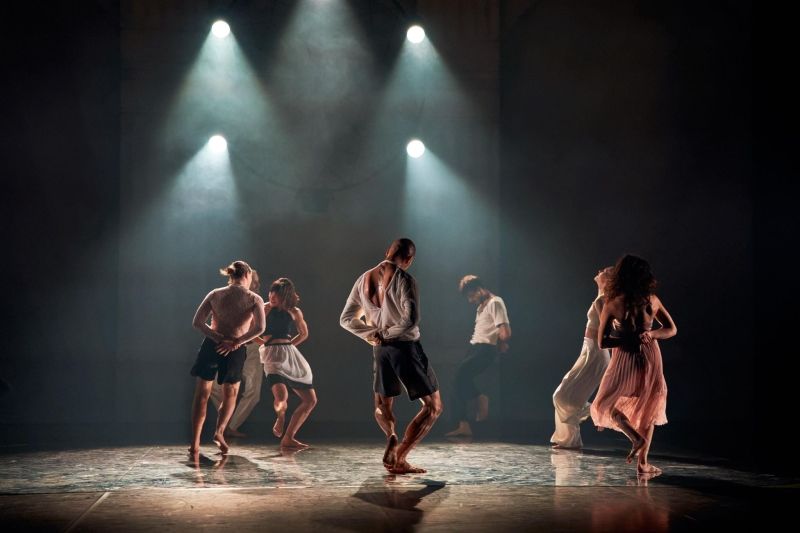
Photo Credit: Romain Tissot
As more dancers are “infected” by the fever, the tone shifts from isolation to eruption. The choreography explodes into motion. The company takes us through a number of communal dance scenes that evoke a familiar feeling.
First, we find ourselves drenched in warm muted lighting with the entire company thrashing euphorically, reminiscent of a warehouse party somewhere between Berlin and Barcelona. Next, a dancer in a party dress appears, her exaggerated smile and extended arms towards her “guests” showing anxiety beneath its surface — an image that perfectly captures Dyptik’s genius for emotional layering. The ensemble then cycles through sequences of group folk dances, intimate duets, and sudden collapses, the boundaries between joy and despair blurring with each breath.
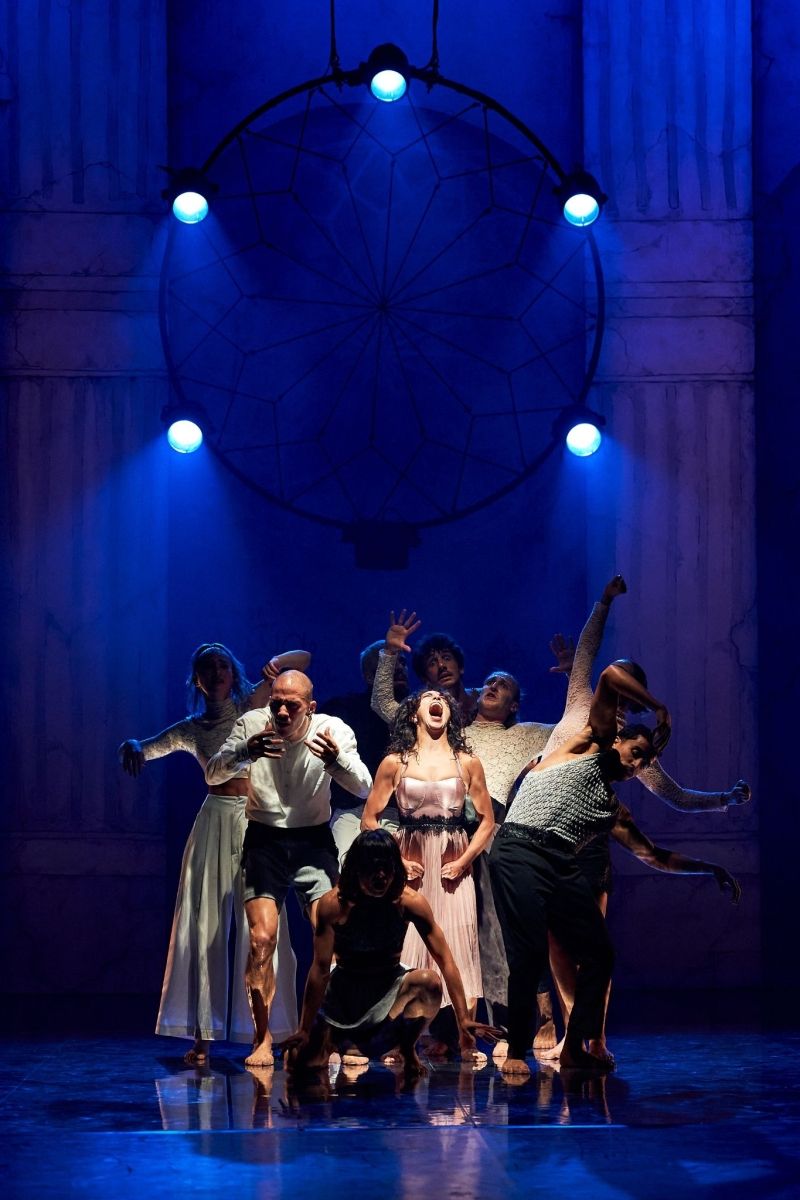
Photo Credit: Romain Tissot
Soon, we learn that breath too becomes choreography. In unison, dancers exhale audibly, married perfectly to the movement and the music, and releasing tension in waves. Over it, a haunting refrain echoes: “Para mí, para ti” — for me, for you. The line repeats like a mantra, bridging solitude, loneliness, and anxiety and community, presence, and solidarity.
In the final moments, the dancers gather upstage, their high spirited thrashing similar to that movement at the top of the show, but this time a bit slower, under a red flickering light, like an old film —a memory, dream, or ghost. Then, silence. Collapse. Darkness. The audience gasps, not from shock, but from awe. What remains is that echo: Para mí… para ti. The joy of dance, it seems, was always for all of us.
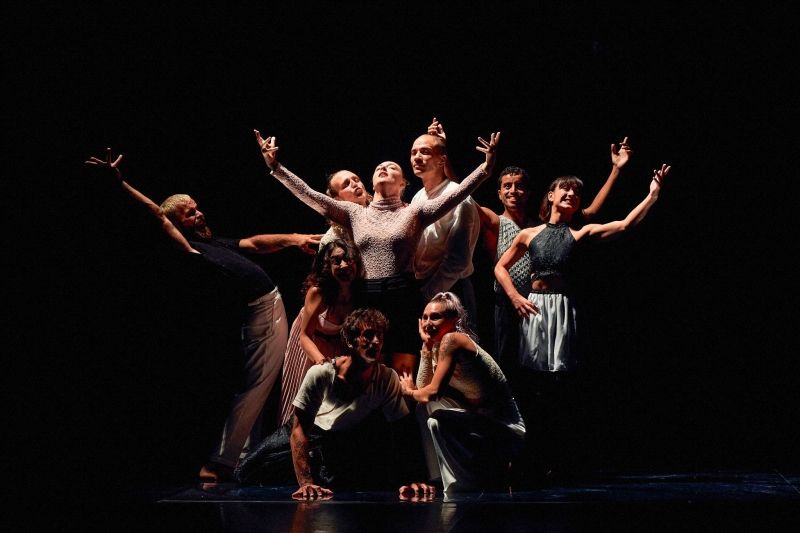
Photo Credit: Romain Tissot
Stylistically, this production is a feast for dance enthusiasts. A fusion of movement inspired by styles such as folk dance, breakdance, hip-hop, classical ballet, and contemporary forms all swirling into a beautiful, organized chaos.
Rhythmic hand gestures that nod to Bhangra-like movement. Buoyant step touch footwork evokes a post apocalyptic Tarantella. This melting pot of movement is interrupted strategically with bursts of choreographed pedestrian movement such as scratching, trembling, thrashing; a reminder that each dancer may be in motion but is still battling their own demons.
Technically, the ensemble is astonishing. Every dancer performs with razor-sharp precision and an unrelenting emotional drive that borders on ecstatic for the entire hour of the full energy production. Dancers are resilient athletes, and this ensemble is no exception.
There is no single “standout” because the company’s strength lies in its cohesion, and in how each body supports the story of another. The musicality is impeccable; dancers hit every sonic texture, from the metallic tick of a clock to the whispered pulse of breath. The precision comes down to the small details of their eyebrow movements — darting, trembling, widening — which become part of the choreographic score. Dyptik’s dancers are storytellers in motion.
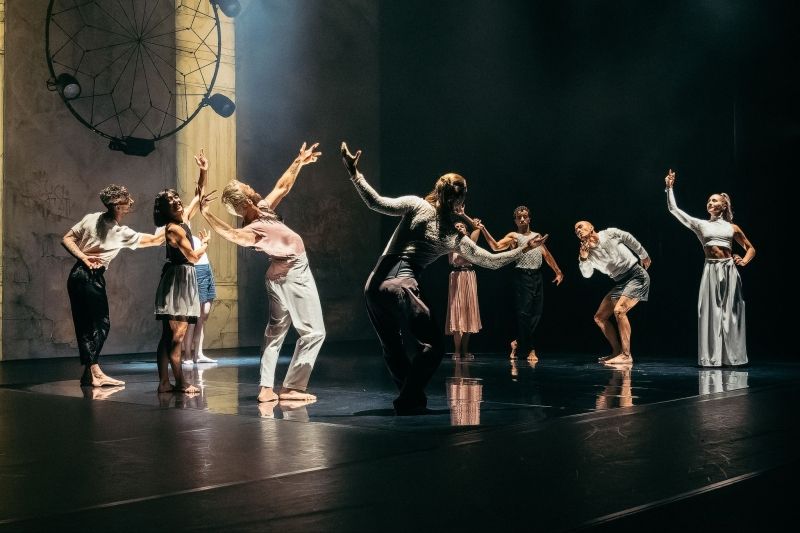
Photo Credit: Romain Tissot
Thematically, the production explores the juxtaposition between confinement and collective release. The work’s structure mirrors that psychological journey: beginning with stillness and introspection, erupting into chaos and communion, and finally landing in shared breath and release.
It’s hard not to read the piece as a reflection of modern existence: the anxiety of constant connection while feeling isolated, the hunger for community and the simultaneous fear of it. For anyone who has ever experienced social anxiety, these scenes feel uncannily honest. The choreographed nervous ticks, scratches, and pulsating on the floor feels like a choreographic representation of a social anxiety attack. The company has translated collective psychological tension into motion that serves as a living study of emotional turmoil and human resilience.
What’s most remarkable about Le Grand Bal is how seamlessly the production fuses sound, lighting, and dance into this storytelling arc. The whispering voices, flickering lights, and immersive soundscapes are not simply effects layered on top of choreography; they are a part of the choreography.
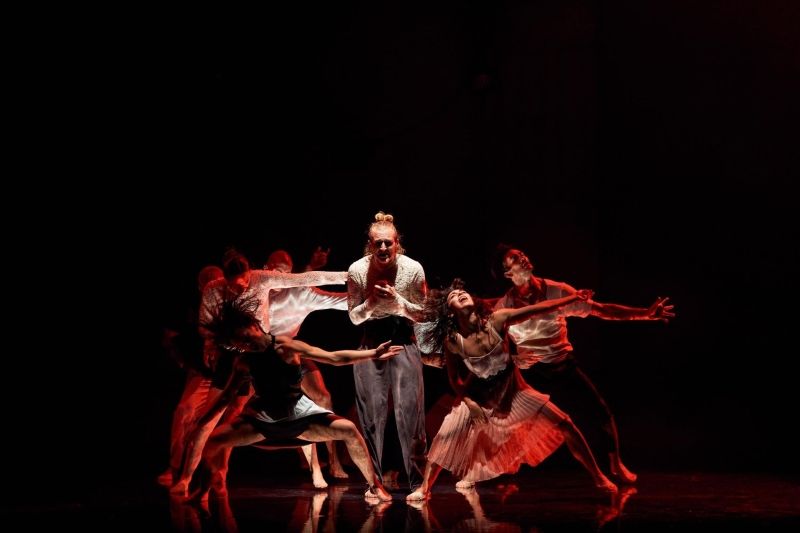
Photo Credit: Romain Tissot
More than a performance, Le Grand Bal is a mirror of life today. The production serves a visceral reminder of what it means to be human in a world where we can feel so isolated yet so connected at the same time. It asks, what happens when our only way out is to dance? The answer, as Le Grand Bal proves, is liberation — messy, imperfect, glorious liberation.
If you’re in New York this week and want to see something unlike anything else on stage, get yourself to The Joyce. Le Grand Bal is not to be watched; it’s to be felt.
Compagnie Dyptik: Le Grand Bal runs at The Joyce Theater from October 28-November 1, 2025. For more information about Compagnie Dyptik visit www.dyptik.com and for tickets visit https://www.joyce.org/.

Reader Reviews
To post a comment, you must register and login.