Member of the Critics' Circle (Drama) with a master's in dramaturgy. Also a script reader and huge supporter of new work. @Cindy_Marcolina on X; cindymarcolina.bsky.social on BlueSky
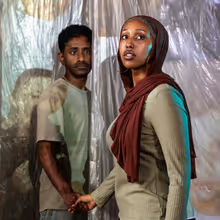
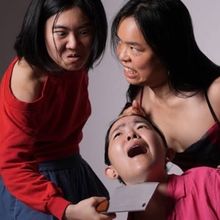
The Barbican has the perfect Halloween show. With a multi-media production devised by Elisabeth Gunawan, Daniel York Loh, and Jasmine Chiu, it will destabilise and provoke you. In Chinese mythology, the greedy, selfish, and envious get reincarnated into “hungry ghosts.” Forced to relive their actions until they learn from them, their insatiable, unfulfillable hunger drives them to ingest anything on their path, turning it to ashes. Talk about allegory!
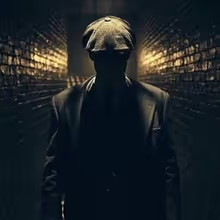
Something wicked this way comes: it’s another exciting high-concept Shakespeare. Director Daniel Raggett moves the action of the Scottish Play to a safe-house pub in the midst of a racketeering war. Succession meets Sons of Anarchy with a hint of The Sopranos in this daring, new production. With a hypnotic tempo that’s almost cinematic in nature, Raggett leaves you on the edge of your seat, gasping for air, mouth gaping and eyes wide. It’s Macbeth like you’ve never seen it before. Is it an extravagant idea on paper? It sure is. Does it work? Flawlessly and explosively so.
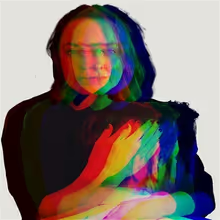
For her debut, playwright Jessica Norman leans into the singular speculation that “the people in power” keep us humble citizens from the truth. It’s fascinating stuff. Long-listed for the Women’s Prize for Playwriting and directed by Imy Wyatt Corner, This Little Earth is a thin exploration of the debris of grief at a time where reality flickers. It’s alright, but it could be so much more.
It’s an extensive rumination on family, Jewishness, marriage, and the boundaries of emotional infidelity, but it neglects the nuances and peculiarities of the characters, who ultimately remain two-dimensional figurines with very little identity. The narrative is severely self-indulgent, without as much scope or aim as it believes it's offering. It exploits womanhood for the benefit of its male protagonists and under-analyses the consequences of their actions. The direction and company are remarkable, but each element suffers the material.
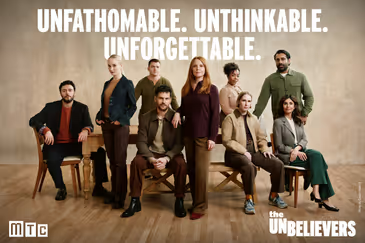
Miriam’s 15-year-old son is nowhere to be found. How does a mother cope? This life-altering event buries in the cracks of their family dynamic and blows it up. Years on, with his case remaining an unsolved mystery, Miriam firmly believes he is still alive. Nick Payne returns to writing for the stage, debuting a play that’s not quite as groundbreaking as Constellations was, but that brings all the excitement of a well-executed and nimbly staged time fracture. The Unbelievers proposes three crucial moments: we see the chaos of the immediate aftermath, the lingering despair of the first anniversary of Oscar’s disappearance, and, finally, the restless hope Miriam still holds seven years later. But this isn’t a show about a missing kid.
In early 1974, American actress Patty Hearst was brutally abducted from her flat in California by the Symbionese Liberation Army, deemed the first far-left terrorist organisation. Faced with the choice of being released or joining the militia, Hearst decided to stay and fight with the dissidents. She was arrested over a year and a half later, after a series of serious felonies that included a bank robbery. Her 35-year sentence was reduced to 7, then pardoned altogether. Inspired by Hearst’s trial, Katherine Moar writes a look at fame and crime for the #MeToo age.
Kimmings propels the plot with meta-theatrical orchestrated chaos. She toys with tone and pace, which results in an engaging rhythm of information and contemplation. It couldn’t be further from being preachy: Kimmings doesn’t judge. She refuses to employ her own anxious attachment to capitalism as a weapon of comparison or opinion, nor does she use her own experience as a cautionary tale. The fable lies in the covert complexity of the storytelling.
Keelan Kember writes a morally compromised microcosm where art is money, status, violence, and power. It’s a shame it doesn’t fulfil its potential. Instead, it’s tasteless, continually slipping into a vicious circle of stereotyping and triteness. Directed by Merle Wheldon, it doesn’t rise above commonplace comedy even when it’s at its best.
Branded as “366 Daily Inspirations for Writers & Artists,” this compendium of prompts contains an abundance of inspiration. Many books like this exist already, yet award-winning writer and director Jessica Swale has compiled an exciting list of ideas that sets her apart from the rest of the flock. Interestingly, this isn’t aimed at writers of any specific technique or level. A newbie can pick it up, a novelist can decide to test their short-form. A poet might choose to compose in verse; a playwright might concoct a dialogued vignette.
Now that days are getting colder and nights are getting longer, it’s time to get spooky. When a viral video asked women if they’d rather choose to be alone with a man or with a bear last year, the internet exploded. To this day, more than half of the women in the 18-29 range who took part in the online discussion chose the bear, citing fears of violence and lack of safety around male strangers. It’s alarming. Riding that wave, Morgan Lloyd Malcolm has written a revolutionary take on Bram Stoker’s Dracula with a twist that redefines the original. Forget everything you know because nothing is what it seems: it’s time to follow Mina Harker on her own quest.
With a cast as starry as the Ibsen’s Norwegian skies, The Lady from the Sea is adapted into a thrilling, biting comic drama by Simon Stone. It features the theatrical return of Andrew Lincoln alongside the stage debuts of Academy Award winner Alicia Vikander, Brutalist actor Joe Alwyn, and rising star Isobel Akuwudike. This is not the play for you if you’re looking for steady auroras and sad prose. Ibsen (Stone’s version) is surprisingly funny, but not thoroughly convincing.
Have you ever wished to have the same auditory experience as a deer? Or maybe a cow? Now you can. Katie Mitchell partners with playwright Nina Segal and sonic artist Melanie Wilson to explore the world from the eyes – or, more accurately, ears – of the titular animals. It’s a crude reproduction of a day in their lives that de-centres humans from its narrative altogether. Cow | Deer is entirely wordless, unique in its genre and unlike anything you’ll see on a main stage. The leaflets handed out before the start encourage the audience to close their eyes and relax while they listen to “moments of a summer day in England”. You could do that, but you’d be missing all the fun of seeing live foley artistry.
At a time when people are arrested by the hundreds for peacefully protesting the ongoing genocide, Swag Age resonates across nations and languages. Written by Park Chan-Min and Min Jeong-Yeon with direction by Lee Kyung-soo, it’s a riotous, roaring, exciting new piece of musical theatre. It challenges the elite and denounces corruption, calling out those who are complicit in silencing the masses.
“Does my flesh dazzle you?” a lascivious Christopher Marlowe asks a flustered William Shakespeare in what we can only describe as an exceptional example of theatrical slash fiction. For the uninitiated, “slash fiction” is a genre of fanfiction that focuses on the romantic relation between preexisting fictional characters of the same sex. Liz Duffy Adams’s Born With Teeth brings the female gaze to the West End. Directed by Daniel Evans and starring Ncuti Gatwa alongside Edward Bluemel, 90 steamy minutes of action puts two most venerated playwrights in England together like we’ve only ever found on websites like AO3 (Archive Of Our Own, the biggest fan-run fanfiction platform) and Tumblr.
Worlds clash once again in Mike Bartlett’s universe. Lip and Ruth’s pull to return to nature is disrupted when Ruth’s stepdaughter, Millie, and her academically inclined best friend, Femi, visit the couple’s earthy homestead. This rural idyll, where the sky is enormous and the trees tell a story of their own, is suddenly disturbed by brutal talks of capitalist wars and nihilism while the economics of permaculture are discussed. What happens when ecological extremism starts to look like a sensible decision? Should we put our planet before our family? Generations lock horns, blame becomes currency, and the land watches on in three big scenes divided by two intervals. It’s all very Mike Bartlett-y.
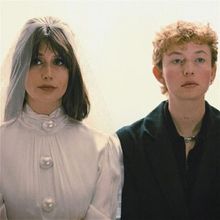
We meet Jamie and Ruby as they’re planning their wedding playlist. What follows is a collection of vignettes that lead up to the big day. Playwright Will Jackson drafts a flawed piece for the 18-25 Bush Young Company. Directed by Katie Greenall, it could be the personal exploration of a society that continuously forces us into our assigned roles, but it comes off as if the writing is simply ticking off a list of pertinent sociopolitical issues. Featuring anxiety, anti-genocide activism, eldest daughter syndrome, the housing crisis, suicide, and more, it’s a lot. Combine that with a cast of 17 young actors who all need to do something, and most productions would be in danger of becoming messy.
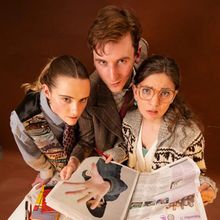
We are delighted to report that real fringe theatre is back. The invigorating, daring, challenging, form-subverting kind of venture that makes the stage its playground. We haven’t encountered anything like this since before Covid. There isn’t a lot of theatre with specifically scientific research as its core, either. Commercially, The Effect (Lucy Prebble’s play about a clinical trial) had a revival in 2023 with Jamie Lloyd at the helm and Caryl Churchill’s evergreen reflection on human-cloning, A Number, was on just the year before (curiously, both starred Paapa Essiedu). Looking away from the West End, it’s even harder to find something that sits firmly at the junction with science. Three Billion Letters swoops in at the rescue and begs you to think. Created by TAKDAJA, the piece is a heady mix of data and experimentalism. Does our DNA control more than our eye colour and predisposition to illness? How do we determine our identity? There’s so much gene-ius in it.
Two joints, both alike in dignity: Monty’s Tacos and Caps Bar. The high street isn’t big enough for the rival families. Shakespeare’s tale of young love and civil bloodshed comes alive in a gripping community-oriented rendition at Stratford East. Adapted by Kwame Owusu and co-directed by Emily Ling Williams and Malik Nashad Sharpe (who also choreographed it), it sees a staggering 38-strong cast of professional performers alongside young artists from the venue’s own training program and representatives of the public. The result is a fresh, energetic, galvanising production infused with music and dance that digs into the more romantic side of the play to deliver an excessively naive interpretation. It’s a springboard for many members of the acting company, but the vision lacks stability.
What did our critic think of SING STREET at Lyric Hammersmith Theatre?
The recent statistics surrounding alcohol consumption in the UK are frankly staggering. Across the four nations, around 80% of adults are regular drinkers, and a significant number of them drink way above the Chief Medical Officers’ low-risk guidelines. The country’s drinking culture is out of hand and few of us pay it much mind. Shows like The White Chip burst onto the scene in a blaze of counter-action, reframing a problem that is standard behaviour for many. After all, how can you let loose without sipping on something?
Videos