


Review: TITUS ANDRONICUS, Hampstead Theatre
Max Webster's clinical interpretation lacks bite.
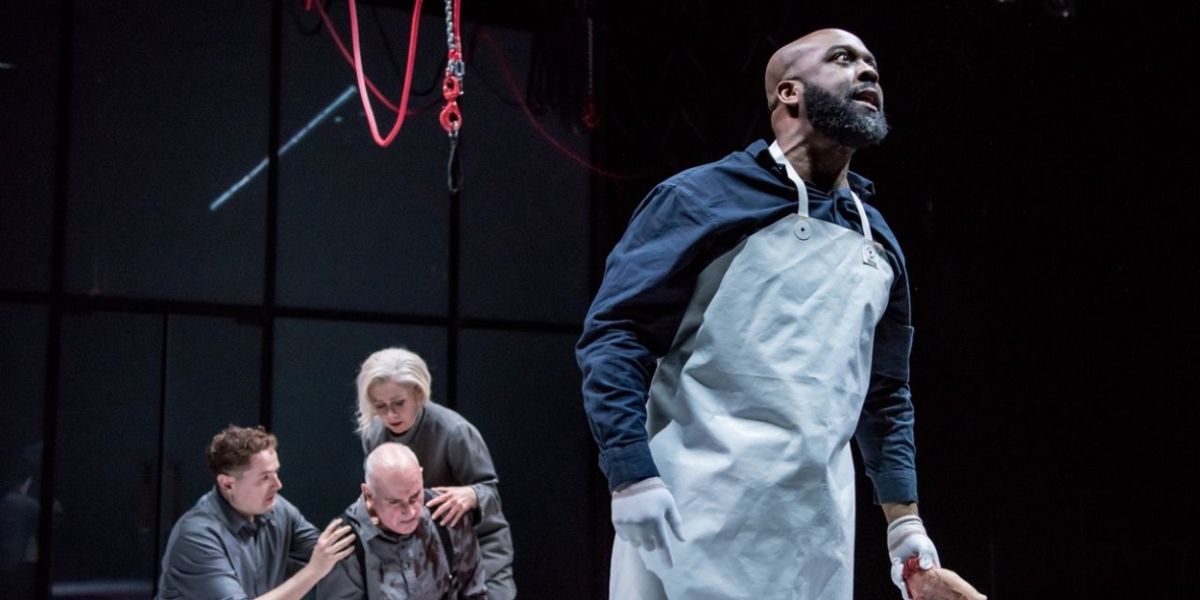
 Hampstead Theatre has seen its fair share of gore. Even so, Max Webster’s Titus Andronicus leaves the boards drenched in something more caustic than fake blood: the acid tang of a civilisation eating itself. Shakespeare’s revenge tragedy is a grotesque feast, and here it’s served up with relish.
Before Quentin Tarantino delivers unto the West End his own theatrical opus, here is a work worthy of the auteur. Succession meets Reservoir Dogs, this slice of politics and brutality has the highest body count of any entry in the Bard's canon: around one in five of all deaths in Shakespeare plays happen in this one drama (even if you don't include the poor fly).
Front and centre is John Hodgkinson as the broken general. He stalks the stage like a man who’s outlived his gods. Despite being regaled as a legendary hero of the Empire, this Titus is no marble statue but flesh, bone, and bile. He returns from war expecting laurels; instead, he walks into a meat grinder of political ambition.
Carl von Clausewitz claimed that war is politics by other means, Michel Foucault the reverse and Titus would agree with both. More principled soldier than pragmatic statesman, his clumsy decisions to sacrifice Tamora’s son and back the wrong claimant for the imperial throne lead him and his family down a fatal path.
Hodgkinson works in counterpoint with Wendy Kweh’s Tamora, who is no faint-hearted Gothic queen. She is razor-wire wrapped in velvet, prowling the stage with a predator’s calm. When she spits out “I am Revenge, sent from the infernal kingdom”, it lands not as parody but as a mortal challenge to all those in earshot. A subtext of racism hums beneath the action, made explicit in Aaron (thrillingly played by Ken Nwosu) as he seeks his own retribution. His declaration, “Vengeance is in my heart, death in my hand,” is practically spat out like gunfire.
Letty Thomas’s Lavinia takes the opposite tack. In the aftermath of her rape and mutilation, she becomes a symbol of silenced women through history. Webster gives us a harrowing vision to contend with: hands gone, tongue cut, yet every stagger across the stage screams volumes. The sexism of Rome is absolute, and her body becomes its battleground.
The younger generation provide the charge that keeps the play from ossifying. Joel MacCormack’s Lucius burns with righteous indignation; Jeremy Ang Jones and Marlowe Chan-Reeves as Tamora’s sons are frat boys turned feral. Around them orbit a strong company: Max Bennett (Saturninus, imperial brat turned despot), Emma Fielding (Marcia, the sharp-edged sibling), and a taut ensemble who keep the bloody wheel spinning.
Even if the concept and design here isn’t anywhere near as engaging as Jude Christian’s brilliant all-female version, the creatives stitch this modern dress hellscape together with clear vision and merciless economy. Designer Joanna Scotcher delivers a set that feels half amphitheatre, half abattoir, its cold geometry splattered with crimson as the acts mount. Lee Curran’s lighting carves Rome into shadow and glare, a chiaroscuro of power and pain. Matthew Herbert’s compositions rumble beneath Tingying Dong’s drums and drones evoking the inexorable march toward collapse.
There’s very much a feeling here, though, of a star vehicle without its star. Simon Russell Beale (who played the title role in its initial Stratford-upon-Avon run) pulled out weeks before opening night due to illness and Hodgkinson has stepped up with little notice to accept what can only be seen as a hospital pass. The overall lack of rehearsal and preparation is clear in places and the portrayal of the great military commander veers between overwrought and and bloodless. Shakespeare gives us an apoplectic general; Webster delivers an outraged corporal.
Moreover, Webster’s interpretation does Hodgkinson few favours. As with Nicholas Hytner’s Richard II earlier this year, the director has made a deliberate effort to inject humour into the delivery of key speeches or exchanges. This leads to some of Titus’ more tense and terse declarations being treated almost as pantomime by an audience increasingly unsure whether and when to laugh. The result is not just confusion in the pews but the dramatic subversion of entire scenes: when Tamora and her sons disguise themselves as the personifications of Revenge, Rape and Murder and approach the general in the depths of his grief and madness, it is treated as if he is on the joke and clearly recognises his foes.
Consequently, this Titus is fierce but lacks bite. True, there are stomach-churning sights aplenty and Webster knows how to turn up the volume to 11; then again, he rarely has anything new to say despite doing well to tease out the core themes in this apprentice play, not least racism (Aaron makes it clear that his skin makes him both target and scapegoat, yet he revels in villainy with more freedom than Rome’s hypocrites), sexism (Lavinia’s brutalisation is the play’s darkest core, and Webster refuses to sanitise it) and political hypocrisy (Titus, Tamora, Saturninus are all pawns of pride, all consumed by it).
What resonates most, though, is the modern context and how what we see on stage echoes what we are seeing around the world. Once-proud democracies are rotting away from the inside; targeted savagery from the highest echelons of power - whether by executive order or military command - is dealt out on a frequent basis; and corruption, tribalism and cruelty dressed up as law have become the order of the day. Was it ever
thus?
"I was reading it like a new play." Read our interview with Max Bennett here.
Titus Andronicus continues at Hampstead Theatre until 11 October.
Photo credit: Genevieve Girling

|
Powered by

|






Reader Reviews
To post a comment, you must register and login.