


Review: STEREOPHONIC at National Theatre
Innovative theatre at it's best!
By: David Friscic Feb. 13, 2026

The heightened reality replete with elongated pauses –(do people really wait this long in real life to answer one another?) that emanates from the stage of the Pulitzer- Prize and Tony -winning production of Stereophonic –now being produced in a touring /edited two hour and 50-minute version at The National Theatre-- certainly grabbed my attention.
The play by the esteemed playwright David Adjmi is interesting ----just as the musician and control room characters in the play must pass a marathon-like endurance test to see if they can hit their recording album deadlines----so must the individual audience members decide if the fascinating melding of content and form and the phenomenal technique/stylistic elements merit their attention for two hours and fifty minutes. The pace of the show is akin to watching a Wim Wenders, Antonioni, or Bergman film------not even quite as quirky in pace as Annie Baker or a Tracy Letts play, this play is a compelling toggle between immersion and detachment.
The themes of this intriguing play percolate as the action unfolds under the sleek veneer of David Zinn’s eye-catching set. The play is a lens though which the audience can witness the characters’ ability to navigate the minutiae of life as they attempt to make a recording that is important to their careers. Playwright David Adjmi dissects the reactions of people under varying degrees of pressure and the claustrophobic intensity of working together to meet intense deadlines.
The power, pressure, strain, and inevitable conflict that can arise from making a recording under a tight deadline ----the collision of commerce and creativity ---is portrayed in real time over the course of several days in a recording studio in Sausalito and Los Angeles, California ----1976-1977.
Director Daniel Aukin captures the intimacy and intersections that these musicians/characters must feel as they navigate several songs that surge throughout this play. Mr. Aukin successfully synergizes the tension between the stylistic and content components of the play (occasionally, when I thought the play was bordering on pretension, I realized that the very human characters in the play were often meant to be pretentious and aggravating-- so this may have been part of the organic vison of the play).
Playwright David Adjmi says that “ the play lives in the space between hypernaturalism and orchestral music.” The play felt like peering through a telescopic lens -------into a private world that led me and, possibly, the audience into the various characters’ intense immersive reality.
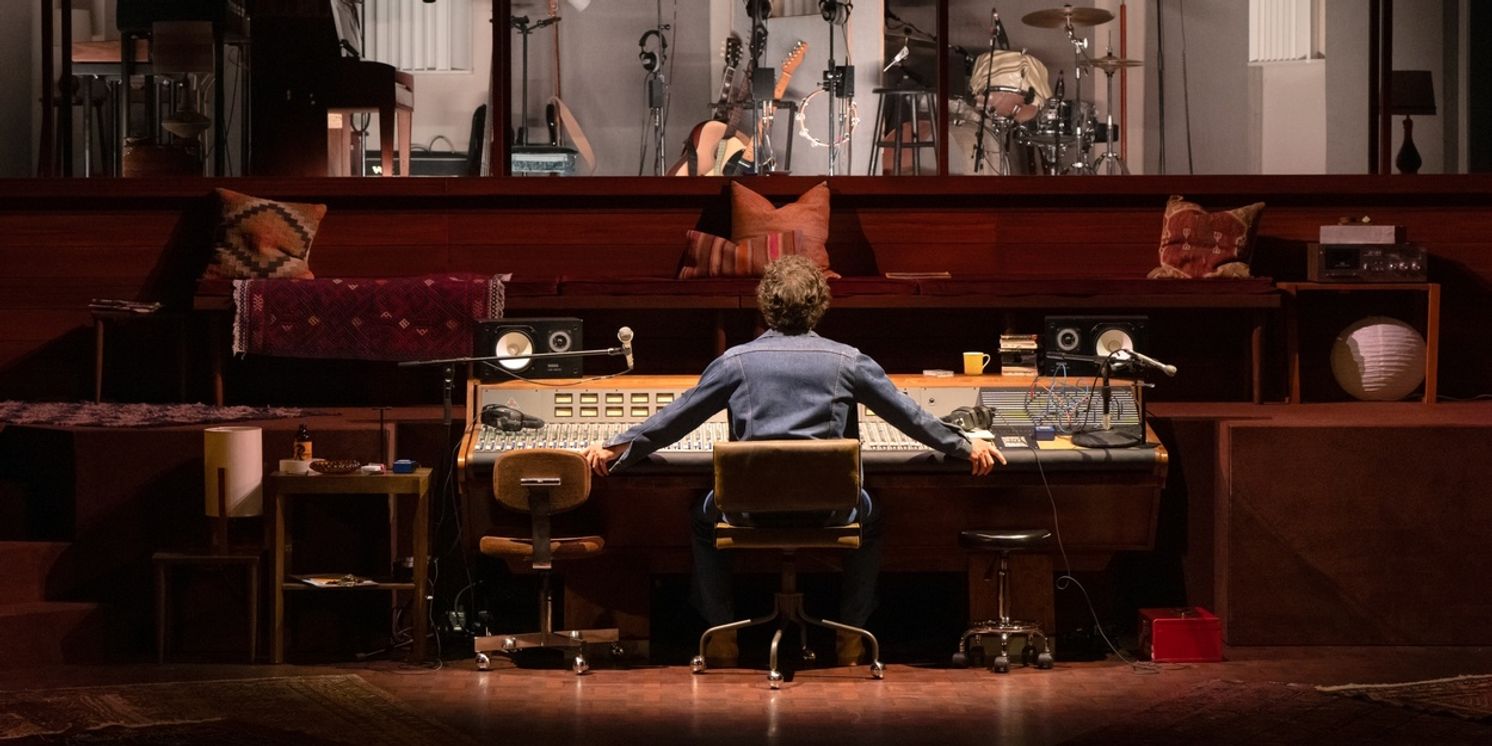
David Zinn’s scenic design is meticulous and encompasses the stage space with a wood-paneled control room and the encased glass window of an upstage sound room. Though this play may not be for all tastes, this is a marvelous and very specialized play (that brought to my mind the play with music End of the Rainbow---- by Peter Quilter that was on Broadway several years ago).
A metaphorical as well as a very real “ticking of the clock” seems to be going on as each minute seems of the utmost importance ---even though the lines are delivered in a variegated manner.
The play reminded me of Annie Baker’s The Flick ---as Baker’s play is set in a fading cinema in real time with shades of similar immersive pacing and timing. The play also reminded me of the play The Pillowman in scenic design. ( I wonder if the influence of Chekhov was in the mind of the playwright?---as various incidental moments built up by accretion to create a dramatic arc as well as deep subtext --).
Original songs and orchestrations by Will Butler are akin to being another character in the play and mirror the character’s moods and longings. (Music Direction and orchestrations by Justin Craig). The characters are often arguing, talking about a broken coffee machine, sex, living conditions, drug -fueled and so -forth ----issues of seeming major importance always fall victim to mundane and ever-present squabbles about food, urges, and tiredness.
The characters in the play (–as they cope with the intersection of minutiae in their lives) become human dramatic and dryly comedic “notes” that reflect the notes utilized in composing music.
The sound of the songs is reminiscent of sound of the Fleetwood Mac era---the songs of the 1970’s era crossed-over to many musical tastes and genres (here we have a pop---rock sound) The cross-pollination of the British musicians to the American shores ---(already exemplified by the Beatles and Rolling Stones ) is felt throughout the play as British and American attitudes are portrayed through the various characters .
The actors must embody the often alternately nihilistic, deadpan, and snarky undertows of humor in the play as well as the highs and lows of drug -fueled adrenaline and the crashing lows of harsh reality cutting into their perceived joyful moments—and , in this production, they certainly did.
Emilie Kouatchou, as the sardonic Holly, delivers a mesmerizing and engaging monologue on her love of the film Don’t Look Now.
Claire DeJean’s taut and biting portrayal of Diana, the main vocalist, is replete with the requisite controlled edginess.
Cornelius McMoyler as Simon, the manager -- is particularly visceral and effective in his scenes with the strong-willed producer Peter (played with confidence and swagger by Denver Milford).
Steven Lee Johnson’s portrayal of the unabashed Charlie is a delirious delight.
Jack Barrett as Grover delivers a sensitive performance as the character who often mediated with the band.
Jake Regensburg is masterly in his many guises and personas as the emotionally fluid Reg. Mr. Regensburg fluidly caught all the shading and texture between being stoned, attempting personal rehabilitation, becoming slovenly, or waxing philosophical. (Mr. Regensburg is the understudy for Christopher Mowood---Mr. Regensburg performed the night I attended).
Costume Designer Enver Chakartash has produced vivid and striking costumes depicting the feel of the time period.
Lighting design by Jiyoun Chang is evocative and employed to illuminating perfection.
The play Stereophonic steadily peels away the surface to get to the core of human dynamics under pressure. The creative urge to face inner demons, to confront the reality of the creative process, and to go to unfathomable depth and acceptance never ends in this fascinating play with music.
Do not miss Stereophonic if you want to see innovative theatre at its best.
Running Time: Two Hours and 50 including one fifteen-minute intermission.
Stereophonic runs through March 1, 2026, at The National Theatre located at 1321 Pennsylvania Avenue, NW, Washington, DC, 20004.
Photo credit: Jack Barrett in the first National Tour of Stereophonic.
Photo by Julieta Cervantes .
Reader Reviews
Videos