


Review: BBC PROMS: AFTERLIFE: VISIONS OF THE BEYOND, Royal Albert Hall
The first of four Proms performances for the BBC National Orchestra of Wales, here overseen by their outgoing principal conductor Ryan Bancroft
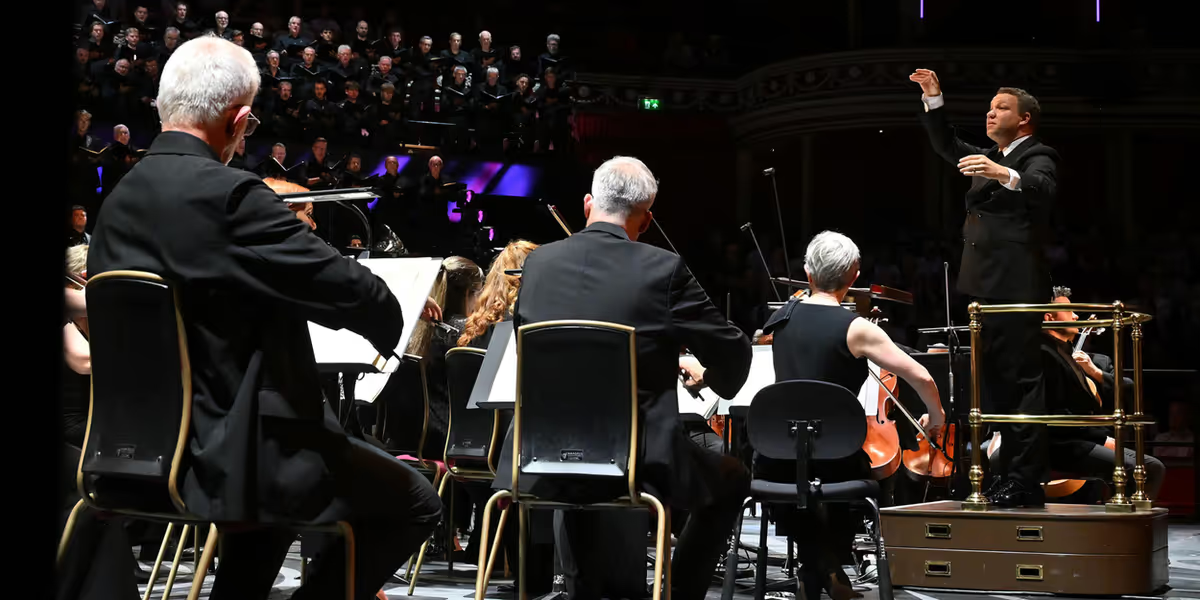

Amongst other things, art exists to try and explain the profound, channelling the artist’s thoughts and feelings into paintings, literature or, in this case, music. Death and what lies beyond is naturally a frequent topic, most often contemplated by creatives with decades behind them - not so for three out of four of the composers on this Prom’s programme. Lili Boulanger, Olivier Messiaen, and Richard Strauss were all in their early 20s when their selected pieces were composed; Karol Szymanowski, by contrast, was in his 40s. Yet each composition suggests a weight of emotion and experience beyond their years.
The BBC National Orchestra of Wales was joined by both the London Philharmonic Choir and the BBC National Chorus of Wales, as well as a selection of vocal soloists for this concert. Ryan Bancroft conducted all three ensembles with deftness and sensitivity, smoothly guiding his musicians and singers through some emotionally heavy pieces.
.jpg?format=auto&width=800)
Boulanger was 23 when she finished composing “Vielle prière bouddhique”, working on it from 1914 to 1917 as the First World War took its course. It’s noted as a prayer of hope, and you can understand why in the context of its writing; there were plenty of bleak works of art produced during this time period, there were still people clinging on to the idea of peace for all humanity. This nine-minute prayer alone is a clear demonstration that Boulanger’s premature death was a great loss to the music world. Tenor soloist James Wey combined seamlessly with the two choirs to create something quite magical with this piece.
According to soprano Mari Eriksmoen, Szymanowski chose to use his native Polish (instead of Latin) for his “Stabat mater” because it could better express grief, and “speak to the people” more eloquently and organically. Given that most classical music is most often accompanied by words in Italian, French or German, it was fascinating to hear how lyrical the Polish language can be; across the six movements The Four Singers take their turns individually and also in combination with each other, creating a delicate balance of harmonies throughout. The whole composition is a mixture of grandiosity and intimacy, most easily demonstrated in the fourth movement when the chorus and soloists have a moment to sing unaccompanied by the orchestra.
Messaien’s “L’Ascension” was directly inspired by his deep Catholic faith, and his evocative style of composition ensures that you can feel this coming through in his music, regardless of your own stance on religion. For me it also brought to mind the latter stages of the Powell and Pressburger film A Matter of Life and Death, as Squadron Leader Peter Carter’s fate hangs in the balance - and whether he would make an ascension of his own. Though the brass section really comes into its own in this piece, the strings being left to fade out into silence at the end is incredibly poignant; the audience were clearly hanging off every note, and allowed Bancroft to hold a final moment of quiet before bursting into enthusiastic applause.
.jpg?format=auto&width=800)
As a contrast to the previous piece, Strauss’s tone poem “Death and Transfiguration” was influenced by atheism and inspired by the final moments in the life of an artist. Despite the implied bleakness, it does feature some striking shifts in mood, capturing the pain and thoughts of what’s to come, as well as looking back at good memories and moments in life; this composition managed to tie the whole evening together, as well as look at things from a different perspective. Whatever your own personal belief system, you can’t help but be moved by the emotion imbued in this piece - and the performance from the BBC National Orchestra of Wales was definitely a showstopper, a real testament to their musicianship.
An evening of spirituality, contemplation, and mortality - but not of finality. A superbly performed Prom which evoked feeling and provoked deeper thought.
The BBC Proms run at the Royal Albert Hall until 12 September
Photo credit: Mark Allan
Sign up for all the news on the Fall season, discounts & more...







Reader Reviews
To post a comment, you must register and login.