


Review: TRU, Starring Jesse Tyler Ferguson, Menier Chocolate Factory
Jesse Tyler Ferguson is Truman Capote in this lush extended monologue

In 1975, Breakfast at Tiffany’s author Truman Capote became a social pariah overnight, after his public betrayal of the group of New York socialites known as the “Swans”. Tru, Jay Presson Allen’s 1989 dramatisation of the incident, locks us in the New Journalism pioneer’s living room in the days following, and doesn’t let us leave.
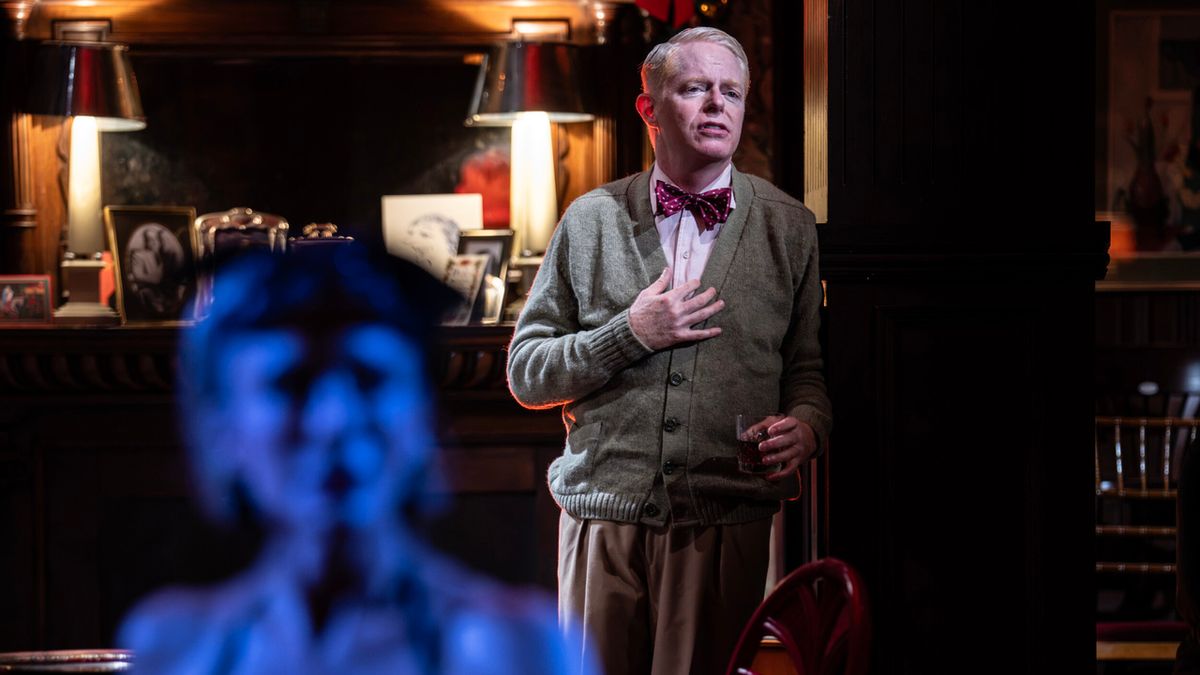
Rob Ashford’s new production is set in a luxuriously detailed recreation of Capote’s plush Upper East Side townhouse; there is memorabilia here to fill a museum, and press seats are labelled “for my special friend”. We feel like unexpected guests to whom Capote has chosen to impart the story of his life, and he frequently cajoles, gossips and flirts with audience members on the front row.
Jesse Tyler Ferguson’s take on Capote elevates him far above caricature, and reveals a facet of the writer different from Philip Seymour Hoffman’s Oscar-winning portrayal in the film Capote. This Capote gains sympathy for his lonely melancholy after a lifetime of social climbing, but loses it with his ruthless callousness towards his friends (whom he sorts into the ‘A list’ and ‘B list’). When addressing his scathing, thinly veiled portrayals of the Swans – in a recently published excerpt from his novel Answered Prayers – he is both defensive and despairing.
%20-%20image%20by%20Johan%20Persson%20(7).jpg?format=auto&width=800)
Photo credit: Johan Persson
In what is essentially an extended monologue, Allen (known for, among other things, the screenplay for The Prime of Miss Jean Brodie) captures both the superficiality and the tragedy of Capote’s prose, but not its tight sense of structure. This version of Capote meanders from his childhood, to his alcoholism and suicidal ideation, and back to celebrity namedropping, without ever dwelling too much on any one theme. The effect is gossipy and alluring, but Presson Allen sometimes strays dangerously far from the point.
For in this production, Tyler Ferguson is not the only person on stage. Standing sentinel while Capote unravels is an amorphous female figure credited only as “The Swan” (a haughty Charlotte D’Amboise). The Swan is initially refined and poised, but her rage and frustration towards Capote trickle out, in stolen glances and exasperated sighs. Brief snatches of choreography conjure both the elegance of the social scene inhabited by Capote and The Swan, and its tragedy, the way it eats its participants alive.
D’Amboise’s character most obviously resembles the socialites whose trust Capote betrayed, but she also morphs seamlessly into several of his female relatives, and into an eccentric fortune teller he visited as a child. The Swan is posited as central to Capote’s psyche, his muse and confidante, but she is silent for almost all her time on stage – put back in the spotlight, but still without a voice.
Clearly Capote, at least in this interpretation of events, was made and unmade by his relationships with the women in his life – he would never complete Answered Prayers, or quite recover from his falling out with the Swans. Ashford has chosen to make this element of the script explicit, to great effect, even if it doesn’t quite overcome the shortcomings of the script.
Tru plays at Menier Chocolate Factory until 14 November
Photo credits: Johan Persson
Prefer BroadwayWorld in Google Search?
Add us as a preferred source so our stories show up more often in Top Stories and Google’s AI answers — for you.

Sign up for all the news on the Fall season, discounts & more...
|
Powered by

|







Reader Reviews
To post a comment, you must register and login.