

Interview: The Cast of SLAM FRANK on Offensive Comedy and Political Extremism
The ensemble behind Off-Broadway’s most provocative musical discusses antisemitism, identity politics, audience walkouts, and why uncomfortable theater matters.

There are few places in American theater where you can expect to hear a joke about the Holocaust, a critique of progressive identity politics, and a musical number that leaves audiences questioning whether they should applaud or walk out. At the Orpheum Theatre, Slam Frank delivers all three, sometimes within minutes of one another.
Before a recent performance, I met with the musical’s eight-member cast. We gathered onstage, sitting together in a circle, for a candid conversation about the show’s controversies, its complicated relationship with political extremism, and what happens when audiences don’t recognize they’re the punchline.
Created by Andrew Fox and Joel Sinensky, Slam Frank imagines a progressive theater company reinterpreting Anne Frank’s story as an intersectional, Afro-Latin hip-hop musical. What begins as an outrageous send-up of performative progressivism eventually becomes something considerably more challenging.
For nearly an hour, Olivia Bernábe, Alex Lewis, Jaz Zepatos, Austen Horne, Rocky Paterra, John Anker Bow, Amelia Louise Barr, and Walker Stovall debated what their production means, challenging assumptions, frequently laughing, and sometimes discovering new interpretations themselves.
The following conversation has been condensed and edited for clarity.
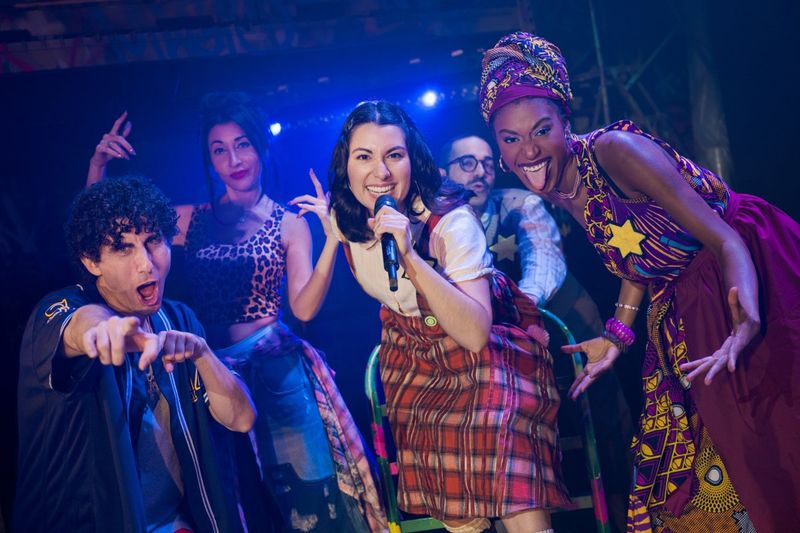
and Austen Horne in Slam Frank.
Photo by Shawn Salley Photography.
Olivia, you’ve suggested that the far left and far right can sometimes resemble one another. Where do you see those political extremes overlapping?
OLIVIA BERNÁBE: I do think it can be a circle where you can go so far in one direction that you kind of end up on the other side of it, but for different reasons, if that makes sense.
Alex Lewis: It sort of feels like identity has almost become a team sport, and that even if you don’t believe what some aspects of that identity are you’ll support it either way because it’s your team.
Rocky Paterra: I think where some common ground lies is that people on both sides are just trying to be understood, and when you feel like you aren’t being understood, that you’re being misinterpreted, or taken out of context, you have the impulse to just be louder.
When did having the right political identity become a substitute for actually being a good person?
Walker Stovall: I feel like it happened in 2012 on Tumblr.com. I was there.
The circle erupts in laughter.
Jaz Zepatos: It’s very easy to feel like you’re a social justice warrior because you have reposted something to your story.
Austen Horne: The hypervisibility of social media, it has made politics something that feels like it has to be public and something that has to be front-facing.
PATERRA: I find these little pockets of truth in the identity conversations, like in my own personal experience from the perspective of a gay man who was closeted for a long time. It’s like when Edith says to Anne, ‘If you want to make it in this world, sometimes you have to hide a bit of who you are.’ I did very much find that to be true in my own life. And, when you think about visible and invisible identities, being gay is an invisible identity. However—
HORNE: Well, I guess it can be.
BERNÁBE: That’s a spectrum as well, I suppose.
PATERRA: You can do things to make that more invisible by the conventional standards that we—okay, you know what, I’ll just shut up.
BERNÁBE: No, no!
ZEPATOS: You’re making a very good point. You're making a very good point.
PATERRA: It really is technically an invisible identity, and the ways in which you need to hide that make you even more invisible.
The production’s fictional director, meanwhile, becomes so preoccupied with contemporary identity politics that he begins erasing the history he supposedly wants to honor.
John Anker Bow: I mean, his intention is to bring those particular identities to the story that has absolutely nothing to do with them. And the removal of the Jewish identity almost completely from the story, with the exception of the one visibly Jewish character, which is Margot, is absurd.
Bow sees a broader criticism of commercial theater in that creative distortion. Citing SUFFS and TOOTSIE, he questions whether producers and public pressure have made contemporary musicals too cautious.
BOW: None of it works, and all of it is too safe. None of it says anything, and it’s not what theater started as. It’s not what theater is supposed to be.
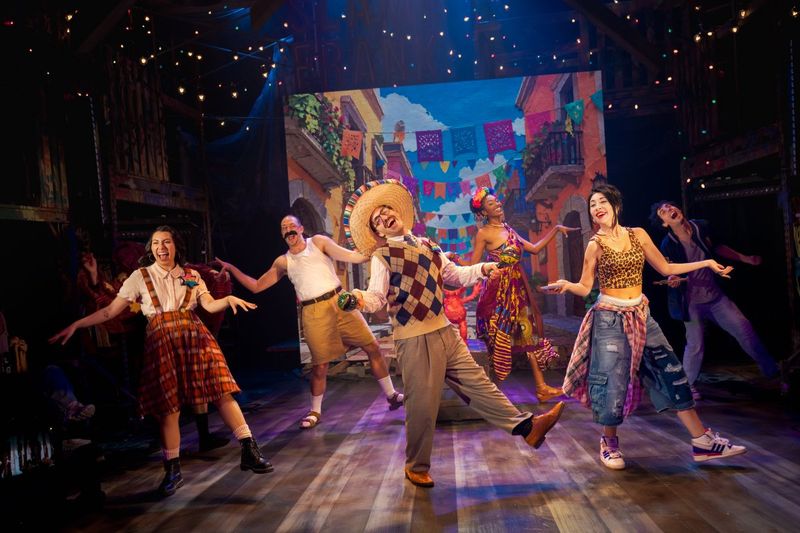
Photo by Shawn Salley Photography.
Horne emphasizes that Slam Frank’s apparent chaos is carefully constructed.
HORNE: I get it that it’s funny, and I get it that it’s a satire, but it is smart, it is intentional, and we’re not just throwing anything at the wall.
Could audiences with completely opposing political beliefs leave Slam Frank feeling equally vindicated, without realizing they’ve both been satirized?
BERNÁBE: Yes, the answer is yes.
LEWIS: There’s people that get offended on either side, I’d say. I mean, we’ve had people leave because they think it’s blatant antisemitism. We’ve had people leave because they think it’s pro-Zionist. In this, you know, whatever propaganda.
ZEPATOS: Liberal rhetoric.
BERNÁBE: Yeah, like woke-maxxing.
BOW: Yeah, everyone laughs together, but if you're not questioning or slightly offended in some way, you’re not thinking about it enough. You’ve missed something along the way.
ZEPATOS: Right, and the punchline is everyone.
BERNÁBE: Yeah, no one is safe.
BOW: Is there anything about what we're doing up here that can be interpreted a wrong way? It's hard to say.
That exchange captures what makes Slam Frank so difficult to categorize. Its most provocative moments confront antisemitism, Zionism, and the Israeli-Palestinian conflict without offering audiences the reassurance of an easily identifiable political position.
HORNE: I was talking about how satire isn't necessarily an endorsement of something, and that it is instead holding up a mirror to the society and the world that we live in.
Yet the cast recognizes that artistic intention doesn’t erase the possibility of genuine harm.
ZEPATOS: It’s not missed by us, and it’s not something that we’re cavalier about. I mean, we care.
LEWIS: I’ve never come into this show being like, ‘I want somebody to come in and leave less happy than they were when they came in,’ or like, ‘I want to hurt someone’s feelings.’
Bernábe recalls a recent performance when an upset audience member attempted to leave during an especially vulnerable moment. They encouraged the patron to stay, hoping they might reconsider after seeing the complete work.
BERNÁBE: We don’t want to hurt people, but I so badly wanted to say, ‘Hey, I know this is uncomfortable, but it’s okay. I promise it’s okay.’
Lewis offers an important qualification: remaining seated shouldn’t be compulsory.
LEWIS: The other night when that girl was here with her boyfriend, she kept trying to leave and he was like, “No.” At a certain point, literally, that’s okay.
BERNÁBE: Like, it’s just this whole big puzzle, and we’re all still trying to put those pieces together.
LEWIS: I think that art is not necessarily meant to just make you feel good all the time.
PATERRA: And after doing the show at The Asylum last year, this year I’m more comfortable with creating discomfort.
HORNE: With theater, there is no stopping. We and you are just living this in the moment. There’s no distractions. You are made uncomfortable in a way that we just are not used to.
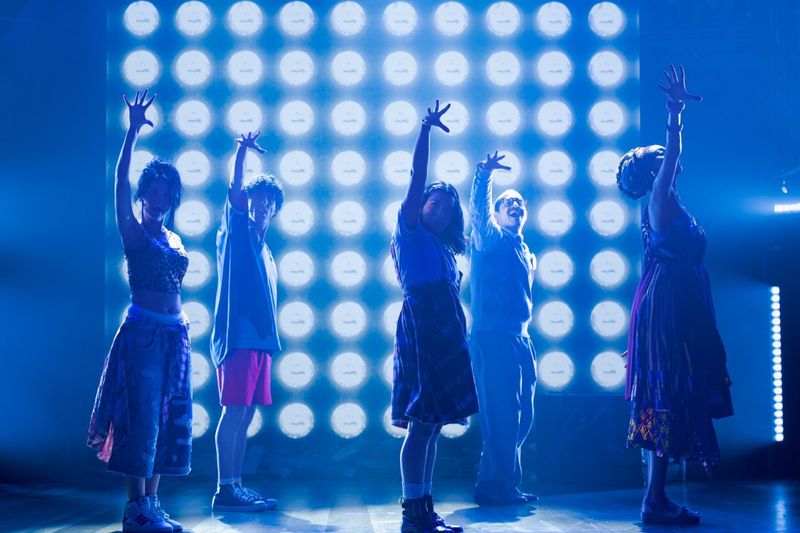
Photo by Shawn Salley Photography.
How can the musical encourage audiences to recognize one another’s humanity when political identities have become so divisive?
Barr, who portrays Margot and Abuela, has been listening intently.
Amelia Louise Barr: I’m purposefully a little quiet because I’ve honestly never heard everyone in this cast talk about the show in this way.
She pauses. Then continues.
BARR: Like, what does meaningful discourse look like? And how does one have that these days? What does that even look like?
STOVALL: I think a good question the show is asking is, ‘Is discourse meaningful?’ And ‘How long can discourse be meaningful?’
The conversation turns to a pre-show gag in which Stovall removes a box labeled “generational trauma” from the theater. The gesture suggests that historical suffering can simply be discarded, although, as Lewis points out, the box always returns.
LEWIS: Well, the interesting thing about that box too is that box is never removed. It’s always put back the next day.
HORNE: This idea of ignoring the past and existing in a present without the context of the things that have happened feels silly. It feels ridiculous.
That historical disconnect extends beyond the show’s fictional characters. Bernábe recalls an audience member earnestly asking whether Anne Frank was actually Latina.
BERNÁBE: I don’t think that the Holocaust actually needs to be diversified because why do we need our own identities to sympathize or empathize with someone else who’s going through tragedy.
What do you wish audiences understood before entering the Orpheum?
STOVALL: Expectations are pre-planned resentments.
BERNÁBE: Just because we’re doing, showing, or saying something doesn’t mean that we're endorsing it.
BARR: I also highly recommend people seeing it more than once.
Barr explains that she watched the musical four times to process its meaning. Bow has encountered patrons whose opinions changed after returning.
BOW: I’ve talked to people outside who say they didn't like it the first time but loved it the second time.
For Zepatos, even disliking the production can become an opportunity for meaningful engagement.
ZEPATOS: If you come out of here and you hate it, write an essay, do something. No one ever left MAMMA MIA and was like, ‘I need to do something about this!’
LEWIS: That’s not true. I took a cruise immediately!
The cast laughs again.
HORNE: And if you would like for us to make a show that is not offensive, I implore you to create a world that isn’t.
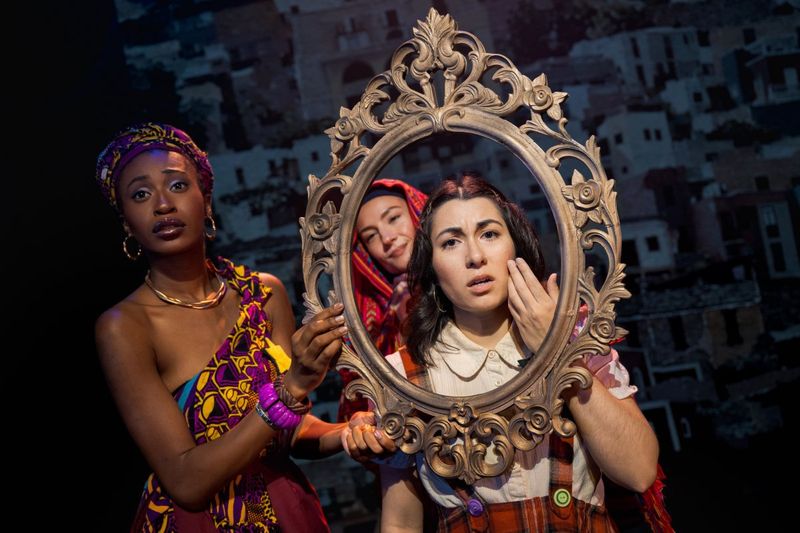
Photo by Shawn Salley Photography.
As our conversation ends, Lewis and Zepatos arrive at a question that may be more valuable than any definitive explanation of the musical.
LEWIS: Just remember that the people that made this are human beings and we all have feelings. And the writers, even though they’re being mean sometimes, they’re not sociopaths.
ZEPATOS: But is it mean or is it a mirror?
Perhaps that’s the question worth carrying home. Not whether Slam Frank confirms what we already believe, but whether we’re courageous enough to recognize ourselves in what it exposes.
Slam Frank is currently running at the Orpheum Theatre (126 2nd Avenue). Tickets and additional information are available at SlamFrankMusical.com.

See more BroadwayWorld in Google
Our stories show up more often in Top Stories and Google’s AI answers.
Breaking Broadway alerts by text
Get the biggest stories sent straight to your phone.
Sign up for all the news on the Fall season, discounts & more...

|
Powered by

|