Hudson Square Bid And NY Dept. of Transportation Unveil New Asphalt Mural On Varick Street
Installation expands the pedestrian plaza near the Holland Tunnel entrance.
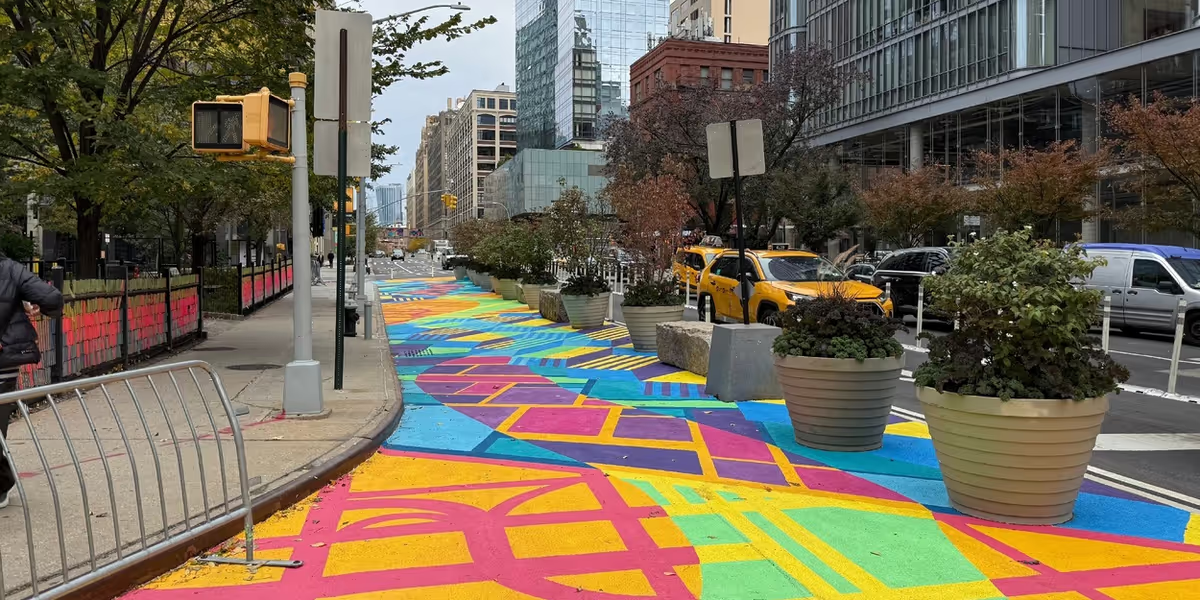
The Hudson Square Business Improvement District and the New York City Department of Transportation have unveiled As Above, So Below, a new asphalt mural by artist Cara Lynch on the Varick Street pedestrian plaza near the entrance to the Holland Tunnel. The mural, permitted through NYC DOT Art Partners, visually extends the adjacent Freeman Plaza East and offers pedestrians a point of refuge amid the surrounding traffic environment.
“‘As Above, So Below’ is more than a mural—it builds on our efforts to bring new life and energy to an area long shaped by heavy traffic,” said Samara Karasyk, President and CEO of the Hudson Square Business Improvement District. “This artwork shows how public art makes Hudson Square feel more welcoming to people and celebrates what makes this neighborhood and city unique. We're grateful to NYC DOT and Councilmember Marte for their continued support of our work, and to Cara Lynch and her team for bringing this artwork to life.”
“Enhanced public space and pedestrian safety improvements are important everywhere, but especially at high vehicular traffic locations like the Holland Tunnel,” said New York City Department of Transportation Commissioner Ydanis Rodriguez. “The ‘As Above, So Below’ mural breathes additional life into this area, and by being located on NYC DOT's Varick Street pedestrian plaza it enhances street safety while also underscoring Hudson Square's vibrancy as a major gateway into Lower Manhattan serving businesses, visitors, and residents.”
“Hudson Square has always been a gateway into Lower Manhattan, but it's also a neighborhood where thousands of people walk, work, and build community every day,” said Council Member Christopher Marte. “‘As Above, So Below’ brings new color and energy to a corridor long dominated by traffic, and it helps reclaim this space for the people who use it. I'm grateful to the Hudson Square BID for showing how public art can make even the most congested parts of our district feel welcoming, safe, and connected. This is the kind of investment that makes our streets work better for everyone.”
The mural was fabricated on-site by Lynch and her team using paint-by-number methods and hand-cut stencils. The abstract, site-specific design reflects the interplay between the natural forces beneath the city’s surface and the engineered systems that shape the streets above. Referencing the Hermetic axiom linking macrocosm and microcosm, the mural incorporates patterns inspired by utility networks, the path of Minetta Creek, and the geometry of city maps. The work creates an immersive environment of color and pattern that echoes the neighborhood’s energy.
Positioned next to the 5,000-square-foot Freeman Plaza East, the mural expands pedestrian space in a heavily trafficked area. The piece joins the plaza’s Noguchi sculpture, fence art installation, public piano, and Audubon mural, contributing to a growing art-focused destination along Varick Street. It also appears alongside “We’re Freeing Ourselves,” the first public artwork mounted on the back of a gantry sign in New York City.
The Hudson Square BID continues to invest in public art as a way to enhance the daily experience of workers, residents, and visitors. Since launching the Hudson Square Canvas program in 2019, the district has completed more than 15 large-scale public art installations. In the 2025 Neighborhood Survey, three out of four respondents reported that public art improved their pedestrian experience. Building on this response, HSBID plans to produce at least two new installations each year in the next phase of the program.