


Review: FLIGHT at Her Majesty's Theatre, Adelaide Festival Centre
A late 20th Century opera buffa, revitalised for this century.
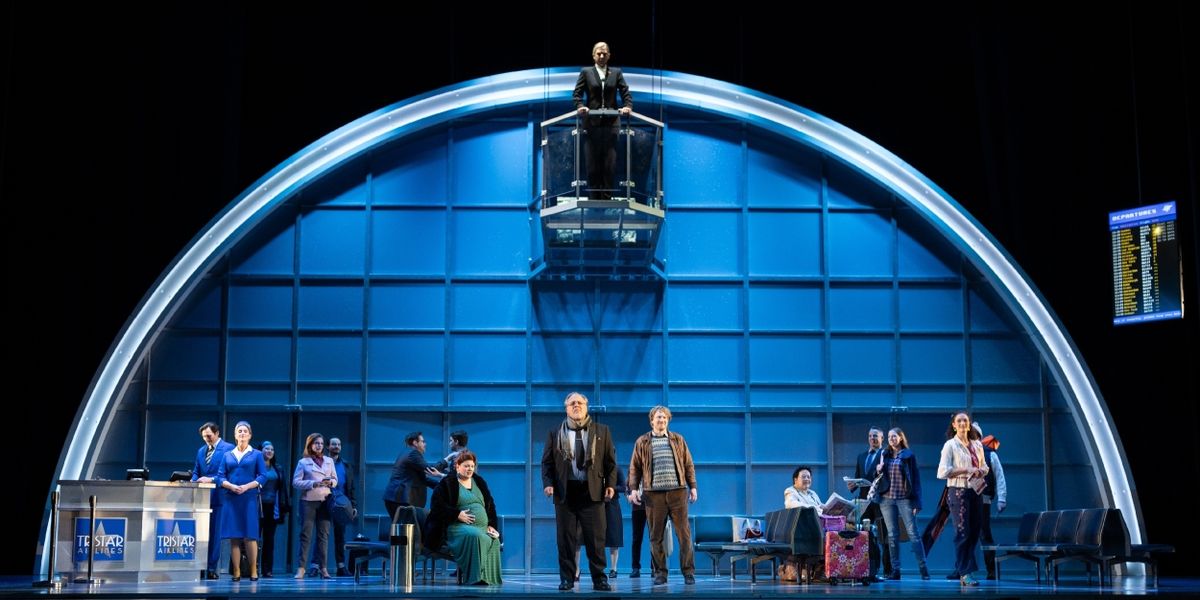
Reviewed by Barry Lenny, Thursday 8th May 2025.
State Opera of South Australia, under its new Artistic Director, Dane Lam, is presenting a very short season, only three performances, of Flight, the opera, by composer Jonathan Dove and librettist April De Angelis, about a group of people unable to leave an airport because of a severe electrical storm. They include stranded passengers, airport staff, and a refugee without papers who, without them, can neither leave the airport, nor get a flight to another country.
It was commissioned in 1998 by Glyndebourne Opera, and this production draws on the Scottish Opera version from 2018. The production is directed by Stephen Barlow and the Adelaide Symphony Orchestra and singers are under the baton of British conductor, Charlotte Corderoy. The Glyndebourne production was seen in Adelaide in 2006 in the Adelaide Festival. Although billed as a comedy, and there is plenty to laugh at, there are also numerous poignant and dramatic moments.
Flight draws loosely on the real-life story of Mehran Karimi Nasseri (1945 – 12 November 2022), also known as Sir Alfred Mehran, a stateless Iranian political refugee, who lived, through a lack of identification after his passport and other papers were either lost or stolen, on a bench in the departure lounge of Terminal 1 in Charles de Gaulle Airport for 18 years from 26 August 1988 until July 2006, when he fell ill and was taken to hospital. He was then homeless, living in a shelter and, feeling out of place, went back to the familiarity of living at the airport in September 2022, dying of a heart attack two months later. He claimed his grandiose, and erroneous, knighthood from a letter from the British High Commissioner that began, “Dear sir, Alfred”.
This opera is set in the departure lounge of Tristar Airlines against a background of a large semicircular framework that, at various times, is a wall in which are set the doors of lifts, or entrances and exits, a radar screen, or a giant window, through which we see the storm, and constant rain. Designer, Andrew Riley, Lighting Designer, Richard Howell, and Projection Designer, Jack Henry James Fox, have worked seamlessly together to create a visually engaging backdrop to the music and action.
The first act serves to introduce the audience to each of the ten characters, and their circumstances. They are referred to as: Refugee, Controller, Tina, Bill, Older Woman, Stewardess, Steward, Minskman, Minskwoman, and Immigration Officer.
At the end of the first act, with a flight to Minsk being the last to get away, an impending storm of great magnitude is announced by the Controller, and all aircraft are grounded indefinitely. The second act takes place overnight, as the people interact, not always appropriately, and the Refugee convinces the four women, other than the Controller, that he has a magic stone that will make their desires come true. When they realise that he has told each of them the same story, they turn on him. The third act is at sunrise the next morning, when the storm has abated and the airport reopens, leaving them to discover all that happened overnight and to come to terms with it, interrupted by the Minskwoman having her baby, and the Immigration Officer apprehending the Refugee.
When the curtain rises, the airport is about to open for the day and the Controller, sung by coloratura soprano, Anna Voshege, looks down god-like from her exalted position on her balcony, high above, ready for the hustle and bustle. She makes it clear that she would much prefer her job if it did not involve all of the people who were about to invade her concourse. Her clear diction and soaring high notes are a joy.
Below her, the refugee wakes and collects his belongings, clearing the way for the people who will be passing through, leaving, arriving, or working in the area. The role of the anti-hero Refugee is sung by countertenor, James Laing, who sang the role in the 2018 production, and his wealth of experience playing the role over such a long period shows in his deep understanding of the character. He is the ‘other’, separate from the others both as a character and through the countertenor vocal range. He is a permanent resident amongst the transitional crowds. He reaches out, attempting to make some human contact, and has an effect on much of what occurs. It is a pivotal role, with which Laing engages with great subtlety.
Soprano, Nina Korbe, and tenor, Henry Choo, play the married couple, Tina and Bill, who are going on holiday to get out of their rut, trying to rekindle the passion in their stagnated relationship with the aid of a sex manual, occasionally announcing a page number and quoting the advice on that page. Much of the comedy comes from this couple, and the bulk of the rest comes from the antics of the Steward and Stewardess, oh, and from the Steward and Bill.
The Older Woman, played by mezzo-soprano, Cherie Boogaart, is awaiting the arrival of her younger ‘fiancé’, a man she met in a bar while on holiday in Mallorca, who has promised to meet her there. She is 52, and he is 22. He doesn’t arrive. We, in the audience, didn’t expect him to and, deep down, neither did the Older Woman who, eventually, finds the inner strength to accept that being single might not be a bad thing. At 76 myself, alive and still kicking, I do rather object to the idea that somebody of only 52 is to be considered as old. Harrumph!
The Stewardess and the Steward, who cannot keep their hands off one another, are sung by mezzo-soprano, Ashlyn Tymms, and baritone, Samuel Dale Johnson. Their physical encounters are hilarious and, like the rest, their performances are as much about acting as they are about singing. This opera demands far more than trained voices, it has to have well-formed characters, a good feel for comic timing, and even a touch of farce.
The Minskman, a diplomat going to his new posting, and his wife, Minskwoman, a couple who are expecting their first child at any moment, are portrayed by bass-baritone, Jeremy Tatchell, and mezzo-soprano, Fiona McArdle. As they are due to board, she suddenly becomes reluctant to fly with him and, at her insistence, he goes on the flight to Minsk without her, while she remains in the airport, promising to follow him later. Their relationship is more loving than comical, in contrast to the other couple and the two randy airline staff. It is a warm and tender moment when he comes back on a return flight, unable to leave her behind, and welcoming the child to whom she has just given birth.
Bass-baritone, Teddy Tahu Rhodes, plays the Immigration Officer who is trying to find and arrest the Refugee, making only a wordless appearance until catching and handcuffing him near the end of the opera. He reacts to the pleas of the others, and to the Refugee’s story of how he came to be there, and Teddy Tahu Rhodes takes his character from the austere and imposing Officer through several levels, developing sympathy, empathy, showing humanity overcoming officiousness and, finally releasing him and agreeing to turn a blind eye to the existence of the Refugee in future.
A well-chosen cast of superb singers, who can also act and create believable characters, as well as engage in some fighting, sexual fun and games, and deliver comedy as well as poignant moments, coupled with the rich, powerful music, makes this a production to remember.
About half of the Adelaide Symphony Orchestra, 32 musicians, are involved in this production, and what a marvellous performance they give of this very complex score, balancing perfectly against the voices of the cast. The ASO never fails to impress.
There are also ten actors in non-speaking roles, who add colour and movement as groups of passengers arriving or departing at various times during the performance. Adelaide audiences will surely recognise many of them from State Theatre performances and other local theatre productions,
With only two performances left, on Friday and Saturday, there is no time to lose. Rush to get tickets for this wonderful production.
Photography, Andrew Beveridge.
|
Log Boy State Theatre Company South Australia (10/01-10/10) |
|
Faulty Towers The Dining Experience - Darwin Oaks Elan Darwin (8/20-8/22) |
|
POMONA Adelaide University Theatre Guild (8/07-8/16) |
|
The Heartbreak Choir State Theatre Company South Australia (11/20-12/05) |
|
Commentary State Theatre Company South Australia (8/21-9/05) |
Reader Reviews
To post a comment, you must register and login.