


Review: SAVING MOZART, The Other Palace
This new take on the life of Wolfgang Amadeus is inspired but confused
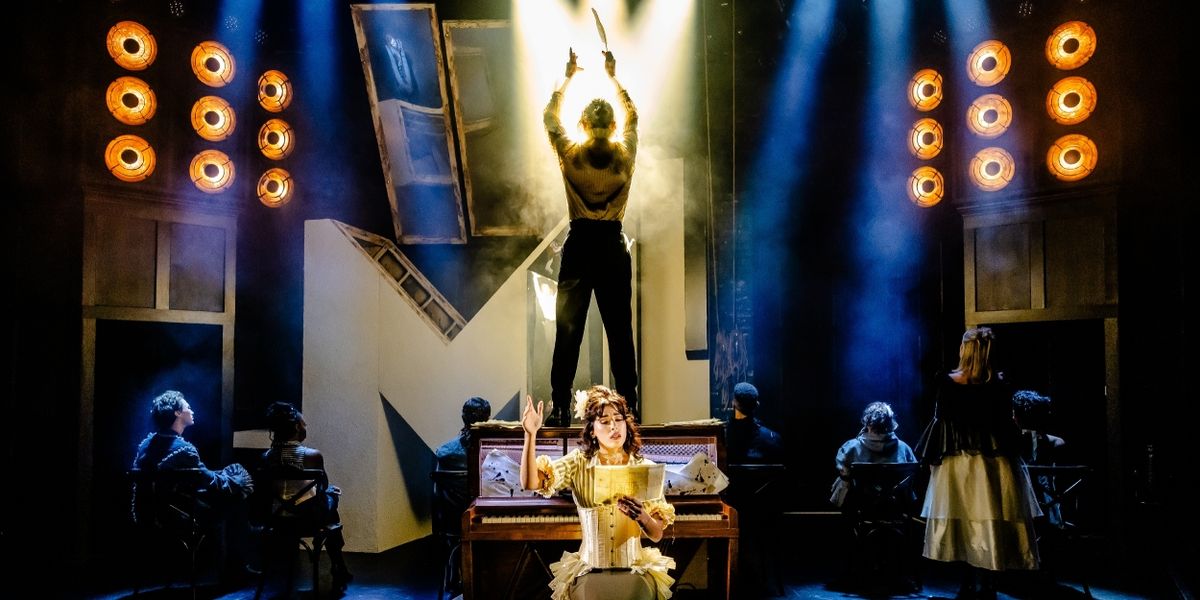
 “But do you know where the story really began?” This could be a line taken from Hamilton, Six, or any of their myriad imitators that try to illuminate some narrative hidden to us and left out of history books. On this occasion, it’s delivered by Jack Chambers as a wisecracking Wolfgang Amadeus Mozart, in a new musical attempting to bring to light the women who had an impact on the composer’s life and work.
Our guiding light here is Wolfgang’s sister Nannerl (Aimie Atkinson) – a musical prodigy and composer herself, who left behind no surviving manuscripts – who teaches her brother while he’s still a child prone to whimsy, sacrifices her own career at the altar of patriarchal expectation, and ultimately serves as the inspiration for her brother’s best known works.
.jpeg)
Photo credit: Danny Kaan
This ought to be a novel way to approach the life of the better known Mozart sibling, but strangely the book – by Charli Eglinton, who also wrote music and lyrics – apes several plot points from the monumental existing play fictionalising Mozart’s life, Peter Shaffer’s Amadeus. Those who know that play (and its film adaptation) well will recognise the sinister circumstances under which Mozart composed his unfinished Requiem, the idea that Don Giovanni was inspired by unresolved issues with his father, and even the scene where Mozart mockingly “improves upon” an existing composition by his rival Antonio Salieri.
Taking inspiration from Amadeus is not necessarily a bad thing, but it ends up giving Eglinton slightly too much to work with. Without sufficient time to explore Wolfgang and Nannerl’s relationship, the trials and tribulations facing a composer for hire in Mozart’s time, and Salieri’s obsessive inferiority complex, each of these subplots ends up suffering from a lack of development.
Another, more pressing, issue is the script’s desperation to make Mozart into an uncomplicated hero, interested only in making music “for the people”, which makes other characters feel insubstantial in comparison. His archetypal “tiger dad” Leopold is written to be abusive or comforting depending on what would cast his son in the best possible light; Eglinton tries to make Wolfgang’s wife, the soprano Constanze Weber (Erin Caldwell), a character of equivalent narrative significance to Nannerl, but mainly ends up shunting her into the “supportive but frustrated wife of a starving artist” trope.
However, fans of Amadeus will be most displeased by the characterisation of Salieri. Jordan Luke Gage gives a performance steeped in rock star charisma, but Salieri’s hatred for Mozart, even before the latter becomes especially successful or celebrated, is never quite explained. Across two solo numbers which both essentially make the same point – Wolfgang needs to watch out! – he ends up feeling like a thinly drawn pantomime villain who could have been left out of the show entirely.
.jpeg)
Photo credit: Danny Kaan
The notable exception to all of this is Wolfgang’s relationship with Nannerl. While I sometimes wish the script would allow Nannerl a little more open resentment of her brother, the beginning of their relationship as children is drawn with tenderness and mutual joy in composition. As the story develops, there’s nuanced understanding of how generational trauma affected them both, and Atkinson especially brings a deft mixture of defiance and stoic acceptance to Nannerl.
Though lyrics can sometimes veer into banality (would a father in the 18th century really tell his son to “always believe in yourself”?), Eglinton’s genre-hopping score is a saving grace here. There’s clever incorporation of several motifs from Mozart’s own work across the board – the Act 2 opener, a jazzy take on the “Queen of the Night” aria performed by Constanze, is a particular highlight. In keeping with the rock influences on many of the songs, Costume Designer Julia Pschdezki has created a punchy, aesthetically cohesive pop punk take on the 1770s, complete with ruffles, distressed tailoring, and corsets as outerwear.
Saving Mozart has created an enticing musical and visual universe, and the culture of 18th century court musicians is promising territory for musical theatre. However, the show needs to decide if it’s Amadeus: The Musical or a feminist retelling of a well known story, rather than landing awkwardly somewhere in between.
Saving Mozart plays at The Other Palace until 30 August
Photo credits: Danny Kaan






Reader Reviews
To post a comment, you must register and login.