


Review: PARTENOPE, London Coliseum
Handel's comic opera lands at the ENO, until 6 December
 Here are all the hallmarks of any good Shakespearean comedy: love polygons, gender trouble and a shipwreck to get things going. However, in Handel’s Partenope there is one crucial difference: everyone here is self-aware.
The regal Partenope, here with her hair coiffed like a silent film star, is at the centre of a love triangle with Arsace and Armindo. Meanwhile, Arsace has romantic troubles of his own, as he’s committed an unspecified betrayal of Rosmira, who in turn shows up in disguise as another male suitor of Partenope, called Eurimene. Everyone find out most of this information – the disguises, the unrequited loves – very early on, so much of the rest of the opera is devoted to parsing through their various conflicting emotions.
Amanda Holden’s translation of Silvio Stampiglia’s libretto is sparse and unpretentious, regularly dropping in “sh*t” and “f*ck” and having the characters tell each other they “fancy” them. The effect is playful and naturalistic, and it’s compounded by the ENO orchestra’s understated performance (conducted by Christian Curnyn, replaced on press night by William Cole), though this sometimes feels too muted for the text’s moments of triumph.
.jpg?format=auto&width=1400)
Photo credit: Lloyd Winters
The cast lend layers to what could easily become a slapstick-led comedy of errors: Nardus Williams is magnetic as Partenope, imbuing her arias with a mixture of sexual freedom and anxiety, while Hugh Cutting’s Arsace is suitably timid when facing up to his wrongdoing and his lingering feelings for Katie Bray’s Rosmira (her gender identity here is in constant flux, so it’s fitting that she sings the line “something queer is happening”).
The foreign invader Emilio (Ru Charlesworth), meanwhile, is played in the guise of a photographer, whom programme notes claim is inspired by Man Ray, but who seems to have more in common with an intrusive Noughties paparazzo. He’s often a silent presence during the characters’ most pivotal moments, which might also suggest some kind of commentary on social media that hasn’t quite been followed through.
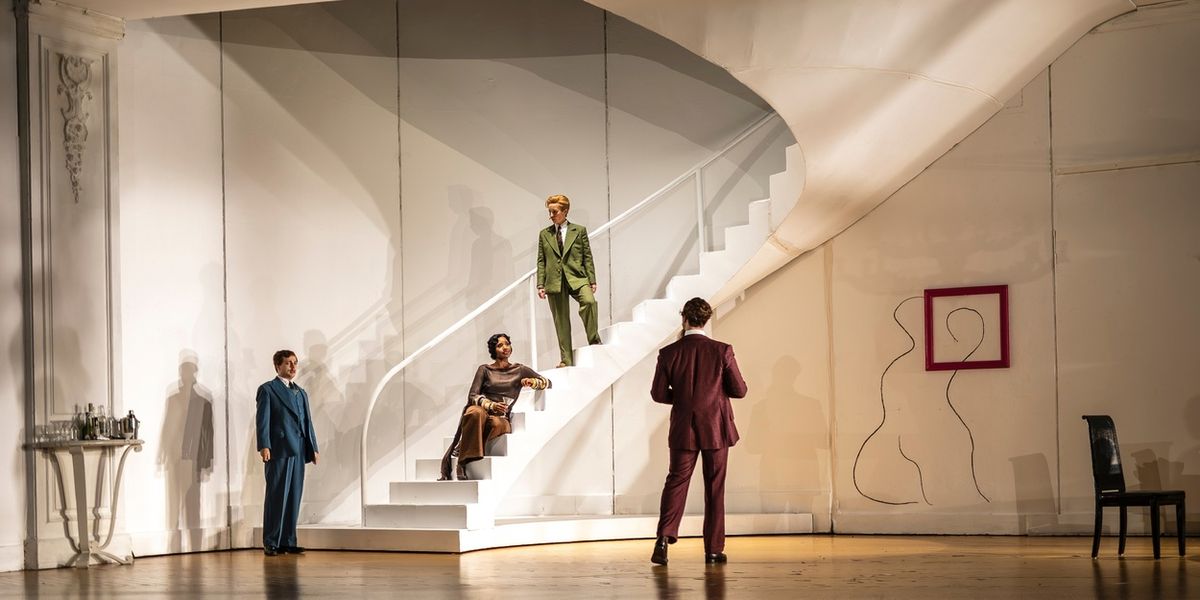
Indeed, much of Andrew Lieberman’s production design, first seen in 2008, is inspired by the surrealist circles which Man Ray inhabited. Sometimes this adds to the drama’s ambiguity, as vintage studio lights cast long silhouettes of the cast on the expansive white walls, just as the romantic web starts to thicken in the second act.
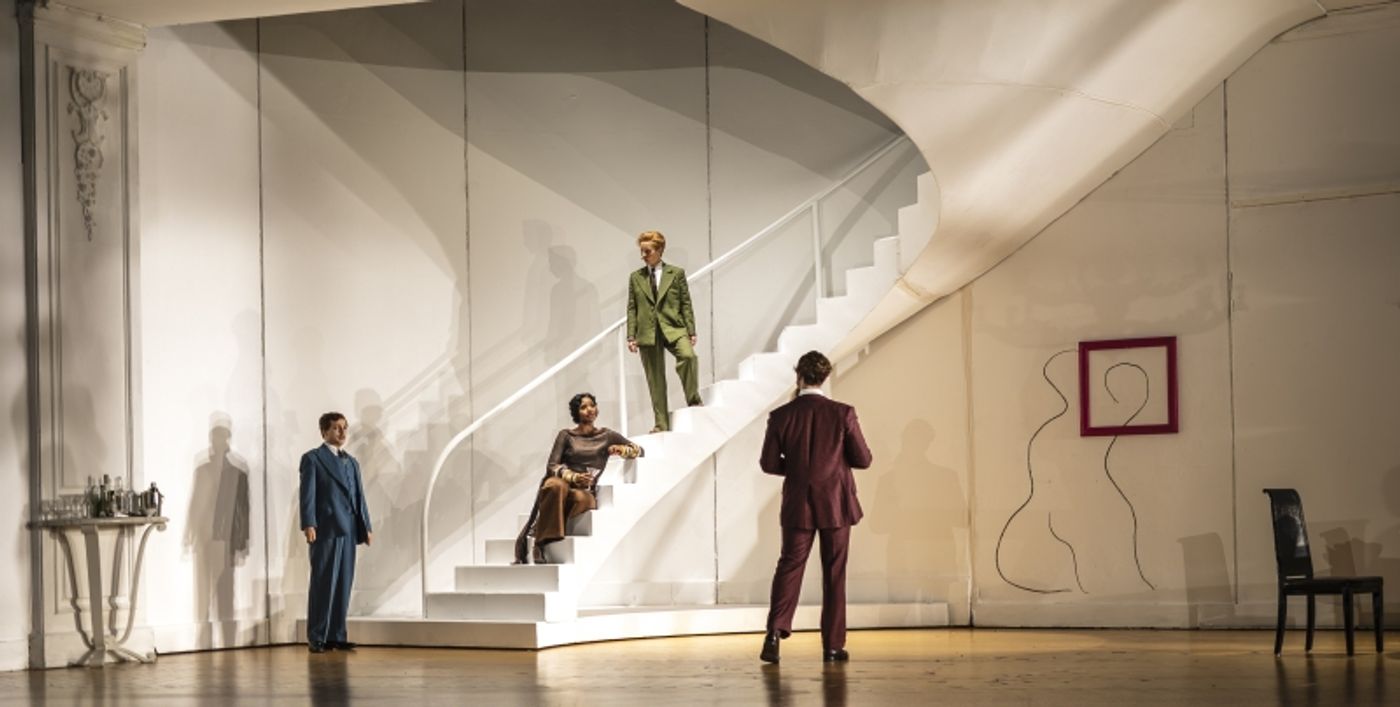
Photo credit: Lloyd Winters
But more often than not, the surrealist touches – a hat moving by itself, or a character buried in toilet paper – feel like an afterthought to make our period setting more obvious. The interesting notion of Emilio as a photographer, constantly scrutinising the characters and holding up a mirror from the outside, gets abandoned once he has a greater role to play in the plot.
More effective is when Christopher Alden’s direction lets this stellar cast speak for itself. The opera’s subtle, ever-shifting relationships really come to the fore when the singers are left to sing and act without any visual distraction. By far the most effective set piece is in the first act, where the cast hash out their initial grievances on a blindingly white staircase, which serves both as an unassuming canvas for quiet confessions of love, and an occasional vehicle for slapstick.
Partenope sometimes struggles under the weight of the period setting it seems to have arbitrarily imposed, visually compelling though that setting is. Seventeen years on from this production’s premiere, though, there is still substance to match the style.
Partenope plays at the London Coliseum until 6 December
Photo credits: Lloyd Winters



Reader Reviews
To post a comment, you must register and login.