


Review: AKRAM KHAN'S GISELLE, London Coliseum
English National Ballet's signature work celebrates ten years
It’ s only four days since the sugar rush of Aaron S. Watkin’s Nutcracker wrapped up a run of forty performances. Frothy and colourful, it is in stark contrast to Akram Khan’s Giselle, a work nearly ten years old that is the closest thing the company has to a signature work. It has toured across several continents since then and only improves with every viewing, each time more absorbing than the last, each detail more acute. T
he hypnotic choreography, the sincere storytelling sits within the bones of these dancers, and their full commitment to the work goes a long way to making this such a modern masterpiece.
Bleak and dark, Khan’s version is set within a community of migrant factory workers (the Outcasts), their environment confined by a dense and imposing wall that separates them from a life beyond. The factory has closed, restless and discontented, the group functions only as entertainment for the Landlord and his wealthy family. You won’t find any jolly harvest shenanigans here.
Beyond the central performances, the mechanical unison of the corps de ballet and Vincenzo Lamagna clanking score that crackles with tension, it’s an engrossing and fully coherent piece of work. The lighting, music and choreography all coming together to pack an emotional punch. The mood switching from thundering to lilting in a breath as we see Giselle and Albrecht fall is love under Tim Yip’s sunlit stage, they dance a pas de deux that wanders tenderly across the stage.
Emily Suzuki starts out as a swaggering Giselle, full of vitality and zest before she is so cruelly wronged by James Streeter’s conflicted Albrecht. In an early scene, the Outcasts dance between them, forming a barrier to keep them separate, they jump and run to catch one another, playful as they go. Suzuki is fuelled by love, floating above the action and the heaviness of the other Outcasts. She’s a gutsy, gritty Giselle with little regard for authority.
Later, she is brittle and broken from her turmoil. In the mad scene her body spasms, ugly and angular, pulsating with grief, before she is finally revealed lifeless in Hilarion’s arms against the imposing revolving wall. She gives an engaging performance but can still afford to go bigger in some of the key choreographic moments, when Lamagna’s score is at its most climactic.
Ten years ago, I remember finding the long moments of silence awkward and frustrating, but it’s clear now they are heavy with drama, which has no doubt been honed over time. There is never quite silence; a fizz or a crackle wracks up the tension, the crash of a wave gives a vivid reminder of the outside world, all evoking a cinematic quality.
Ken Suruhashi is a dynamic and agile Hilarion (Giselle’s would-be-lover), sharp and instinctive. In a predominantly still opening scene, his sudden jerky, urgent movements are striking, taking easy command of the stage. Later he is full of bluster and bravado as the Outcasts dance for the Landlord.
Isabelle Brouwers remains an ice-cool Bathilde (Albrecht's intended), a role she knows well. The entrance of the landlords is perhaps one of my favourite scenes in a modern ballet. So uncomfortably slow, the costumes so ostentatious, (the landlady’s dress always stealing the show). Brouwers has mastered the posture and stage presence of the regal role. I love the knowing way she drops her glove in front of Giselle and how she commands attention with just a tilt of her head.
All this and arguably it’s the corps de ballet who are the stars of the act with fast and furious feet in the repeated fast skips across the stage, before breathing as one in the mournful mad scene, they envelop Giselle in a blanket of sorrow. A word too for Giselle’s friends who lead the pack expressively, Carolyne Galvao’s small but spritely figure is the pick of the crop.
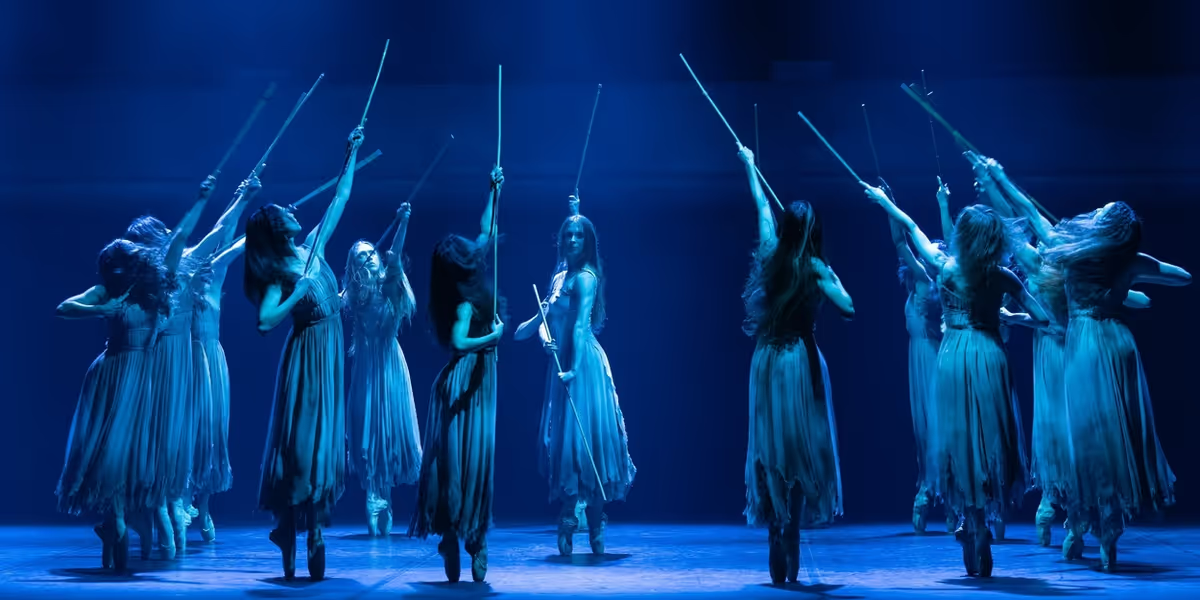
Act II is less impactful, more eerie and affecting, with the vision of ghostly Wilis (workers seeking revenge). We see less momentum than before the interval but the image of these women all bourréeing en pointe in unison, striking their canes with their hair wild is pure horror that lingers long in the memory. The storytelling, for my money, is not as lucid as in Act I but the key moments are all there. The Wilis’ brutal disposal of Hilarion, and the final image of Myrtha (an ethereal but no nonsense Emma Hawes) guiding Giselle away from Albrecht into darkness is still a quietly devastating conclusion.
English National Ballet have revisited Khan’s Giselle many times over the last ten years and surely will again in the next ten. It may not be for everyone, the darkly lit stage and unique soundscape will be quite the jump for ballet purists, but you’ll struggle to find a more creative and exhilarating evening of dance drama than this.
Akram Khan's Giselle runs at the London Coliseum until 18 January
Photo Credit: ASH
Sign up for all the news on the Summer season, discounts & more...







Reader Reviews
To post a comment, you must register and login.