


Review: MAGDALENE is a Moving Portrait of Christianity's Infancy
Contemporary American Theater Festival's "Magdalene" is a Moving Play on Christian Themes
To be American is to be part of one of the most spiritual nations on earth—ironically, it’s also a nation where the institutional side of faith, actual temple- or church-going, seems to be on the wane. Perhaps this is because of our Constitution’s refusal to endorse a specific church, while other nations dictate your spirituality from birth.
Our singular history, some 235 years and counting, gives our playwrights a unique position from which to write about religious controversy. We’re free to create characters and alternative narratives without looking over our shoulders, without the baggage and dark history that comes with dogma and brick-and-mortar façades. We’re also free to humanize the controversies surrounding our faith, in ways that could get us into serious trouble elsewhere.
Mark St. Germain, whose “The Happiest Man on Earth” explored the remarkable life of Holocaust survivor Eddie Jaku at least year’s Festival, has returned with a thoughtful examination of the roots of Christianity. (You know, that notorious offshoot of the Jewish tradition, whose history has been littered with mistakes, with centuries of brutal dogma, leavened occasionally by miracles of light.)
It’s no small task, taking on Christianity’s formative years, and portraying the people at its heart as three-dimensional, warts and all. And yet St. Germain succeeds brilliantly with “Magdalene,” offering his own take on Peter, the Church’s founder, and one of Jesus’ most devoted disciples, Mary of Magdala (hence her name). Director Elena Araoz creates a two-character drama that is rife with tension at once personal, intensely personal, and spiritual, always reaching beyond the limitations of the moment to something beyond its characters’ grasp.
St. Germain has us focus on two pivotal figures from Christianity’s birth, and posits a testy relationship between the two of them as polar opposites—one male, one female; one tasked with organizing Christian Jews into a distinct religion, the other furious about what has been done to her own reputation, and to her mentor Jesus’ teachings, barely one generation after His crucifixion, resurrection, and ascension/return to Heaven.
But first, a note to the uninitiated, un-cathechized and perplexed: if my description of the characters which follows seems bit above your paygrade so to speak, try not to be deterred. Christians, to be frank, can be just as clueless about their own tradition, and the tradition’s founders, as anyone else can be with theirs. It is a tradition that is remarkable precisely because of the diversity in understanding that ultimately defines the tradition—or traditions, to be more precise. St. Germain reminds us that in the end it’s not the dogma or the formulaic confessions, so much as the way Christians are meant to live, to ‘bear witness’ so to speak, that matters most.
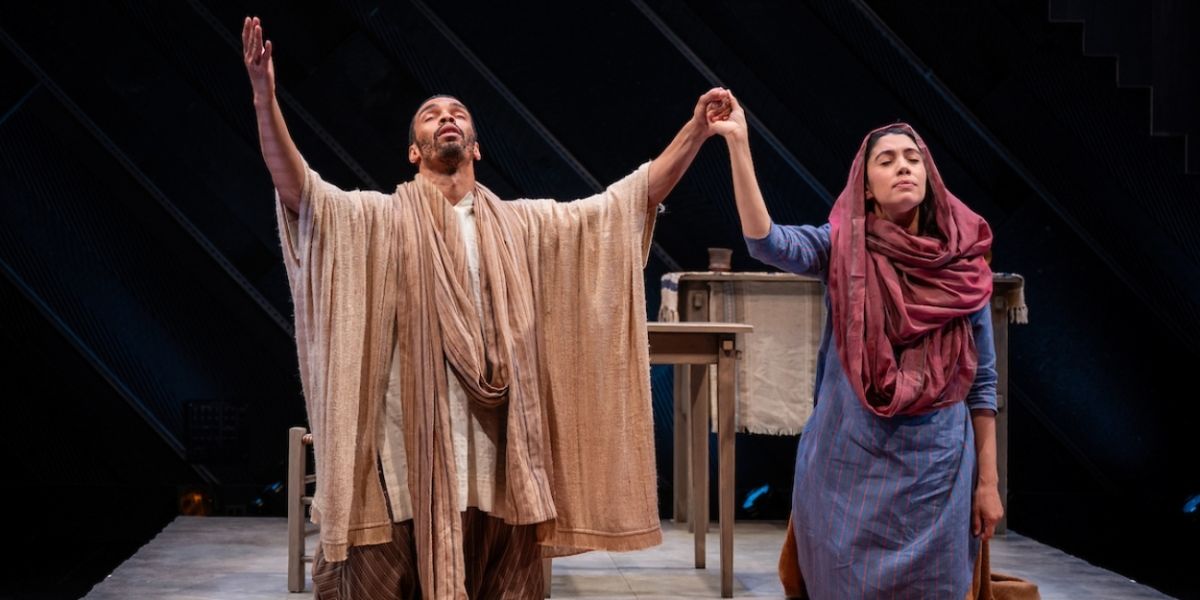
Sam Morales’ turn as Mary is a welcome corrective; often portrayed as a whore, the sources describe her as one of Jesus’ closest followers. Morales gives us dignity and spiritual conviction that is as firm as it is little known. It is only recently that Mary Magdalene’s reputation as a disciple has been restored, and we get to see a woman whose fury at slander is leavened by a profound understanding of her mentor’s message. The play also gives St. Germain an opportunity to revisit the scandal caused by Dan Brown’s notorious fictional novel “The Da Vinci Code;” his solution to Brown’s conspiracy theory creates an opportunity for Morales to offer yet another version of her rich, complex story.
As Peter, meanwhile, Julian Elijah Martinez gives us a man who seems trapped by the culture and pressures of his time. That Peter has to deal with Paul’s (revisionist?) approach to Jesus’ teachings is only one of his challenges, because he must also make amends with Mary Magdalene, after rejecting her some years before. Martinez gives us a complex Apostle, one who betrayed Jesus in His hour of need, but who now must make amends by laying out the founding principles of a spirituality even he only dimly understands. St. Germain’s version of Peter is a man who isn’t so much haunted by doubt as one made awkward by his realization that he might not fully appreciate Jesus’ message.
Christopher Vergara’s costume design is by turns simple and elegant, portraying as he does two towering figures from Christian antiquity, decked in simple layers of cloth, each humble in their own way. And Harold Burgess II’s lighting design is simple as well, but allows for one brilliant tableau at the play’s conclusion.
“Magdalene” is likely a play that will see numerous productions, given the times and the need for religious communities to break bread and try, in some way, to understand each other. You should definitely take time out this July to see this remarkable reflection on two of Christianity’s most pivotal figures.
Running time: 80 minutes, without intermission.
Production Photo: Julian Elijah Martinez (Left) and Sam Morales (Right). Photo by Seth Freeman.
The 2025 Contemporary American Theater Festival will run from July 11 through August 3, on the campus of Shepherd University in nearby Shepherdstown, West Virginia.
For tickets call 800-999-CATF (2283), or 681-240-CATF (2283) or visit:
www.catf.org.


|
Misery Aldie Mill Historic Park (8/20-8/30) |

|
Little Shop of Horrors 40th Anniversary Tour with Ellen Greene (the Original Audrey) Lincoln Theatre (9/25-9/25) |

|
Keyboard Conversations® with Jeffrey Siegel: Glorious Musical Jewels – Beethoven and Schubert Center for the Arts (10/11-10/11) |
|
Measure for Measure Folger Shakespeare Library (9/22-11/01) |
|
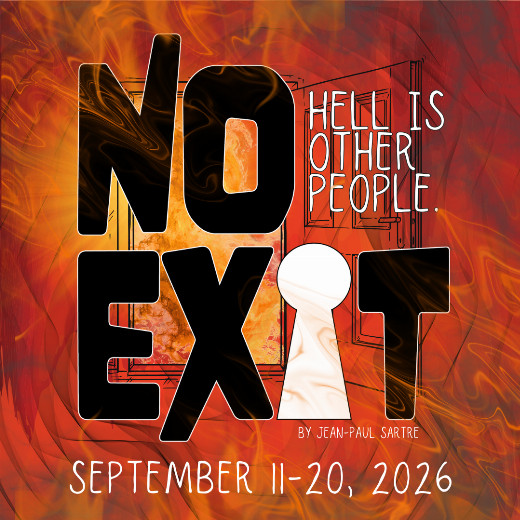
No Exit by Jean-Paul Sartre ARTfactory (9/11-9/20) |

|
Murder at the Mansion presents "Funeral for a Gangster" Glenview Mansion (11/06-11/08) |
|
Harry Potter and the Sorcerer's Stone in Concert Wolf Trap (8/27-8/27) |

|
Natural History Mosaic Theater Company (1/21-2/07) |

|
Dracula's Midnight Masquerade George C. Marshall's Dodona Manor (10/16-11/01) PHOTOS VIDEOS |
|
The Comedy of Errors Folger Shakespeare Library (5/18-6/27) |
Reader Reviews
To post a comment, you must register and login.