


Review: POETRY FOR THE PEOPLE at Fountain Theatre
A unique and inclusive opportunity to experience to the words of a remarkable individual
 Click for Tickets
All tickets are pay-what-you-can. Your program is actually a bookmark with a QR code. Upon entering The Fountain Theatre, you’re provided with a notepad and a pen which you are encouraged to put to use at points throughout the evening. “Whatever might come up, try not to judge yourself,” is an early instruction. “Don’t be afraid to experiment, be playful, have fun.”
Well and good, even if neither the space you have entered nor the vibe of the evening is what most would consider playful. Still, message received: this one – as the title suggests – is intended for all of us.
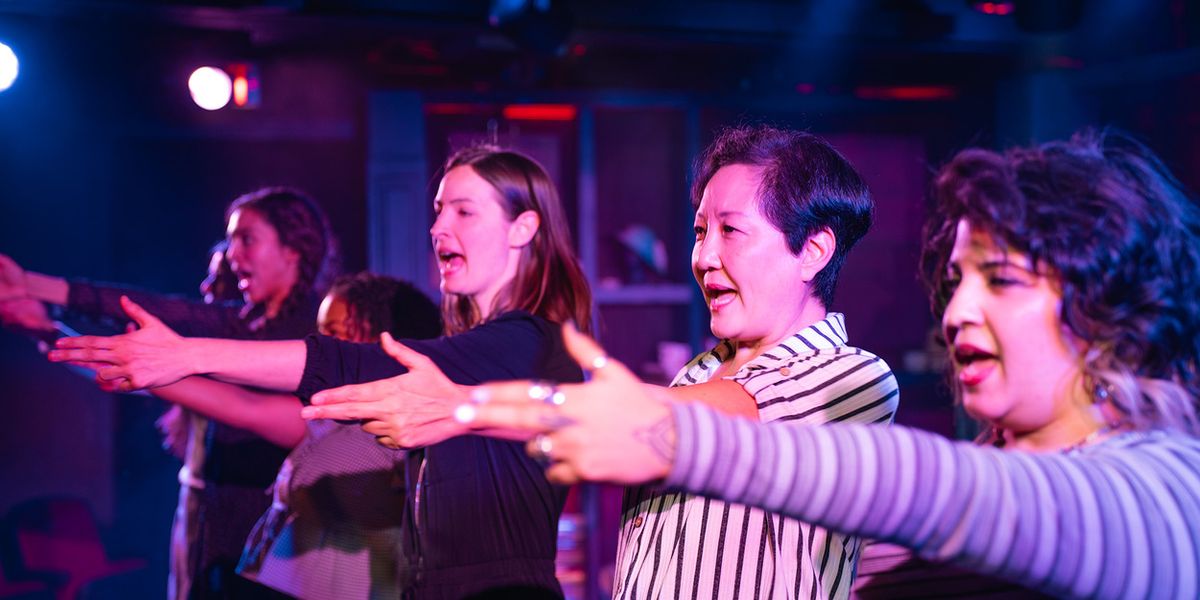
A mashup of a poetry workshop, a biographical tribute and dramatic enactment, POETRY FOR THE PEOPLE: THE JUNE JORDAN EXPERIENCE eases viewers into the life and activism of its subject and spends the ensuing 100 minutes celebrating this unique artist who was taken too soon. We commune with June Jordan (1936-2002) through photos, through her words (including archived speeches and readings) and through the six actors who trade off playing the poet and some of the key people in her life. To see a pioneering feminist, artist and civil rights activist interpreted by six women of assorted ages, ethnicities, and body types is to get the message that we are all storytellers and activists. Each of us has a June Jordan within us. And that pen and paper is available for those of us who want to get scribing even before we’re back out onto Fountain Avenue.
Co-developed with Jordan’s longtime partner Adrienne Torf, newly appointed Fountain Theatre Artistic Director Raymond O. Caldwell (who also directs) has structured POETRY FOR THE PEOPLE as kind of an all-are-welcome sit-in. The fact that the Bay Area-based Jordan spent her life speaking out against prejudice and inequality will land comfortably in 2026 Los Angeles, particularly at a progressively-minded venue like the Fountain. This is very much in their audience’s wheelhouse. How much people will go in for versifying - will probably vary. The encouragement is not pushy. During a Friday night performance amidst a very light house, several audience members eagerly wrote down ideas when prompted, and shared their writings. (Another play-goer, who had checked out, asked near play’s end, “Were we supposed to write something? I took a nap!”)
OK, but don’t go to sleep on America Covarrubias, Naseem Etemad, Kita Grayson, Mackenzie Mondag, Savannah Schoenecker, Janet Song, POETRY OF THE PEOPLE’s highly versatile ensemble members who pilot us – via speech and song - through Jordan’s career, biography and her words. And tuning out the heat and fury of Jordan herself isn’t even an option. Not someone who writes, (from “Poem About My Rights):
And before that it was my father saying I was wrong saying that I should have been a boy because he wanted one/a boy and that I should have been lighter skinned and that I should have had straighter hair and that I should not be so boy crazy but instead I should just be one/a boy.
Or, from “Song of the Law-Abiding Citizen”
TRUCKS CRUISIN’ DOWN THE AVENUE /CARRYING NUCLEAR GARBAGE RIGHT NEXT TO YOU/AND IT’S LEGAL/IT’S RADIOACTION RIDIN’ LIKE A REGAL /LOAD OF JEWELS PAST THE BARS THE CRUEL/SCHOOL HOUSE AND THE CHURCH AND IF/THE TRUCKS WIPEOUT OR CRASH/OR EVEN LURCH TOO HARD AROUND A CORNER/WE WILL JUST BE GONERS.
These are words that both sing and challenge. If, like this reviewer, you were not previously acquainted with June Jordan, POETRY FOR THE PEOPLE is a crackling introduction.
The scenes are structured around a period or theme of Jordan’s life. There’s her girlhood where, as the daughter of a Jamaican immigrant, she is subjected to abuse from her father for not thinking sufficiently deeply enough about THE MERCHANT OF VENICE. There’s her musical work with Sweet Honey in the Rock. The activist Fannie Lou Hamer was an influence and a maternal figure, and later we hear from several famous women from different social spheres enter her life. We follow Jordan into classrooms, through protests to her collaboration and relationship with composer Torf to the creation of play BANG BANG UBER ALLES and ultimately to the post-it filled instructions of what music she wants played at her memorial
Whatever the context, Jordan’s poetry is forceful, hugely angry and still very timely whether delivered (or sung) collectively by the performers or by Jordan herself whose recitation - at least in the sampling we are given - is decidedly lower-key than the actors.
The action is set in a replica of Jordan’s home (designed by scenic and lighting designer Matt McCarren , with book and bric-a-brac-lined shelves, a keyboard and video screens which show photos of Jordan at various times of her life (Deja Collins is the media designer).
From its mission to its special events including poet spotlights and community conversations, everything about this experience feels like it’s pitched toward inclusion and accessibility. Including and especially the ticket prices. The Living Ticket Model, as the program explains, has the organization laying out what the production costs - $94,000, meaning $2,851 per performance, and that the Fountain would need to charge $50 per ticket and get 75% capacity to break even. But in the spirit of “radical inclusion” and unity, audiences get to name their own ticket price, paying what they can afford.
That’s some food for thought along with an experience worth sharing.
POETRY FOR THE PEOPLE: THE JUNE JORDAN EXPERIENCE plays through March 29 at 5060 Fountain Ave.
Photo of Mackenzie Mondag, Kita Grayson, Savannah Schoenecker, Janet Song,
and Naseem Etemad by Areon Mobasher.

Sign up for all the news on the Fall season, discounts & more...
|
CLUB27 Jaxx Theatre (10/01-10/30) |

|
Crone Creed El Portal Theatre (9/30-10/17) |

|
The Cottage North Coast Repertory (10/28-11/22) |

|
Woof Odyssey Theatre (10/03-11/08) |
|
A Killer Night in Studio City Vitello's (9/06-10/31) |

|
Adam Pascal Feinstein's at the Nikko (10/23-10/24) |
|
CHAÏR The Elysian Theater (10/17-10/17) |

|
Catch Me If You Can Colony Theatre (9/17-10/18) |
|
EVITA Valverde Annex (10/17-10/25) |

|
Magic at the Biltmore with David Minkin The Biltmore Los Angeles (3/28-3/28) PHOTOS |

Reader Reviews
To post a comment, you must register and login.