


Interview: Cast And Director of A NICE INDIAN BOY at Shunya Theatre
A romantic comedy for today’s Desi diaspora.
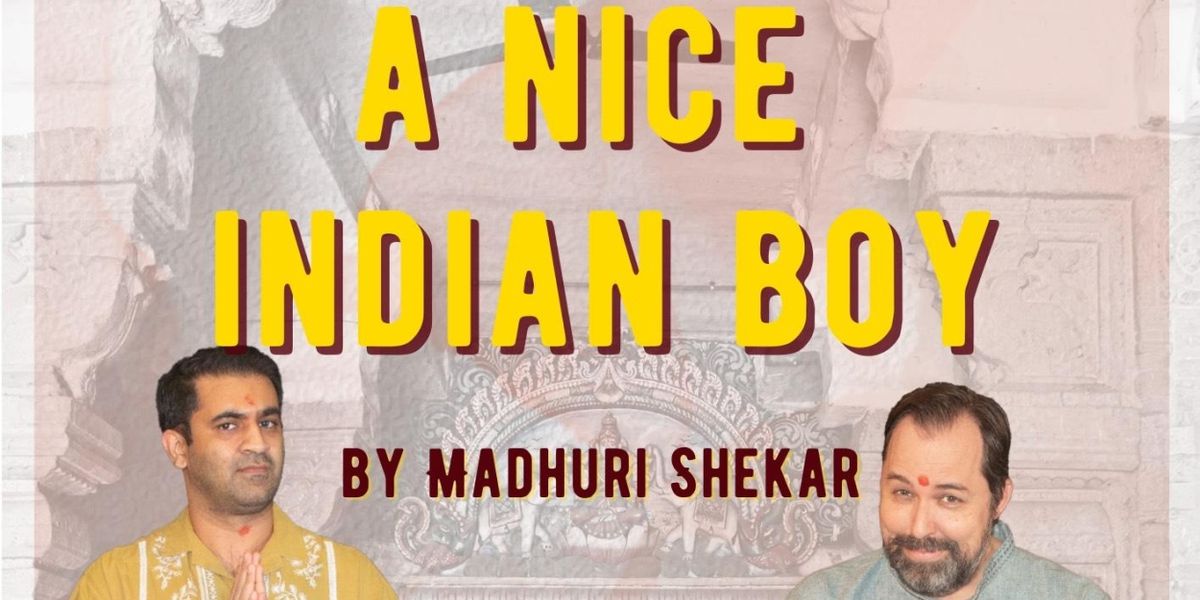
Broadway World writer Brett Cullum was recently joined by two members of the cast and the director of A NICE INDIAN BOY. It is a show presented by Shunya Theatre that will be at the MATCH complex from April 10th through the 13th. The play's premise is that a meet-cute at a temple results in a romance between Naveen Gavaskar and Keshav — a Hindi-speaking, Bollywood-loving man who happens to be white. As the love story unfolds, the Gavaskar household must also brace itself for the return of Naveen's older sister, Arundhathi. The play is by Madhuri Shekhar and is a heart-warming romantic comedy set in today's South Asian or Desi Diaspora.
Brett Cullum: This sounds like a cute little romantic comedy. So, how did you all get together to make this production at the MATCH?
Anjana R. Menon: In November 2015, we actually did this play as a reading at Spring Street Studios. It was me directing it, and at the time, I cast Taher in the role of Naveen. We had worked together on a production also with Shunya Theatre, and I happened to be looking for a white man to play the role of Keshav. Deeba Ashraf, who played the role of Megha in the reading, recommended John to me. I remember thinking back then that if I had a chance to direct this as a full-length production, I would. And well, it happened. Yaksha Bhatt, who is the artistic director of Shunya, mentioned to me that there was a chance that this was coming back as part of Shunya’s comeback into the Houston Theater scene.
Brett Cullum: Good. Well, tell me about the Shunya Theatre. I'm not familiar with the company. Tell me about their mission and how long they've been around.
Anjana R. Menon: I think 2002 or 2003; I can't remember offhand. But like the early two thousands. It was founded by a gentleman called Soham Mehta, who has now since moved on to make movies. The objective was to bring South Asian theater to the diaspora audience. Over the years, the company has brought a number of different productions to Houston that have served the South Asian diaspora in many different ways. There was a bit of a hiatus because Harvey happened first, but it was where THE WAITING ROOM was scheduled to go up the week that Harvey happened. And when they were ready to recover, Covid hit—so, little bit of bad luck. But I think with this play, there really isn't a better chance or opportunity to return. Here we are, fingers crossed!
Brett Cullum: I've got my fingers crossed, and it's an interesting time to bring this play to Houston because the writer, Madhuri Shekar, is known for her Bloomhouse movie called EVIL EYE, which was based on an audible drama that she did. She's written for the Netflix series THE THREE BODY PROBLEM and THE NEVERS. I mean just an incredible writer. She worked on SISTER ACT 3 for Disney and is a star on the rise here.
John Dunn: I didn't know that
Brett Cullum: And then this one, A NICE INDIAN BOY, is being adapted into a film starring Jonathan Groff and Karan Soni. And what's weird is it's debuting in the US this month after traveling around and doing a lot of film festivals. And the movie actually has a hundred percent rating on Rotten Tomatoes so far, so that bodes well for your script!
John Dunn: Well, we held off. We held off on watching the trailer for it because we didn't want to be influenced by it, but I think some of us sneaked a look, and it actually seems to be very different from the stage script. There are things that are sort of more fleshed out, perhaps, and slightly different situations. So I think seeing both would probably be a good approach because it looks like they might complement each other in that way
Brett Cullum: So Taher, tell me how you got involved in this production. We that John Dunn was cast by word of mouth and was obviously pulled in as a referral. How did you end up here?
Taher Lokhandwala: Anjana and I were castmates in another one of Shunya's productions. That's when I got to know her, and I did the reading. Strangely enough, I had a somewhat longer hiatus than Shunya. The last thing I've actually done in Houston from a theater standpoint was this play reading. I actually haven't done anything for about a decade on stage. But Anjana was remaking this and was like, “Hey, would you be interested in doing this by chance?” And I was like, “I haven't fed this part of my soul for a very long time, and this felt like a “stars aligned” kind of moment. I was so grateful that she called me. I jumped at the opportunity to get involved. And it's truly been fantastic! For anyone reading who has a creative soul, it's important to feed that from time to time.
Brett Cullum: Oh, we love a good comeback story! John, your character has to be a Bollywood fan. Were you a Bollywood fan before you entered this production?
John Dunn: I have seen maybe a couple of Bollywood movies prior to this, and in part of the preparation for this play, I watched yet another one called Dilwale Dulhania Le Jayenge, which is often shortened to DDLJ. This is a movie that has been playing constantly for thirty years now. It is still showing in Mumbai! It is a 3-hour-long romantic comedy and Bollywood film. It has great music, which we play throughout the show. My character references this show and the music, and some of the situations in the play, I think, were inspired by events and themes in the film. This is a beloved film throughout the Indian diaspora. I ran into some neighbors of mine and mentioned I was doing the show, and I mentioned DDLJ. And they were like, “Oh, okay, we have to see that!” It's a phenomenon.
How I came to be associated with Shunya was that years ago, I was doing a 24-hour play festival called Madcap 24, and I reached out because I wanted to involve people from different theaters who maybe hadn't worked together before. And so it was kind of an excuse to do a 24-hour setting of theater and just have people run in, write a script, learn the lines, and then go up the next night. I reached out to Sanjay Mehdiwala at Shunya and started bringing people in to act on that. Later on, I did a show called CHINGLISH in 2013, where I was a white man living in China who had to speak Chinese. The majority of my lines were in Mandarin. So that was a show where I met Deeba, who had seen that show. She told Anjana, “Oh, well, maybe you should look at him. He's the white guy who does all of the Asian things.” So that's apparently become my brand, perhaps.
Brett Cullum: I always thought YOUR brand included dancing cockroaches and figures from the Texas legislature.
John Dunn: Right. That's me; that's my Tamarie Cooper thing. The surprise is the role I've played the most in theater is Jesus in various forms.
Brett Cullum: Well, what does this one offer? We're looking at some South Asian traditions and things like that. Do we get into the culture?
Anjana R. Menon: I would say so. Yes. The opening scene is at a temple. It's a cultural immersion at that point. There are a lot of references to the movie DDLJ. You are in the parents' living room as well. It's a typical South Asian family in the Bay area. I really don't know how to describe it more than that.
Brett Cullum: Does that spark the dramatic conflict? What's the center core thing? I'm imagining this possibly has to do with you guys as a couple.
John Dunn: There are so many things. But go go ahead, Taher. I think you had something…
Taher Lokhandwala: I think it is. I think that's one of the central tensions. Keshav’s character really embodies an interesting tension in terms of who he is. What he looks like versus how he feels. I think there's tension between Naveen and Keshav as a result of that. But I think, yeah, I think it embodies so many like unique distinct experiences, the queer experience, the South Asian experience and intergenerational immigrant experience. There are so many of these wonderful, rich, layered themes that Madhuri brings through just really, really artfully if you relate to even one of those groups or even none of them. There are human elements in there that you can fall in love with very easily.
John Dunn: It struck me how there are those crossovers between these various identities that are sort of vying for position in the play, trying to find who you are, trying to find your identity and your authenticity, and what it means to you is something that's pretty much common throughout all of the characters, but they're all coming at it from different directions. It's very layered. There are some lines in the play. If you step back from them and think about them, they can be really sad or really dramatic. I mean, essentially, it's a romantic comedy on paper. If you pull any of these lines out occasionally, you're like, oh, that person really hurts. That person really wants something, and that's what I really love about the playwright's approach to this is that she's really made these dynamic characters, and from the get-go, when they're in any scene together, they are going for what they want.
Brett Cullum: I love the fact that this is going to be so universally appealing because I know that when I looked at Shunya Theater at first, I thought, “Oh, this is for a specific audience,” but it sounds like you've got the capability to really have a broad group come in and all relate and enjoy it. But obviously, the South Asian group is going to understand some of the references and some of the situational things.
John Dunn: Well, and Shunya doesn't only do Indian plays like they did John Patrick Shanley's ITALIAN AMERICAN RECONCILIATION.
Anjana R. Menon: Yeah, yeah, we did ART in 2012. It's for the South Asian audience, but it's also for the South Asian creators. But it's for those of us who actually live here who have a life that is not confined or contained within South Asianness. With this play especially, you don’t have to be South Asian or have a South Asian loved one to be able to come in and enjoy what's actually happening on the stage.
Brett Cullum: And Anjana, you're the director. What else have you directed?
Anjana R. Menon: No, so this is my directorial debut! Other than the fact that I did direct the reading of this. But you know that, does that really count? Maybe not. Maybe it does. I made my start with Shunya Theater in the Houston theater scene in 2011 with a play called THE PROPHET AND THE POET that was directed by Yaksha Bhatt, who is now the artistic director of the company and so, in a way, this is kind of full circle that I debuted on stage with Shunya, and now I'm debuting as a director with them. But you may have seen me in other productions around Houston.
John: But I will say, some of the members of Shunya have gone on to other things. Karthik is doing movies in India now. So we've got such an interesting range of experience here in this community. Shiva Juturi, who plays Archit in the play, his parents were actors, and he had always dreamed about getting into Hollywood films. He's had small roles. So yeah. It's interesting to see what people bring to the table. I have really loved being in the room. In our company here we have what? Something like eight different languages spoken and four different faiths. Everybody brings such interesting insights to the experience, and it's fun. The really funny part is where you know we'll have the Indian experience being shared. And then Taher and I will be like, “Okay, well, in gay culture, this would never happen.”
Brett Cullum: Great. I love the idea of all of these mashups, and they seem to be a hallmark of Houston Theater right now. I mean a lot of diversity and a lot of cultural and queer identity. Everything gets kind of thrown together, and you just see what comes out of all of it. So I'm very excited about this one. I am so glad that I've already got my tickets and everything! I want to warn everybody. It's the MATCH and only April 10th through the 13th. This is a fast run! It's Thursday through Sunday and runs about an hour and 40 minutes. And you actually have an intermission. Thank you.
John: Intermissions are an endangered species.
Brett Cullum: They really are.
Anjana R. Menon: I also don't know if maybe we need the intermission more than the audience!
John Dunn: I will plead with everybody to get your tickets soon because all the aunties and uncles are showing up! Matchbox One is a small theater. So please, please get your tickets as soon as you can.
|
Jesus Christ Superstar Deluxe Theatre (8/14-8/17) |

|
Therapy Gecko Punch Line Houston (9/20-9/20) |
|
Frankenstein Pearl Theatre (10/30-11/02) |
|
Disney's The Little Mermaid Theatre Under The Stars (12/08-12/24) |
|
AC/DC NRG Stadium (8/31-8/31) |

|
The Who's Tommy Theatre Under The Stars (2/02-2/14) |

|
Come from Away Stages (9/18-10/18) |
|
An Old-Fashioned Family Murder Theatre Southwest (9/11-10/03) |
|
Ride the Cyclone HITS Theatre (8/16-8/16) |
|
PROOF 4th Wall Theatre Company (9/11-10/03) |