


REVIEW: The Festival d'Avignon Presents LES PERSES By Gwenaël Morin
When the Festival spotlights a language as underrepresented in European cultural institutions as Arabic, it must do so with commitment.
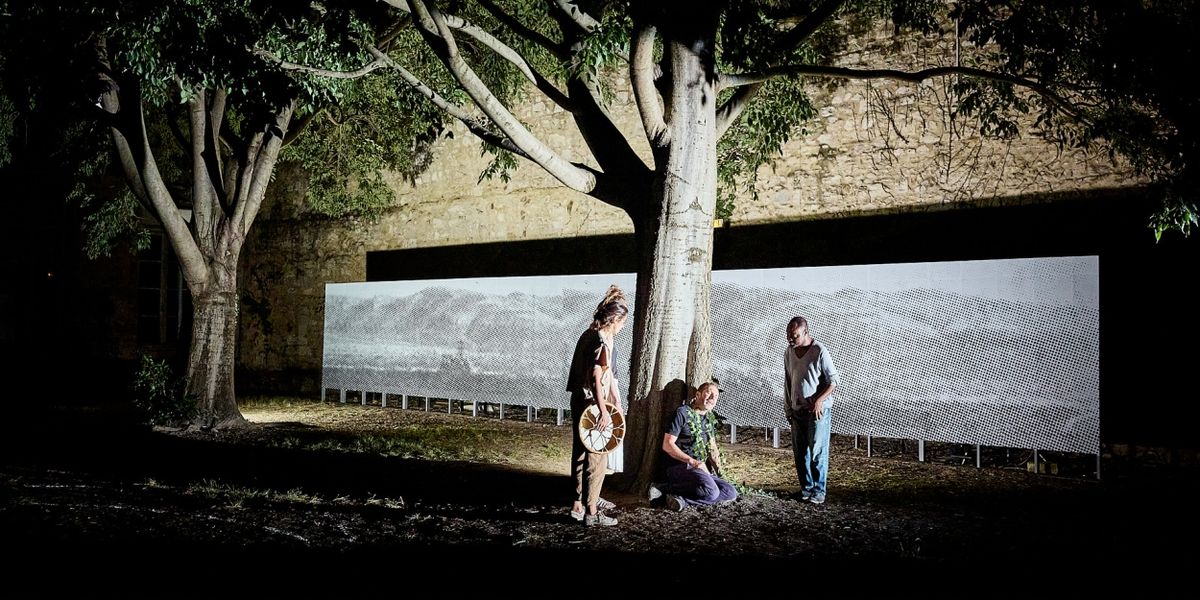
From 2023 to 2026, Festival d’Avignon artistic director Tiago Rodrigues has invited director Gwenaël Morin to stage an annual production under the banner Démonter Les Remparts Pour Finir Le Pont / Dismantle the Walls to Finish the Bridge. Each installment is meant to respond to the Festival’s “invited language” of the year. In 2023, the language was English, and Morin adapted A Midsummer Night’s Dream. In 2024, it was Spanish, and he presented Don Quixote. For 2025, the invited language is Arabic, and Morin has chosen to stage The Persians by Aeschylus. Notably, there is no mention of the Festival’s host language in the description of this initiative. What results is a missed opportunity in a well-played but under-conceived production.
Morin stages his annual work in the garden of the Maison Jean Vilar. Behind the audience seating stands the imposing edifice of the Palais des Papes. A church steeple glows behind the garden wall, and trees drape a natural canopy over the dirt playing space. It's a divine setting for an evening of theatre. On the ground, Morin has drawn two large, intersecting chalk circles. Four performers then enter. Morin met these local performers through community workshops in Avignon. They walk the chalk outlines in a slow, rocking rhythm, embodying the pulse of the poetry. Then they advance downstage, and a performer drums a steady beat. They speak the choral text in unison, a challenging and unforgiving choice, and one that occasionally falters under the strain of its difficulty.
The narrative is faithful to Aeschylus: Atossa, Queen Mother of Persia, awaits news from the war in Greece led by her son, Xerxes. Haunted by a dream foretelling defeat, she receives word of the Persian navy’s devastating loss at Salamis. She raises her late husband, Darius, from the underworld, who denounces Persia’s arrogance before the gods. Xerxes finally returns, broken and shamed.
The staging gives space to the texture of Aeschylus’s language, and Philippe Gladieux’s chiaroscuro lighting highlights the raw performativity of the tragedy. As Atossa, performer Julie Palmier has been given the most to do and makes the most out of it. She channels the pathos of a grieving wife and mother through the poise of a wise queen and commands the audience’s attention throughout. The rest of the ensemble offers strong turns. Gilféry Ngamboulou’s Xerxes is sensitively humbled. Jeanne Bred delivers the messenger’s account with compelling clarity. Fabrice Lebert imbues Darius with quiet weight. Yet for all this, the elements never fully cohere. The result feels more like a polished workshop than a finished production. Don Quixote and Midsummer welcomed a more forgiving and playful touch, The Persians demands precision, and that precision is, at times, absent.
The choice to stage The Persians reflects a broader tension in this year’s Avignon program. While Arabic is the “invited language” and several works incorporate Arabic theatre, it remains marginal to the Festival's programming. This omission is underscored by the two major events at the Festival's main performance space, La Cour d'Honneur: Nôt by Cape Verdean artist Marlene Monteiro Freitas, which I enjoyed, was elusively inspired by 1001 Nights; and soon it will host the Comédie-Française’s eight-hour staging of Claudel’s Le Soulier de Satin, arguably the most quintessentially metropolitan French evening of theatre imaginable.
When the Festival spotlights a language as underrepresented in European cultural institutions as Arabic, it must do so with commitment. The opportunity to stage work by Arabic artists is an opportunity for all, including audiences, and those projects which veer from this theming should only manage to do so through their irrefutable quality.
Photo Credit: Christophe Raynaud de Lage / Festival d’Avignon
Recevez l'actualité de Broadway sur WhatsApp
Recevez les dernières mises à jour, les nouvelles de dernière minute et une couverture exclusive directement dans l’application.

|
DE LUMIÈRE TH DU ROND POINT -SALLE JEAN TARDIEU (10/02-10/10) |
|
|
UBU ROI THEATRE DE PARIS (9/16-10/25) |
|
|
MERCI DE VOTRE COLLABORATION TH DU ROND POINT-SALLE RENAUD BARRAULT (11/04-11/14) |
|
|
LES ROCHAMBELLES THEATRE MICHEL (9/25-10/25) |
|
TEAM BUILDINGUE, LA COMÉDIE MUSICALE - TEAM BUILDINGUE La Scene Parisienne (9/29-11/24) |
|
|
HISTOIRES DE CREVETTES TH DU ROND POINT-SALLE RENAUD BARRAULT (9/18-9/27) |
|
|
LES ODYSSEES DE JULES VERNE RADIANT - BELLEVUE (3/14-3/14) |
|
ROMEO & JULIETTE PALAIS NIKAIA DE NICE (3/17-3/19) |
|
STEPHAN EICHER TH DU ROND POINT-SALLE RENAUD BARRAULT (9/30-10/04) |

|
ORLANDO TH DU ROND POINT -SALLE JEAN TARDIEU (1/27-1/30) |