


REVIEW: The Festival d'Avignon Presents LE SOULIER DE SATIN By La Comédie Française
The doing of this play is not in its writing but in its performance.
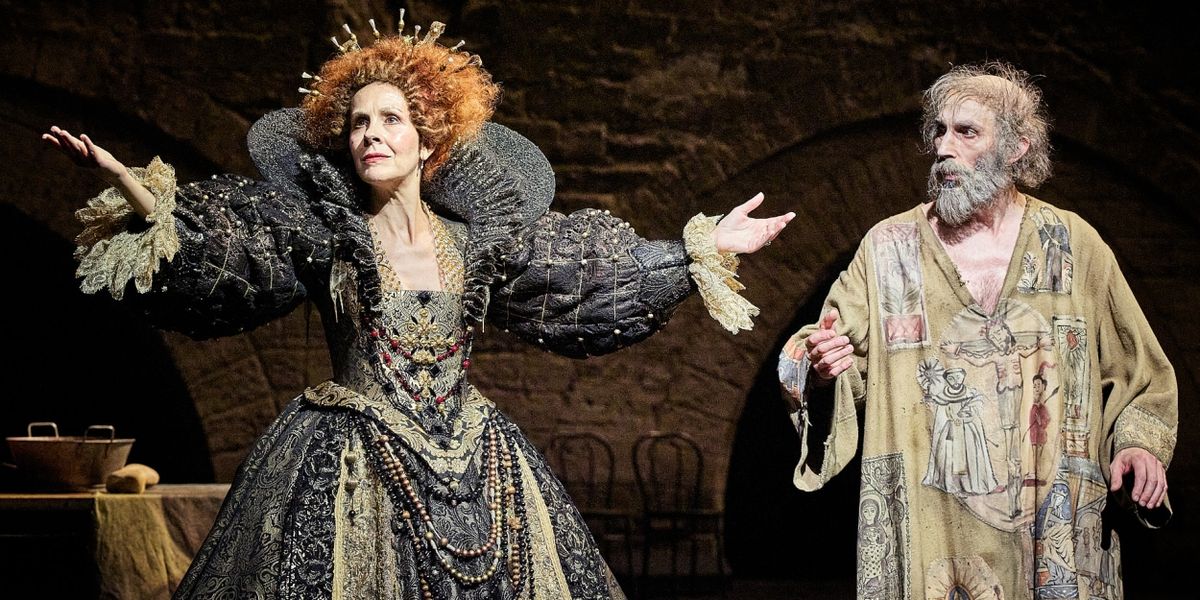
Since its founding in 1947, only a handful of performances at the Festival d’Avignon have achieved mythic status. These productions offer their audiences bragging rights for life as “you had to be there” events. Among them, the Comédie-Française’s 1987 production of Le Soulier de Satin has enjoyed an especially long shelf life. Now, nearly forty years later, the company returns to the Cour d’Honneur with a new staging of Claudel’s eight-hour epic. As the audience takes their seats, a question lingers in the air: was the 1987 lightning in a bottle, or is there something essential about the harmony between this play and this space that renders the experience transformative?
While the 1987 production earns its place in history for its pioneering audacity, Éric Ruf’s enchanting mise en scène confirms that something elemental binds this play to this venue. The result is another rapturous evening of theatre.
Claudel wrote Le Soulier de Satin in 1929. It premiered in 1943 under the direction of Louis Barrault, also with the Comédie-Française. The play, even in its abridged state, stretches across eight hours and traverses genres, continents, and decades. Set in the era of the conquistadors, it follows Don Rodrigue and Dona Prouhèze, whose unrequited love affair spans a lifetime. Across four parts, or journées, they endure humiliations and triumphs, navigating a kaleidoscopic world. The result is part Odyssey, part Candide, part Forrest Gump. To tell the story such an unlikely scale, the play passes through Commedia clowning, Racinian monologue, Symbolist fantasy, Shakespearean psychology, and Brechtian meta-theatre.
To craft a Soulier of his own, Ruf reaches beyond 1987 to the work of Festival founder Jean Vilar. His scenography, a bare stage with exposed lighting, leans into the strength of Claudel’s language. Its dramatic power resides squarely in the hands of the actors. The Cour d’Honneur itself, so often a challenge for directors hoping to transport their audience elsewhere, here becomes an asset. Its pockmarked façade, mismatched arches, and cavernous windows are reshaped into a port, a grand palace, and a prison. Ruf’s staging, like Vilar’s before him, depends on faith in both the text’s clarity and audience imagination.
The cast of this Soulier may soon enter Festival legend. Where one might assume that epic theatre demands a tone perpetually at 11, these actors move fluidly between gravity and levity, ruthlessness and poetry, tension and ease. Their emotional range is bolstered by the indefatigable onstage orchestra, led by pianist Vincent Leterme, who performs stage left for the play’s full duration. To honor every standout performance would require a book, not a review, but particular applause must go to the central couple: Marina Hands and Baptiste Chabauty. In Ruf’s uncompromising staging, their characters collide with the full force of melodrama. We believe in their love, hate, sorrow, and maturity
Bertrand Couderc’s lighting design creates an enchanting atmosphere with flickering candlelight, moonlit shadows, and sudden flashes of lightning. Samuel Robineau’s sound design keeps the dialogue crisp while punctuating key moments with thunderous, theatre-shaking effects. The sparse set comes alive through props such as boats, swords, feasts, lanterns, paintings, which give the bare stage texture and specificity. And then, there are the costumes. Christian Lacroix’s designs are simply the finest I’ve seen at the Festival d’Avignon, and among the most beautiful I’ve ever seen on stage. Their sophistication rivals that of an opera house. Even the simplest ensemble costume features rich silhouettes, textured fabrics, and finely coordinated palettes. As for the leads, the ateliers de la Comédie-Française have outdone themselves with gowns, armor, and robes crafted with stunning precision. In a more elaborate scenography, the performers might have been overwhelmed. Here, the costumes make them luminous.
At 4:00 a.m., the audience returns from its third and final interval. Many had been lounging on the grass just outside the Cour d’Honneur, where refreshments and restrooms offered respite. The night sky still sparkles with stars, but dawn is imminent. Florence Viala and Didier Sandre, who have introduced each act, reappear downstage. Viala begins, “La quatrième—” but is cut off by thunderous applause. The notoriously demanding Avignon audience erupts into a long ovation before the final act begins, stomping on the ground. The cast appears stunned, even moved. Viala gestures for calm and continues: “La quatrième journée.” Applause breaks out again.
The doing of this play is not in its writing but in its performance. A script holds only potential energy; it is the performance that releases it. I can’t say what I would think of Le Soulier de Satin if I encountered it first on the page. But when a weathered, weary Don Rodrigue looks out at the dawn breaking over the Cour d’Honneur and says, “I’ve never seen a more beautiful day,” I couldn't agree more. And when his daughter urges us “en avant” forward, I find myself moved. After a lengthy final ovation, the audience, still under the spell of a long romantic night, spills quietly into the waking city. They wander through medieval streets, before the buskers take their posts, before cafés pour their first espressos, before over 1,500 productions unfold, mesmerized by the night we’ve just shared, suspended in imagination.
Photo Credit: Christophe Raynaud de Lage
Recevez l'actualité de Broadway sur WhatsApp
Recevez les dernières mises à jour, les nouvelles de dernière minute et une couverture exclusive directement dans l’application.

|
LILLY ET LE MUSICAL THEATRE DE LA TOUR EIFFEL (11/21-1/02) |
|
TOSCA (de Puccini) LE 13E ART (2/02-2/02) |
|
|
AILLEURS STUDIO DES CHAMPS-ELYSEES (9/30-12/30) |
|
|
MON FRÈRE TH DU ROND POINT -SALLE JEAN TARDIEU (9/18-9/27) |
|
LE FILIP THEATRE 100 NOMS (12/09-12/09) |
|
NOVECENTO THEATRE DES MATHURINS (9/17-12/17) |
|
|
CELTIC KANAN CASINO PARTOUCHE DE HYERES LES PALMIERS (10/17-10/17) |
|
|
DÉNI THEATRE DE PARIS - SALLE REJANE (9/18-12/26) |
|
|
VOLPONE LE BAL DES CRAPULES ORANGERIE DU PARC DE BAGATELLE (8/16-8/16) |
|
|
DIRTY DANCING - LE TRIBUTE - DIRTY DANCING THEATRE SEBASTOPOL (4/18-4/18) |