


REVIEW: The Festival d'Avignon Presents LE PROCÈS PELICOT By Milo Rau
Content Warning: Descriptions of Sexual Violence
Les Amazones d’Avignon, a local feminist collective, distributed flyers to audience members entering the Cloître des Carmes for Milo Rau’s Le Procès Pelicot. Their protest was not just against their exclusion from the project, but also against the broader marginalization of militant feminists from public discourse. In their flyer, they clarify: “We seek neither recognition nor artistic partnership.” Their protest is not a call to boycott or disrupt the performance but concludes with a question for reflection during the performance: “Can the story of this trial be the object of appropriation, even artistic appropriation?” It's a fair question, one without easy answers, and one I grappled with throughout the performance’s four-hour runtime.
The story of Gisèle Pelicot, a woman in her seventies from a small town near Avignon, made international headlines late last year. For context, her Wikipedia page is now translated into thirty languages; she has received letters of support from royalty and heads of state. Yet what happened to this otherwise private woman, who lived a modest but content life in Provence? She suffered a horror, and chose not to remain silent.
In 2020, her husband, Dominique, was arrested for upskirting a woman at a local supermarket. Gisèle was upset, but forgave him, assuming it was a solitary mistake. Then the police searched Dominique’s computer. In a private conversation, an officer showed Gisèle a video of a man having sex with an unconscious woman. Only at the end of the clip did she realize the woman was herself. The police showed her two more such videos before she told them to stop. For a decade, Dominique had been drugging Gisèle and inviting local men to rape her unconscious body. By the end of the trial, fifty men, including Dominique, were convicted and sentenced to prison. The case shocked the world, not only for its scale, but for the courage Gisèle Pelicot demonstrated in refusing a huis clos, or closed trial, insisting instead that the proceedings be made public.
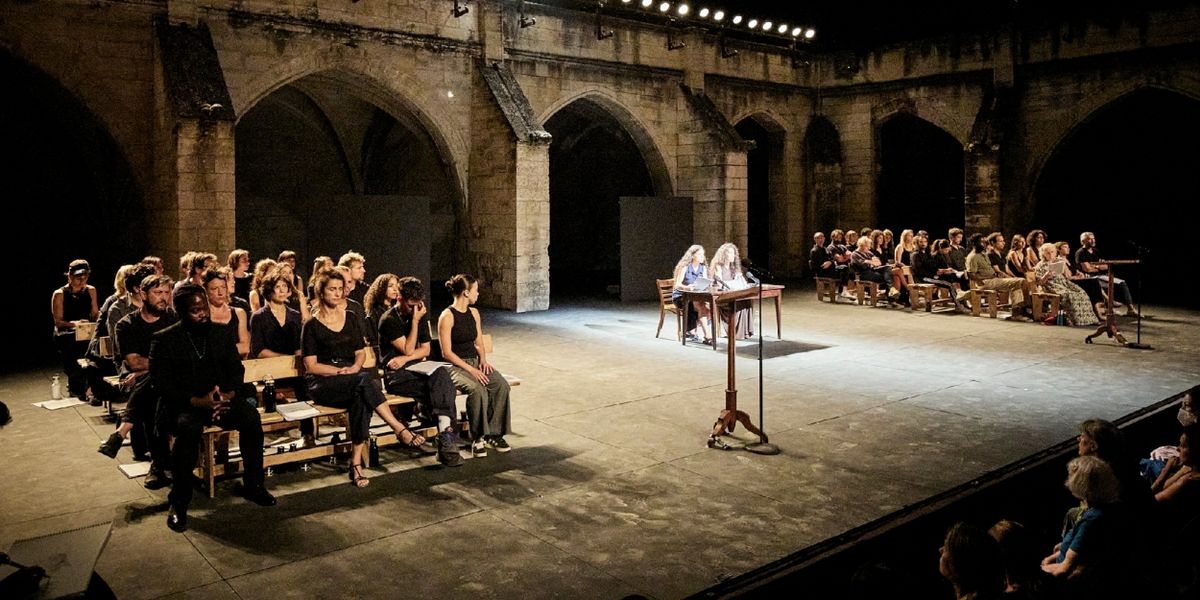
Milo Rau’s piece draws from publicly available information assembled in collaboration with Servane Dècle and Pelicot’s lawyers. In the theatre, a group of actors in casual dress sit in pews flanking the stage, holding scripts throughout the performance. Two actors preside at a table center stage; two podiums split center downstage, from which actors recite transcripts. The performers are filmed in real-time, with live projections cast onto two square screens upstage.
Rau divides the evening into forty segments, ranging from Fragment 1: Reconnaissez-vous les faits reprochés? (“Do you recognize the charges against you?”), to Fragment 14: Les vidéos doivent être montrées (“The videos must be shown”), to Fragment 33: Le dernier discours de Gisèle Pelicot (“Gisèle Pelicot’s final address”). Le Procès feels like a staged reading and, apart from its prologue and epilogue, that is largely what it is. In light of Les Amazones’ concerns, this restraint feels deliberate, even necessary. A more dramatized staging might risk emotional exploitation.
The artistic appropriation of current events has long been controversial. Streaming series and podcasts under the “true crime” label often exploit private suffering for the purposes of public entertainment. Some artists, however, use their medium not to entertain, but to investigate the aesthetics of journalism and current events. In 2016, Dana Schutz exhibited Open Casket, a painting based on the infamous photo of Emmett Till’s disfigured body. The work was widely criticized for exploiting Black pain for her, a white woman, professional gain. On that material level, I agree. And yet I would argue that the painting isn’t about Emmett Till so much as it is about the photograph itself. Open Casket examines how we view and consume atrocity, or as Proust once described it: “That abominable and sensual act called reading the newspaper, thanks to which all the misfortunes and cataclysms in the universe over the last twenty-four hours (…) blend wonderfully, in a particularly exciting and tonic way, with the recommended ingestion of a few sips of café au lait.”
Where Pelicot and Till converge, and where they differ from much of so-called true crime, is in their decision to go public. This choice exposes them not only to death threats and conspiracies, but to subtler indignities: having to “make your case” in the public eye and to surrender full ownership of your story. When a narrative is allowed to radiate outward to enact change, it is no longer wholly your own. This trial is not just the story of a specific woman; it is the story of a town, a region, a nation, and a world confronting the violent bedrock of patriarchy. So where do we draw the line between private trauma and public reckoning? Between conversation and spectacle? I don’t know. But Rau treads carefully, avoiding sensationalism and coup de théâtre, the very devices he is best known for. His performers rarely emote. Their tone remains factual, almost clinical. This lack of affect only heightens the documentary realism of the piece.
Also, crucially, this is Le Procès Pelicot, not Le Crime Pelicot. The piece is less about the crime than the process of legal recognition. And law, as we know, is highly performative. The French have staged their governmental processes for centuries. During the 1790s, average French citizens joined performances of the Assemblée Fédérative in which they role-played as political figures. As the performers remind us, the law is based on material evidence and moral intention. While it might feel reductive to say so, Gisèle Pelicot’s testimony is a triumph of rhetoric. While other speakers falter, searching for words to rationalize their pain, Pelicot is unwavering. Her statement, “Pour que la honte change de camp” (“So that shame changes sides”), has become a rallying cry. It hangs outside the theatre on a banner and is brought on multiple occasions throughout the performance.
Which brings us back to the question posed by Les Amazones. Yes, the piece is appropriative in the broadest sense, but it adheres to the materials Gisèle Pelicot chose to make public. Rau also uses the text of the trial toward the ends she herself pursued: cultural reflection and solidarity with survivors too afraid to speak out. In terms of dramatization, the production resists theatrical flourishes. Most performers are local amateurs, reading transcripts with unaffected sincerity. A few stylistic elements,one man singing in falsetto, Marie-Christine Barrault reading a Petrarch poem about Mont Ventoux (which looms over the Vaucluse), provide atmosphere, but little else. They bookend the performance.
In the end, Rau does his best to remove his aesthetic hand from the proceedings, leaving the text, the testimony, and the experience raw. However, in art, there is someone behind the camera, holding the brush, or adjusting the lighting. They are there, not just for our pleasure, but to construct the best argument possible. In Le Procès Pelicot, Milo Rau decided that a minimalist staging would be the least likely to impede Gisèle Pelicot's voice. To that end, I think he was right.
Photo Credit: Christophe Raynaud de Lage / Festival d'Avignon
Prefer BroadwayWorld in Google Search?
Add us as a preferred source so our stories show up more often in Top Stories and Google’s AI answers — for you.
Recevez l'actualité de Broadway sur WhatsApp
Recevez les dernières mises à jour, les nouvelles de dernière minute et une couverture exclusive directement dans l’application.

Sign up for all the news on the Summer season, discounts & more...
|
LE TEMPS DE VIVRE TH DU ROND POINT - SALLE ROLAND TOPOR (6/09-6/13) |
|
|
LES TRIBULATIONS D''UN CHEF D''ORCHESTRE RADIANT - BELLEVUE (11/22-11/22) |
|
ARTICLE 353 DU CODE PÉNAL THEATRE DU PETIT SAINT-MARTIN (9/10-10/30) |
|
|
UBU ROI THEATRE DE PARIS (9/16-10/25) |
|
DÉNI THEATRE DE PARIS - SALLE REJANE (9/18-12/26) |
|
|
MONTE-CRISTO, LE SPECTACLE MUSICAL - MONTE CRISTO ZENITH NANTES METROPOLE (12/11-12/11) |
|
|
LA RENCONTRE STUDIO DES CHAMPS-ELYSEES (9/15-9/20) |
|
|
PUNK.E.S RADIANT - BELLEVUE (1/12-1/12) |
|
|
KNOCK THEATRE DE LA RUE DE BELLEVILLE (10/06-10/21) |
|
|
L''EXPERIENCE THEATRALE RADIANT - BELLEVUE (11/28-11/28) |
