


REVIEW: The Festival d'Avignon Presents LE CANARD SAUVAGE By Thomas Ostermeier
Ostermeier, in collaboration with Maja Zade, relocates the play to the early 21st century without compromising its central dilemmas.
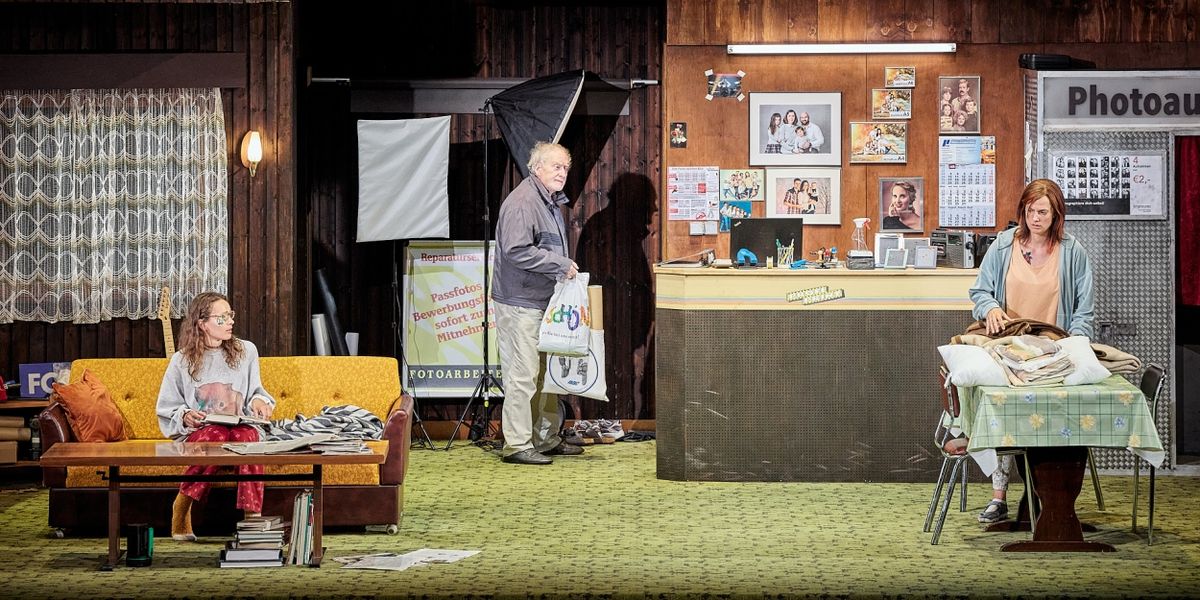
Tragedy doesn’t hinge on a twist but on a reversal or, as the Greeks termed it, a peripeteia. At the start of Ibsen’s The Wild Duck, the characters have already endured a series of such reversals. The play is structured less as a tragedy than as its postmortem. What happens after the cataclysm? However, tragedy doesn't pass; it lingers through heritage: the conditions that once triggered collapse continue to echo across generations. While the characters attempt to rationalize their fallen state through conversation, tragedy hangs in the air. In his staging at the Opéra Grand Avignon for the Festival d’Avignon, German director Thomas Ostermeier expertly crafts Ibsen's dramatic reversal: from polemic to tragedy.
Hakon Werle and Old Ekdal were business partners. Then, through a scandal, Ekdal was removed from his position. Gregers, Hakon’s son, is disgusted with his father for both his treatment of the Ekdal family and his blasé treatment of Gregers’s recently deceased mother. Gregers decides to leave his father’s home and move in with the Ekdals. The Ekdal family home includes Old Ekdal, Hjalmar (Old Ekdal’s son), Gina (Hjalmar’s wife), and Hedvig (Hjalmar’s daughter). The Ekdals have converted their apartment into a makeshift photography studio. Gregers steps into a household that is uneasy but intact. The reversals to come, though familiar to many, still deserve to unfold unspoiled.
Stefan Stern plays Hjalmar as an emotionally erratic man of arrested development, undependable but sincerely devoted. He believes he is the play’s tragic center, and Gregers seems determined to convince him. Gregers, an idealist with a messianic devotion to the truth, hovers somewhere between investigative journalist and blind prophet. His intrusion slowly reveals to Hjalmar that his household is a prison, Gina a Jocasta, and himself an Antigone, cursed to confront the downfall of his father.
The titular wild duck, kept in the yard out back, becomes a repository for the characters’ projected meanings. It is less a symbol than a mirror. The family grasps for metaphors to avoid recognizing themselves as a living, fractured family.
Marcel Kohler plays Gregers with earnest righteousness. He offers Hjalmar nothing but the truth, but to what end? What use is truth when it yields no path forward? Can the virtue of honesty outweigh its potential harm? Holding a microphone, Kohler breaks the fourth wall and poses these questions directly to the audience. This confrontation forces the audience to actively consider their thoughts on the theming. Rather than a famiy drama, Gregers invites us to treat the family as a case study. “Is lying good?” he asks, offering the mic to an audience member who replies, “Well, it’s normal to lie.” The room applauds, and Kohler continues the dialogue with a responsive, game audience before returning to the play and Hedvig, Hjalmar’s daughter.
Magdalena Lermer’s heartbreaking Hedvig grounds the play with practical wisdom. She prefers truth but understands its limitations, especially when it comes to her father. She is at once Gregers’s ally and his sharpest critic, torn between belief and survival. Falk Rockstroh’s calm but charismatic Hakon Werle is a man who has discarded tragedy altogether. Ironically, he shares his son’s fidelity to truth, but expresses it amorally, embracing a Don Juan philosophy: one cannot be a hypocrite if one never espouses values. In contrast, Thomas Bading’s expertly balanced Old Ekdal haunts the stage like a ghost of tragedy past. The mill doctor, performed by David Ruland, is the outside appraisal asking for the momentum of knowledge to cease. He sees the emotional architecture of the household and knows it cannot support Gregers’s idealism. Finally, Marie Burchard offers a restrained but devastating performance as Gina, a tragic figure in her own right.
Magda Willi’s photorealistic set reinforces Ibsen’s commitment to Naturalism, rendering the family’s apartment with cinematic precision. Vanessa Sampaio Borgmann’s understated costumes reflect each character’s social position and personal taste. Lighting by Erich Schneider and sound by Sylvain Jacques complete the immersive effect, creating a fully inhabited world.
Ostermeier, in collaboration with Maja Zade, relocates the play to the early 21st century without compromising its central dilemmas. Their adaptation sharpens the stakes of Ibsen’s drama, transforming philosophical crises into both timeless questions and historically grounded confrontations. While Ostermeier has built his reputation in Avignon on shocks in mise en scène, he has tempered his aesthetic palette, allowing the shock to be Ibsen's. Almost 150 years later, this shock still receives stunned gasps and ovations.
Photo Credit: Christophe Raynaud de Lage / Festival d’Avignon
Recevez l'actualité de Broadway sur WhatsApp
Recevez les dernières mises à jour, les nouvelles de dernière minute et une couverture exclusive directement dans l’application.

|
LILLY ET LE MUSICAL THEATRE DE LA TOUR EIFFEL (11/21-1/02) |

|
TOSCA (de Puccini) LE 13E ART (2/02-2/02) |
|
|
AILLEURS STUDIO DES CHAMPS-ELYSEES (9/30-12/30) |
|
|
MON FRÈRE TH DU ROND POINT -SALLE JEAN TARDIEU (9/18-9/27) |
|
LE FILIP THEATRE 100 NOMS (12/09-12/09) |
|
NOVECENTO THEATRE DES MATHURINS (9/17-12/17) |
|
|
CELTIC KANAN CASINO PARTOUCHE DE HYERES LES PALMIERS (10/17-10/17) |
|
|
DÉNI THEATRE DE PARIS - SALLE REJANE (9/18-12/26) |
|
|
VOLPONE LE BAL DES CRAPULES ORANGERIE DU PARC DE BAGATELLE (8/16-8/16) |
|
|
DIRTY DANCING - LE TRIBUTE - DIRTY DANCING THEATRE SEBASTOPOL (4/18-4/18) |