


Review: EVITA Is Ever the Spectacle at Musicals at Richter
The Lloyd-Webber and Tim Rice Classic Runs through July 19
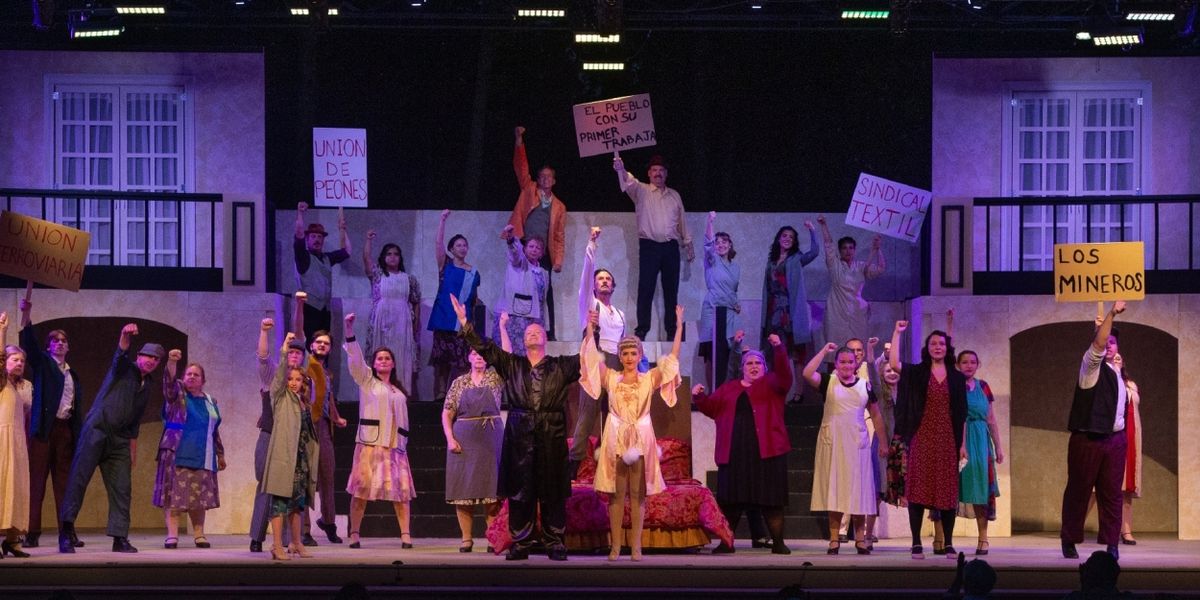
Evita is a spectacle. Its co-creator (with lyricist Tim Rice), celebrated Broadway tunesmith Lord Andrew Lloyd-Webber (he’s also a Sir and a Baron in the hierarchy of British society), is a stickler – not to mention a sucker – for spectacle, because, well, blimey, audiences around the globe are a sucker for spectacle, are we not? That’s one reason his shows play well wherever in the world they play.
From his earliest work – Cats, Evita, Jesus Christ Superstar – through to Starlight Express, Phantom of the Opera, and Sunset Boulevard, the crowd-pleasing impresario has invested big in “bigger is better” and he’s been handsomely rewarded for his canny instincts and craftsmanship, as he approaches billionaire status, a fabulous wealth built over five decades on one box office receipt at a time.
I’m happy to report that, in its current incarnation as the mainstage production of Musicals at RIchter (all of whose shows are performed under the stars at Richter Arts Center in Danbury, Connecticut), Evita’s undeniable spectacle remains joyfully intact – along with its other charms that easily hold an audience in its thrall throughout a thoroughly diverting couple of hours that move with potency, delivering numerous delights along the way.
The spectacle soars on the wings of Evita’s many-splendored sung-through score (recitative, with no spoken dialogue), where even secondary numbers boast a spirited swagger and a bounce that perfectly meld Lloyd-Webber’s catchy and diverse compositions with Tim Rice’s witty and politically astute lyrics. Rice knows how to economically inform as well as entertain, propelling with great style the colorful, improbable story that mythologizes impoverished teenager Eva Duarte into the larger-than-life global icon Eva Peron. Along with husband and Argentine president Juan Peron, Eva ruled that South American country in the late 1940s to early 1950s, and ultimately was memorialized as “Spiritual Leader of the Nation of Argentina.”
The inherently theatrical persona of Eva Person – who thrived on making a spectacle of herself – is tailor made for a musical spectacle like Evita, and the Lloyd Webber-Rice team make the most of that opportunity.
Along with Jesus Christ Superstar, Evita is testament to their earlier work being arguably more durable and richly textured than any later Lloyd-Webber scores, with or without Rice. Evita won the Best Musical Tony and six others in 1980. There’s the show-stopping “Buenos Aires,” the anthemic and emotional Act I closer “A New Argentina” (first cousin to “Do You Hear the People Sing” from Les Mis), the signature Evita ballad “Don’t Cry for Me, Argentina,” plus (my favorite) “And the Money Kept Rolling In.” The hummable melodies keep the non-stop music continually engaging, with even secondary numbers holding their own in tunefulness and energy.
At the center of the spectacle are the principals – Eva Peron, Che Guevara, Juan Peron – each of whom is splendidly cast, bringing those characters to vibrant life both in their strong acting and vocal skills. As Eva, honey-voiced mezzo-soprano Jazzy Cores takes impressive command of the title role from her first entrance to her death scene, confidently managing the layers and shades that defined Evita.
Before we see him, we hear Che Guevara – in the person of smooth-moving and smooth-singing Gabriel Montanaro – – emerging up the middle aisle from the back of the open-air theater. Mr. Montanaro makes a silky one-man Greek chorus who wryly stitches together Eva’s evolution for us – starting with meager scraps of show biz gigs, to celebrated and controversial first lady of Argentina, to cancer-stricken patron saint of the downtrodden. (In truth, legendary Cuban revolutionary Che Guevara had zero connection to Eva in real life – they never met – but his character in Evita is a useful conceit that works exceptionally well.)
As scheming Juan Peron, jut-jawed Michael Solano is physically formidable and convincingly imperious, with a strong lower register in the few songs he undertakes.
Apart from the three principals, standing out in her solo turn is Lauren Dattilo as Juan Peron’s mistress. Her poignant and powerful rendition of “Another Suitcase in Another Hall” is a highlight of the show. Also to be applauded is Thomas Koo, who lends his bright tenor to the role of tango singer Agustin Magaldi, with whom Eva has an early fling before her Perion period.
Together, the leads and ensemble perform Evita’s great score faithfully and forcefully. Credit too goes to sound designer Mark Firestone, who maintains a critical balance to ensure the show’s beautiful blend of voices is projected clearly and crisply into the night air, so they are easily heard in tandem with the excellent orchestra.
Besides the three leads, another “triple threat” responsible for Richter’s luminous Evita spectacle is the masterly direction by Donald E. Birely, the lush-sounding music supervision by Andrew Gadwah and the spirited, precise choreography by Matthew Farina (who also is assistant director).
It takes a nimble and knowing stagecraft to keep more than 40 actors moving around the proscenium platform fluidly, in a way that creates what some theater people call “pretty pictures.” Evita ensemble members pour in from both wings and from upstage to cohere into one satisfying tableau after another, creating the aforementioned spectacle to serenade the audience’s eyes and ears.
Mr. Birely is at the top of his game here, making sure every last actor moves with intent and knows to hit their marks with every beat of music. Of course, that’s also where Mr Farina comes in, instilling this Evita with dynamic and expansive choreography that the sprawling cast executes with the kind of discipline and verve that can prove challenging for local musicals (where some cast members can look lost on stage). Meeting the spectacle vibe too are the Broadway-caliber costumes, by DB Productions Costume Rental and costume cooriinator and wig designer Stephanie Salsman. Whether it’s a phalanx of nine nattily outfitted soldiers or nine choir children or aristocrats or villagers, the spectacle is fleshed out with plentiful ensemble members parading their smartly selected wardrobes.
Epitomizing both Mr. Birely’s and Mr. Farina’s expert chops in crowd control, so to speak, is the rigorous staging of crowd-pleaser “And the Money Kept Rolling In.” For my money, it’s the show’s best number, which is saying a lot, considering how many great production numbers there are in this Evita.
As for conductor Mr. Gadwah (who doubles on Keyboard 1), suffice it to say he manages to elicit an orchestral fullness from his 10-piece ensemble that sounds twice its number. It would be remiss not to name everyone in the pit: Charles Smith (Keyboard 2), Max Abarientos (Keyboard 3), Ella Djilani (Clarinet), Nicole Dionne (Violin), Sean McKiernan (Trumpet), Sam Lovera (Trombone), Nick Dickerson (Guitar), Don Hurta (Bass), Logan Madureira (Drums).
The spectacle of Richter’s Evita is enhanced by its al fresco setting, especially after the sun has fully disappeared midway through Act I. The natural nocturnal vignette adds electric authenticity to the densely-peopled crowd scenes that take place outdoors. At one point, in fact, it appeared (to me, at least) as if some lights were momentarily trained on the audience, as if to employ us as willing background actors. Talk about an immersive experience. The sharply designed lighting is by Eric Schutz of RKE Productions, Inc., executed by Liam Cuneo.
It’s worth mentioning that Musicals at Richter – as its executive director (and fine actor himself) Robert Bria informs each audience – is undergoing various phases of capital improvement: a new stage structure is in place, plus in 2026 there’ll be a permanent pavilion for the top-flight orchestra, as well as a new shop for set construction and props. That kind of master plan in action is possible only thanks to impressive support from a grateful public that recognizes – and shows up in force to support – the kind of gold-standard community theater that is not common and should not be taken for granted. The broad spectrum of community theater quality, it can be said by those who sample it in several places, ranges from tolerable to serviceable to impressive to the high bar continually cleared by such dedicated and accomplished theater companies as Musicals at Richter.
Photo: David Henningsen Photography
(Disclosure: Bruce Apar sits on the board of directors of Ridgefield Theater Barn, whose productions he does not review.)
[An Actors’ Plea to Local Theater Companies and Producers: In addition to featuring playwrights and directors in the marketing materials promoting your productions, please remember to also openly acknowledge cast members by listing the actors’ names in the same materials. Doing so can help fill seats with people who recognize a familiar name and buy a ticket to see and support that person.]
|
Charlie & The Chocolate Factory Kweskin Theatre (8/06-8/15) |
|
CATAPULT: MAGIC SHADOWS Jorgensen Center (11/15-11/15) |

|
O.A.R. Hartford HealthCare Amphitheater (9/20-9/20) |

|
Annie Goodspeed Opera House (10/30-12/27) |
|
Girls Night - The Musical Bushnell/ Belding Theater (1/23-1/23) |
|
JAKE SHIMABUKURO Jorgensen Center (10/10-10/10) |

|
Disaster! Ridgefield Theater Barn (9/18-10/10) |
|
Sunday Broadway Concert Series with John McDaniel, starring Sam Gravitte Legacy Theatre (10/18-10/18) |
|
PAT METHENY: Side-Eye III+ Jorgensen Center (9/25-9/25) |
|
Jim Henson's Labyrinth: In Concert Palace Theatre Stamford (9/19-9/19) |
Reader Reviews
To post a comment, you must register and login.