


Review: ROMÉO ET JULIETTE at Winter Opera
Gounod's masterpiece plays through March 1.
 Click for Tickets!
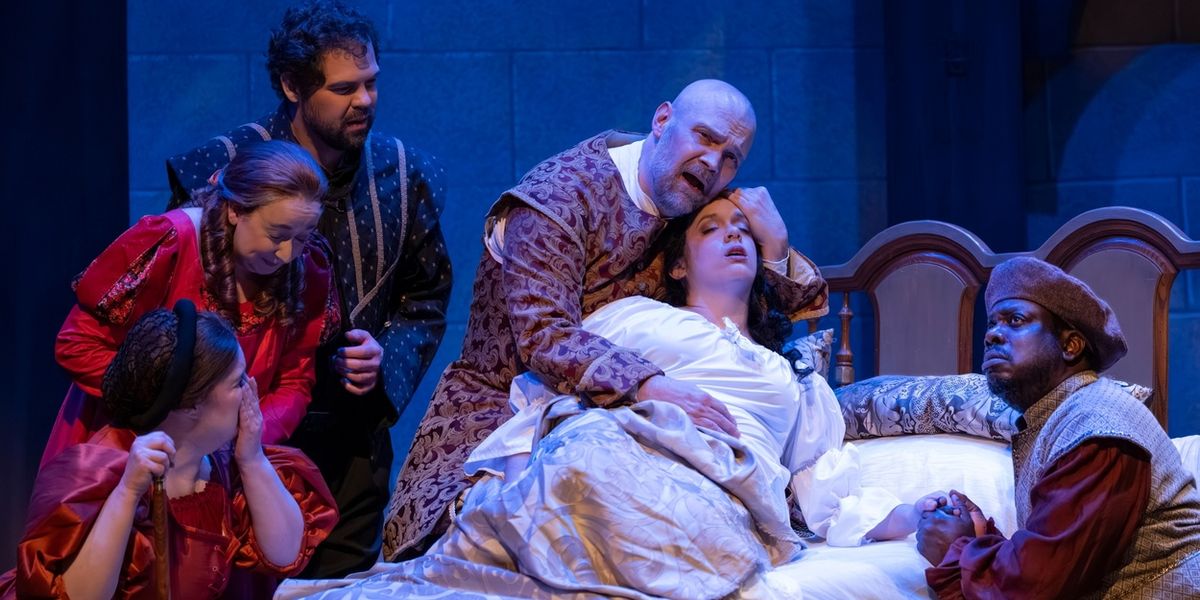
Opera is widely considered to be a seasonal flower. Around the world opera festivals show their shoots in early spring, they blossom in the summer, and they stretch their glory into the fall. In St. Louis, though, we find one of the few fine opera companies willing to brave the icy blasts of winter. Gina Galati’s Winter Opera company has opened a quite beautiful production of one of the world’s most familiar love stories—Roméo et Juliette by Charles Gounod.
The composer wrote many operas—from 1851 through 1881. But his three great successes he wrote in his forties: Faust, Mireille, and Roméo et Juliette.
This libretto is quite true to Shakespeare’s play, though as with any adaptation from play to opera the text must be shortened. (Well, it just takes longer to sing things.) But Shakespeare usually deserves trimming anyway, and the librettists kept their focus on that star-crossed love; the resolution of the Capulet/Montague feud is left on the cutting-room floor. (Anyway, in this civilized day and age what interest do we have in random armed chaotic battles in the streets?)
In soprano Megan Barrera Winter Opera has found a brilliant gem to play Juliette. Hers is a voice of such clarity and power! In her three arias and nine duets this is a vocally busy lady and she flourishes that voice. Now Juliette is only thirteen—and no thirteen-year-old could possibly rise to those challenges. Ms. Barerra’s voice is a mature instrument capable of mastering every moment. And her French accent and articulation are so perfect as to be understood by listeners with even my modest French. Such an actress! In her first arietta, “Je veux vivre”, she conveys a school-girl’s elation at the joys of life—and of a costume ball! We sense her heart beating breathlessly in waltz-time. And what honest deep sorrow and fear she displays when she discovers that the boy she’s been flirting with is a Montague.
We’ve met Taylor Comstock before on the Winter Opera stage: he sang the Riff chieftain in The Desert Song, and the Chevalier who’s in love with Manon Lescault. Here again, as Roméo, he shows a sweet pure tenor voice that grows in power as he rises into those higher notes. And as the passions intensify Comstock’s vocal power grows even more impressive. He too conveys intense passions. In the final scene, after finding that his love is “dead”, his grief and torment as he chooses to take poison are heartbreaking.
Keneth Stavert fills Mercutio with immense vitality, physical agility, a bright sense of humor, and a marvelous baritone voice.
Tybalt, Juliet’s hot-tempered cousin, is sung by Marc Schapman, a familiar and welcome face in St. Louis opera. He summons a fierce acetylene anger in the moments leading up to the lethal swordfight in Act III.
Jacob Lassetter has become the “go-to guy” for any St. Louis opera in need of a powerful bass-baritone. Here he sings Juliet’s father, Count Capulet. As always, Lassetter is a commanding presence on stage. He carries this role well indeed.
Nathan Whitson brings a marvelously resonant basso to the role of Frére Laurent, and Eli Panek fills the Duke with weighty solemnity and authority when he arrives to condemn the killings and banish Roméo.
The “trousers role” of Stéphano is delightfully sung by Raphaella Medina. She gives a fresh lightness and good humor to this very young and witty lad. Her movement is so graceful and natural.
Emily Taylor as the Nurse, Joel Rogier as Count Paris, Thomas M. Taylor as Benvolio, and Fitzerald St. Louis as Gregorio make this an all-around dream cast.
The chorus has moments of great beauty—even grandeur. As Mercutio and Tybalt lie dead at their feet both Montagues and Capulets sing their mourning in a gorgeous requiem.
Scenic Designer Scott Loebl gives us a simple and beautiful set which changes easily among the several locations. And once again he gives us a glorious backdrop of clouds. (These are, would you believe, hand-painted.) Lighting, by Michael Sullivan, makes these clouds appropriately threatening or tender or drear. In the balcony scene Mr. Sullivan’s lights transform the pale face and decolletage of Juliette into moonlight incarnate.
Costumes are by Jen Blum-Tatara. They are beautifully true to the Renaissance, and I must particularly praise her palettes—especially in the masquerade ball, where it flows with balanced shades of soft red and rose and lavender and purple—deeply romantic colors.
But I’ll quarrel with the costumer’s choice for Juliet’s nurse; she was in a kind of dark orange. Now the Nurse is an old family retainer—a servant. She’s most usually seen in black. In this production she looks more like a guest in a ball-gown. And no headdress! A family “nurse” in those times would always wear a sort of wimple. It’s part of the uniform, as it were.
John Stephens, a fine and seasoned Stage Director, adds another beauty to his list of Winter Opera productions. But I can’t resist a tiny nudge or two: The chorus needed rather more individual action—especially in the festive ball scene, which had little or no dancing. (No choreographer was listed in the program.) Also there were few times during non-vocal passages when nothing much happened on stage.
Lastly, this production stepped lightly on one of my pet peeves: In Act 5 just before he dies Roméo sings:
“It is your husband who, trembling with happiness, embraces your knees!”
At that moment, in this production, Roméo was nowhere near her knees! (I know, I know: it’s all in French, so most of the audience won’t understand anyway, but it’s up there in the super-titles!)
But these are quibbles. All in all this is another quite splendid production. Our thanks to the indefatigable impressaria Gina Galati and to this production’s sponsor, Mary Pillsbury. Gounod’s Roméo et Juliet plays at the Kirkwood Arts Center through March 1.
Photos by Dan Donovan
Sign up for all the news on the Fall season, discounts & more...

Reader Reviews
To post a comment, you must register and login.