


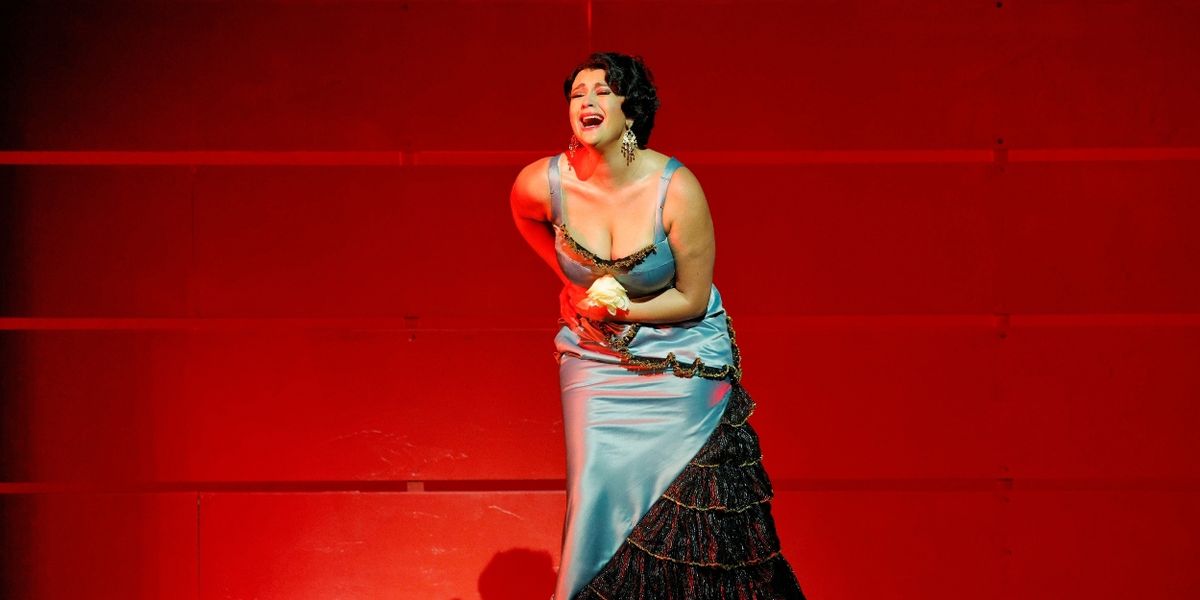
The ever popular and hardy perennial of the operatic canon, composer Georges Bizet’s Carmen, was given a unique yet solid interpretation by the Wolf Trap Opera under the direction of John de los Santos. (Originally directed by Anne Bogart, according to the program). This opera is so well-known (and almost ubiquitous)---that I could feel the palpable excitement in the audience as the opera was about to begin ---even on a hot and humid August evening at the cavernous Filene Center at Wolf Trap.
The lively urgency and concurrent sensitivity of Bizet’s music wafted over the audience like a cool summer breeze and was conducted with skill and panache by José Luis Gόmez. The flavorful and amorous music of the great Georges Bizet was the primary reason to attend this special evening of opera. The Wolf Trap Orchestra did a superb job of managing the demands of this creative and popular score.
The classic archetypes of the free/liberated woman (Carmen), the jealous lover (Don José), the dutiful childhood sweetheart (Micaëla), and the macho lover (Escamillo) are all on display in this always captivating opera.
The theme of free will and agency versus fate is paramount throughout Carmen and director de los Santos highly accentuates Carmen’s (Elissa Pfaender) fight for agency and empowerment amidst the forces of fate and doom (doom is cited by the fortune tellers in the opera). I applaud the strong accent on the conflict between free will /empowerment and fate throughout the opera, but the ending shows Carmen stabbed twice yet she oddly rises up and walks off of the stage.
Director de los Santos accentuates the jealous need for Carmen of Don José(Daniel O’Hearn) rather than the love triangle of Carmen, Don José, and Escamillo (Laureano Quant). There is almost a sado-masochistic quality inherent between Carmen and Don José in this interpretation which works well.
The libretto of Carmen is by Henri Meilhac and Ludovic Halévy ---based on a novella by Prosper Mérimée and is set in Seville, Spain and in surrounding areas –it is sung in French. Excellent period flavor adds texture to the libretto.
Large ensemble numbers were exceptionally well done and appeared as painterly tableaus to the eye. The ambers, golds, and soft reds of the costumes (select costumes are designed by James Schuette and originally created for the Glimmerglass Festival) were aided by the lighting design of Chad R. Jung –and made the stage space appear vividly encased in the atmosphere of the period.
The Chorus and supernumeraries are integrated into the narrative to such a degree that they become as one distinct member of the ensemble. In several scenes, they linger, move forward with surging power, or laugh and talk in groupings. The Children’s Chorus of Washington performed admirably.
The excellent operatic singing is the second-best reason to have been privileged to attend this opera---the operatic singing was above par in every key role.
As Carmen, mezzo-soprano Elissa Pfaender dominates both physically and vocally. Ms. Pfaender’s depth and controlled power were evident in every scene and aria or duet she performed. Ms. Pfaender’s commanding presence fit the dramatic impulses of her role as if Bizet were writing the role of Carmen with her in mind. Ms. Pfaender’s acting skills alone are a veritable feast to behold.
The sultry and enticing “Habanera” on the ambience of love “L’amour est un oiseau rebelle”/ “Love is a rebellious bird” –was delivered with soaring chest tones that caressed each note of this famous aria. Ms. Pfaender’s “Seguidilla” as she beguiles Don José was a mesmerizing operatic moment.
Daniel O’Hearn as Don José dramatically engaged the audience with a myriad of moods from scornful to vengeful to obsessive –and each mood was played with aplomb. Mr. O’Hearn’s tenor was full of control and subtle, variegated shading especially in the “Flower Song” which is known as “La fleur que tu m’avais jetée”.
Baritone Laureano Quant as Escamillo delivered a splendid “Toreador Song” in the Spanish tradition of dignity. Mr. Quant’s resonant baritone was thrilling to hear and there was a bit of a subtle “send-up” of the overwrought machismo inherent in such roles.
Amanda Batsista as Micaëla, the dutiful childhood friend of Don José, possesses a beautiful soprano voice and she drew sustained “bravos” from the audience as she sang the incredibly moving “Je dis que rien ne m’epouvante.”Ms. Batista’s soprano was sensitive yet distinctive and compelling in tone.
Scenery and properties are designed by Riccardo Hernandez , constructed by Glimmerglass Festival, and jointly owned by the Minnesota Opera and the Glimmerglass Festival. A cement mottled grey wall is shown upstage with a door that is encased inside-- that is utilized for a prison gate, cigarette factory entrance, etc. The opera’s courtyard space is used for several scenes including a space to mill about, Lillas Pastia’s Inn, a gypsy encampment, and a square in Seville as Escamillo enters the arena.
Vivid red on the upstage back wall foreshadows what should be a tragic ending but director John de los Santos has chosen to have Carmen get stabbed twice by Don José only to stand fully erect and walk off the stage ---presumably to show that this Carmen can defy fate and, simultaneously, embody female empowerment. The free will and agency of Carmen has long been established throughout the opera and, since this is a tragic opera, I firmly believe that Carmen should die in the finale --as dictated in the libretto.
The Wolf Trap Opera production of Carmen is a ravishingly engaging evening of the superb music of Georges Bizet and glorious operatic singing.
Running Time: Three Hours including one twenty-minute intermission
Carmen was presented on August 15, 2025, by the Wolf Trap Opera at the Filene Center located at 1551 Trap Road, Vienna, Virginia, 22182.
Photo credit: Elissa Pfaender in the Wolf Trap Opera production of Carmen.
Photo by Cory Weaver/Wolf Trap.

|
Misery Aldie Mill Historic Park (8/20-8/30) |

|
Macbeth Three Notch Theatre (8/06-8/15) |
|
Step Afrika!'s Magical Musical Holiday Step Show Arena Stage at the Mead Center for American Theater (12/04-12/23) |

|
Body Language The Allan Lefcowitz Theater at The Writer's Center (9/25-9/27) PHOTOS |
|
Grand Kyiv Ballet presents "The Swan Lake: Symphony of Lights F. Scott Fitzgerald Theatre (11/18-11/18) |

|
Hairspray Hylton Performing Arts Center (9/18-9/27) |
|
Beethoven’s Ninth Symphony Wolf Trap (8/14-8/14) |
|
Commedia Christmas Carol (2024) Streaming Traveling Players Ensemble (12/23-12/23) |

|
Rockville Little Theatre presents "Fences" F. Scott Fitzgerald Theatre (4/30-5/09) |

|
Measure for Measure Folger Shakespeare Library (9/22-11/01) |
Reader Reviews
To post a comment, you must register and login.