


Review: HER PORTMANTEAU at Strand Theater Company
Last Call for Gripping Diaspora Tale
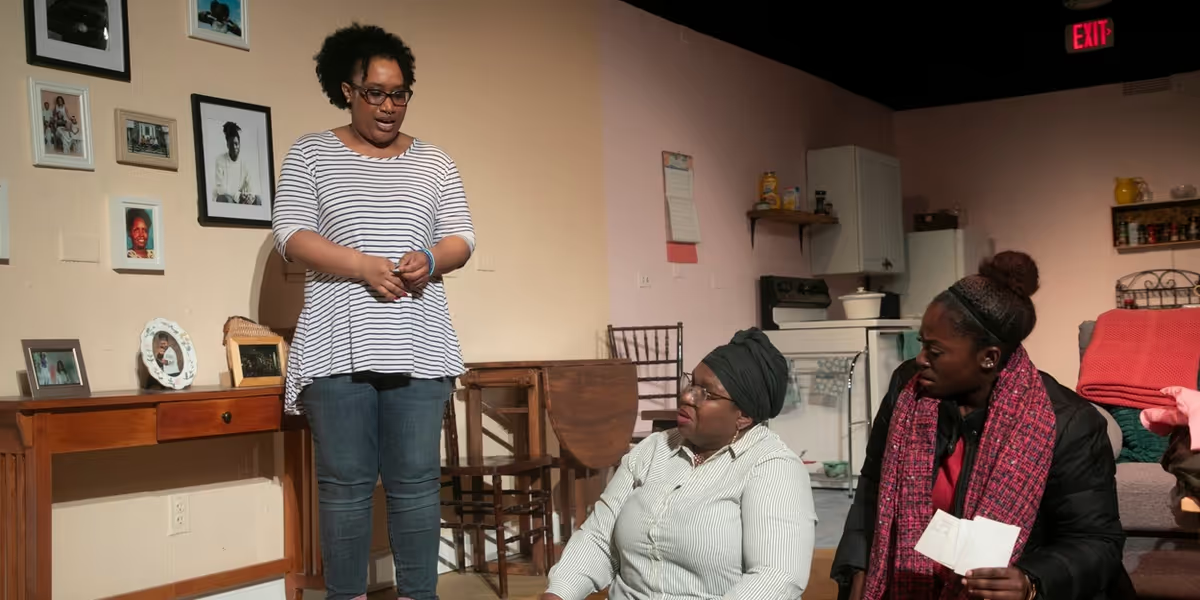
Was it worth it?
“It” is the monumental sacrifice Abasiama Ufot, a Nigeran mother, makes leaving her homeland for the U.S. And “it” is the resulting—and unanticipated—harm that follows.
HER PORTMANTEAU, a gripping tale of family relations, looks deeply into the answer to the question of whether sacrifice is a worthy relationship goal. Sacrificial love is the thread weaving the complex stories of the mother and daughters who reunite in the production.
Cultural clashes, mother wounds, and abandonment issues are unpacked at the Strand Theater Company in the play written by Mfoniso Udofia and directed by Sandra L. Holloway.
It’s gritty and intense. And Udofia’s universal themes of identity, belonging, and familial love translate into a spellbinding production.
With immigration front and center in today’s political environment, HER PORTMANTEAU provides a reminder that the issue is never cut and dry.
More so, a person’s quest for a better life may require leaving behind something or someone. Unfortunately, that immigrant may also pay a dream tax: an unexpected, negative impact on their emotional, financial, and/or relational health. HER PORTMANTEAU explores the abandonment, betrayal, and resentment that often arises in such instances.
But HER PORTMANTEAU is no tragedy.
Yes, it’s thought-provoking and heavy. But Udofia has penned a play that makes room for slivers of hope in the Harlem apartment where the play unpacks a critical turning point in the lives of Abasiama and her two daughters.
HER PORTMANTEAU opens with tension.
Iniabasi, played by Azure Grimes, arrives at JFK Airport in NYC. Straight off a flight from Nigeria, she is carrying a big red suitcase—which the audience later learn is a significant link to her mother’s past. Symbolically, it later serves as a bridge to the family’s healing and an effort not to repeat past mistakes.
A hint of the emotional baggage Iniabasi has carried abroad is visible to the audience when she realizes Abasiama let her down again. To make matters worse, her half-sister, Adiaha, races on the scene to pick her up; clearly their matriarch is not coming to the airport.
Although she doesn’t say the words, Iniabasi’s entire reaction screams, “I want my mommy!”
Eventually, the sisters head to Adiaha’s Harlem apartment where the family’s drama, estrangement, and fragile re-connection unfolds in the 90-minute production.

Iniabasi is unhappy about being there. Grimes masterfully captures her character’s feelings of loss, betrayal, discomfort, and anger. With sensitivity, Grimes powerfully steps into the role of an angry daughter who unsuccessfully masks an underlying desire to be loved and accepted. She also beautifully shows her character as a loving single parent whose child is ever-most in her mind—as is Iniabasi’s commitment not to perpetuate generational abandoment.
Powerfully showcasing Iniabasi’s conflicting desire for family and belonging, Grimes initially ticks the audience off through her character’s arrogance, rudeness, and attempts to use her native language and food as both barrier and boundary. Ultimately, Grimes garners compassion and empathy for her character whose budding transformation is admirable.
Indications of Iniabasi’s estrangement include her laser-focus on weight, decorative pillows, and wall pictures.
She views her sister as heavier than their last encounter; of course, womanly Aidha would be as she’s no longer a child. In Iniabasi’s view, Adiaha’s pillows also are too soft and too colorful while her wall photos fail to include their Nigerian kin. While Aidha’s weight and pillows are perhaps symbols of the soft life that Iniabasi believes her mother and half-siblings have enjoyed in the US, the lack of family pictures symbolically evoke issues of family identity and belonging.
Conversely, when Iniabasi believes her mother is much slimmer than in older pictures she’s seen. Perhaps, too her, the weight loss signals the thinner love Iniabasi believes her mother has for her—or the thinning of a relationship over decades of distance.
Meanwhile, Adiaha challenges Iniabasi’s perceptions of life in America: it’s not easy, cheap, or burden free! She has recently moved into her apartment and then willingly sacrificed a relationship to make space in her home for her sister whose trip she help fund. Adiaha is the people-pleasing daughter—until she isn’t. And the shift is seen and applauded through Geneva Plaisir’s acting.
Plaisir has a difficult and daunting task of playing the familiar role of the eldest daughter who feels obligated to make sure everyone is OK—even if that means sacrificing her own interests, finances, or love life.
But Adiaha is not Abasiama’s eldest child.
She is the eldest of the half-siblings in the U.S. The full weight and burden of responsibility falls on her due to proximity. One of the production’s most heart-wrenching scenes is when she bucks against pleasing her mother and finally and freely addresses her sister’s false perceptions.
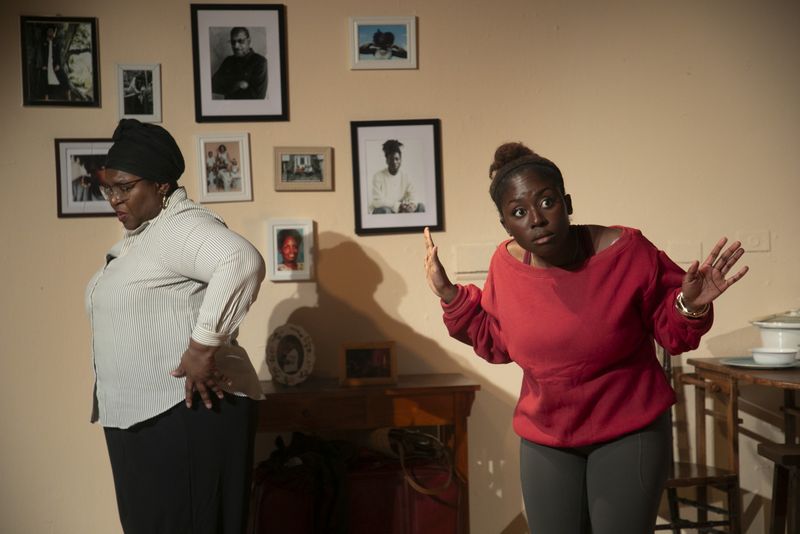
It’s powerful and the audience cheers that she’s found courage to advocate for herself.
The sisters are enmeshed in sibling rivalry due to no fault of their own. And working through issues that have caused these daughters to be pitted against each other is a central theme of the play.
The audience meets Abasiama last.
Andromeda Bacchus plays Abasiama, the matriarch who loves her children but has made sacrifices with unimaginable consequences. Bacchus draws the audience into Abasiama’s past and present, pulling on heartstrings as her character’s complex actions must be explored and explained (not rationalized). The audience feels the love—and the angst—as Bacchus plays the role of a mother who’s also a wife dealing with her second husband’s illness.
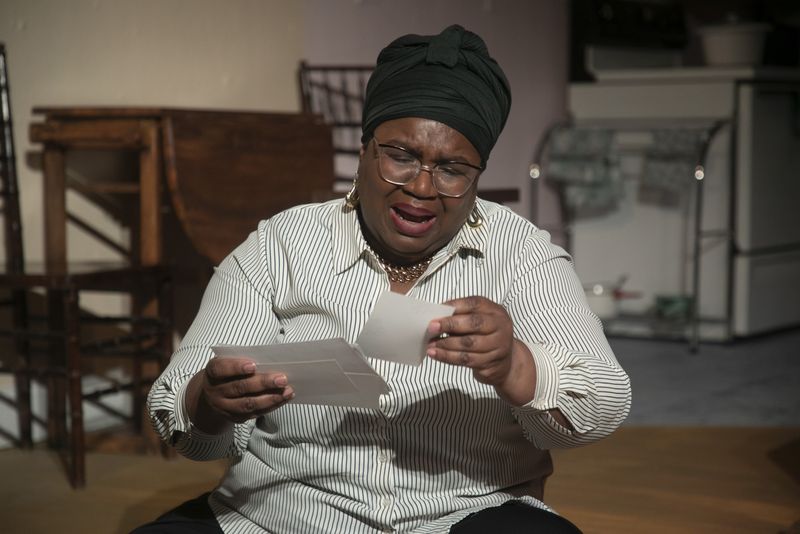
It’s a complex role, and Bacchus adeptly portrays its duality of tenderness and toughness. It’s clear that Abasiama loves each of her family members. The sacrifices she made were not intentionally designed to harm, but she’s ready to face that harm and make amends.
One of the most tear-jerking scenes that Bacchus nails is when Abasiama tenderly embraces Iniabasi. That tender scene comes toward the play’s end and is hard won given that Abasiama had invited her to America under false pretexts.
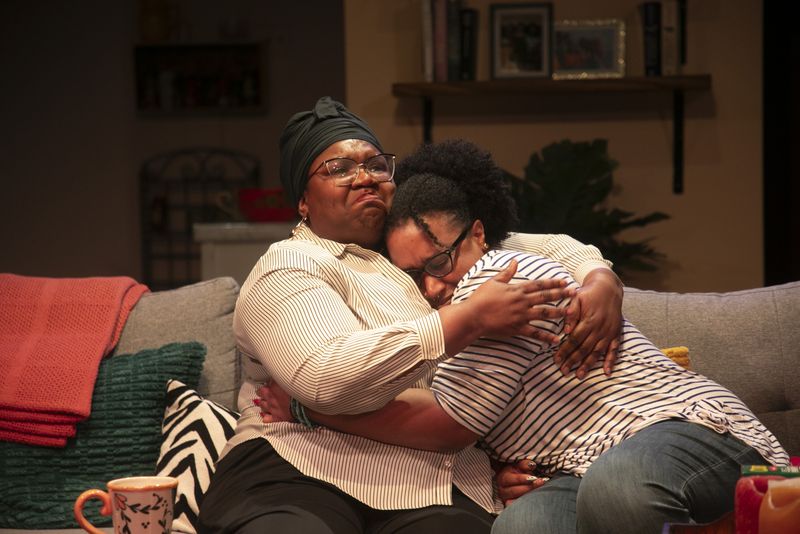
Not a great way to start a reunion with Iniabasi who’s been missing her mother and resenting her absence for decades!
By the production’s end it is obvious that Abasiama has learned from the past and is willing to make different choices that could possibly lead to generational healing, reversing division and trauma. It ends on a soft, satisfying note—yet sparks lingering reflection.
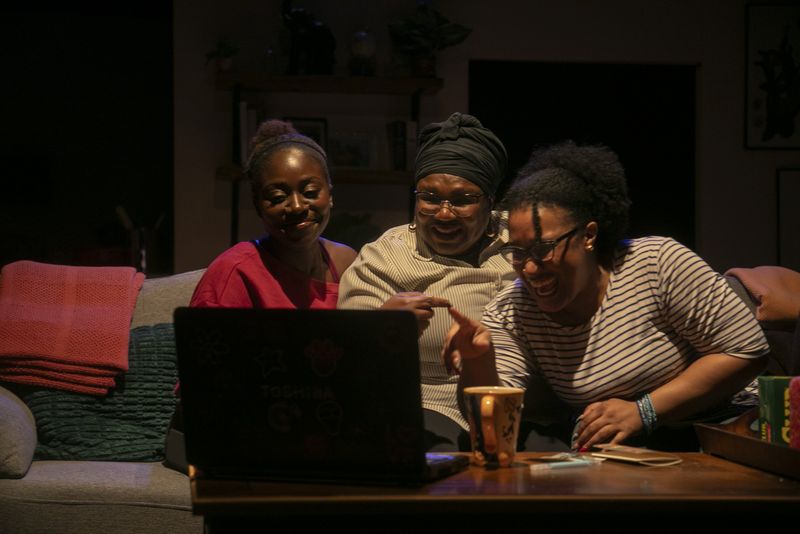
HER PORTMANTEAU is part of Mfoniso Udofia’s nine-play series called the Ufot Cycle that centers pivotal points in Abasiama’s journey and their generational impact. The Strand Theater Company produced SOJOURNERS, the first installment of the Ufot Cycle, in 2019.
HER PORTMANTEAU closes this weekend. Its final three performances are available from April 24-26th. See it on Friday or Saturday at 8:00 p.m., or Sunday’s matinee at 2:00 p.m. Tickets start at $15.00 for students and seniors; general admission is $22.00. Purchase tickets at Strand-Theater.org or call the box office at (443) 874-4917.
Sign up for all the news on the Fall season, discounts & more...

|
La Sylphide Maryland Hall (10/16-10/18) |

|
The Score Shakespeare Theatre Company (9/11-10/25) |

|
Student African Drum Ensembles McDaniel College (12/01-12/01) |

|
The Rocky Horror Show Iron Crow Theatre (10/16-11/07) |

|
The Fall of the House of Improv Highwire Center (10/23-10/23) |

|
College Band Concert McDaniel College (12/04-12/04) |

|
Fall Over Laughing with The Comedy Pigs Maryland Ensemble Theatre (11/07-11/07) |

|
Planet Claire: A Sci-Fi Go-Go Musical with Music by The B-52s JBK Theatre @ Federick Community College (10/29-10/31) |

|
Different Words for Happiness Everyman Theatre (10/18-11/15) |

|
Chicka Chicka Boom Boom: The Musical Imagination Stage (9/26-10/18) |

Reader Reviews
To post a comment, you must register and login.