


Review: THE FLOWERS OF SREBRENICA, Jacksons Lane
Part play, part performance, this production is moving and timely
 Wer redet heute noch von der Vernichtung der Armenier? In the Big Book of Journalism, it warns the writer never to start with a quote, even more never if it’s in a foreign tongue - but sometimes it has to be done.
That’s Adolf Hitler in August 1939, a week before the invasion of Poland - "Who, after all, speaks today of the annihilation of the Armenians?" The thing to remember about fascists is that when they tell you what they’re going to do (and they usually do), FFS believe them.
The speed at which one genocide (maybe “disputed genocide”, but the dead are not extended the privilege of parsing their fate) is a key theme of The Flowers of Srebrenica. A roll call of them is akin to being reminded of reality TV show winners. “Oh yeah - that one. I do remember now you mention her…” That’s not to diminish the horror: I suspect it’s a coping mechanism, walking around with all this evil festering in your head is simply too much.
But remembering, memorialising more accurately, is important not just to honour the dead, but to sound a warning for the future. Even if it won’t always be heeded, what else can you do?
This LegalAliens / Sarajevo War Theatre co-production is based on Aidan Hehir’s novel, his response to a visit to Potočari, a village in Bosnia and Herzegovina. Mere sight of the name Srebrenica is enough to trigger some of us who recall, with deep shame, the failure of United Nations Protection Force, hopelessly ill-prepared, hopelessly led, to prevent over 8000 Bosniaks being slaughtered, on European soil, by forces commanded by Ratko Mladić. He is still alive today, but not for much longer. Dear me, it shook our belief in international cooperation, in Europe’s ability to look after its own, in our enlightened, civilised ways. Then, as alas no longer, I really believed that stuff - my head is down and I’m looking at my feet now.
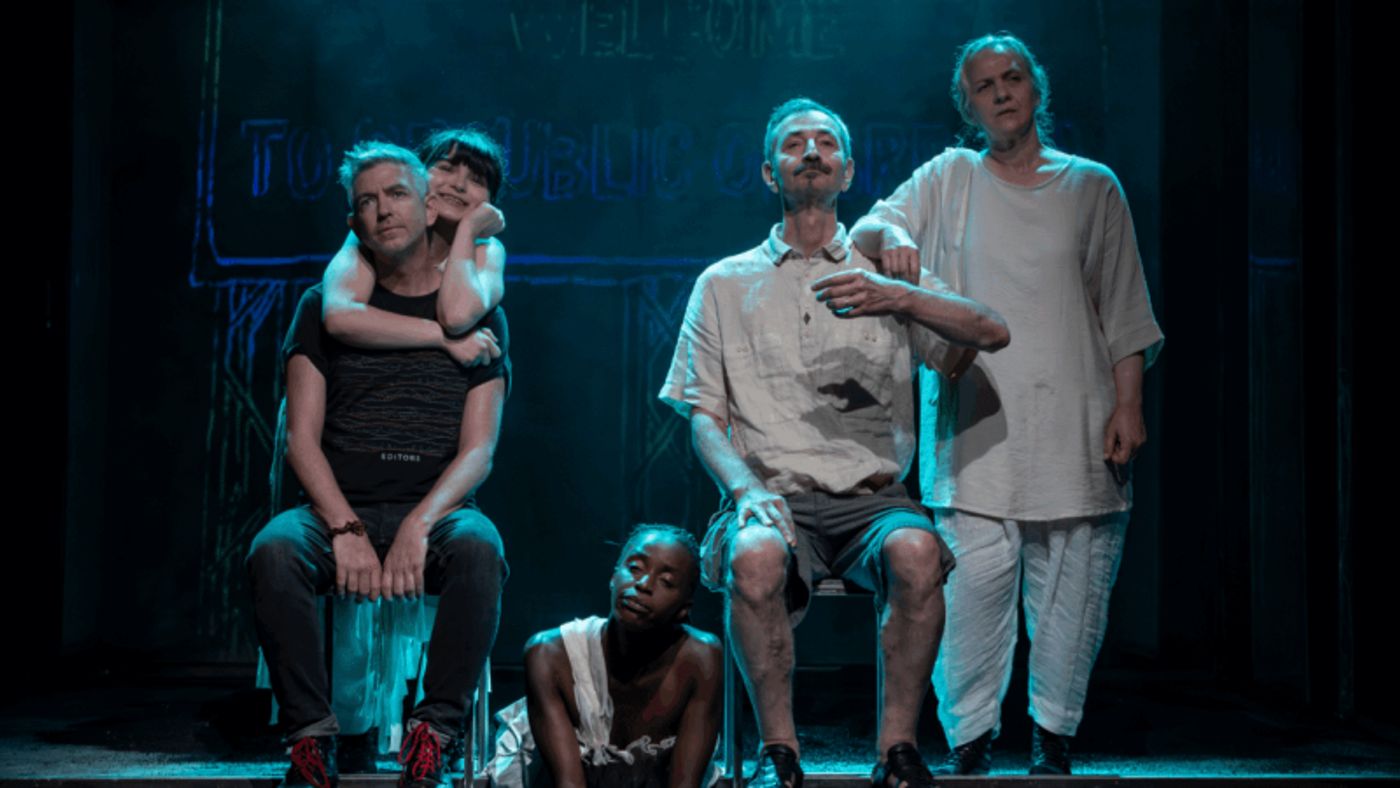
The play is not a straightforward retelling of the events, but a work that uses movement, music, video and allegory (the soil that was once fought over and now buries the bodies, is a continual motif). The script mainly focuses on Aidan (an emotional, even at the curtain call, Jeremiah O’Connor) a lecturer who teaches Balkan history, but who has never felt its impact viscerally, too safely cocooned in academia’s ivory towers.
He is educated by his guide, Mustafa (Edin Suljić) who drives him out to the killing fields, himself a veteran of the war, a Bosniak who survived but who waited, tellingly, nearly 30 years to start a family.
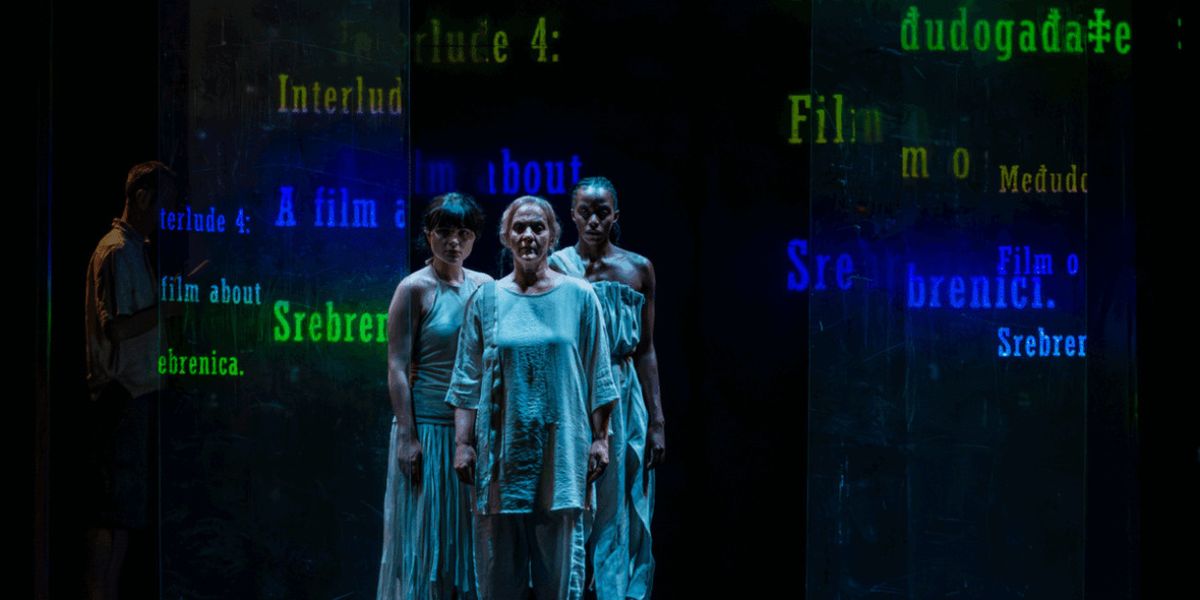
Is Mustafa real at all? He has, after all, been conjured from the earth by three women, a Greek Chorus who call interludes to inform us of background knowledge and steer the men’s thoughts.
The three actresses (Selma Alispahić, Taz Munyaneza, Valeriia Poholsha) are Bosnian, Rwandan and Ukrainian, underlining the universality of the subject in which they are experts. They also express grief alongside Aiden’s anger, a necessary counterbalance that lends an elegiac note to the evening.
At 65 minutes, it’s a production that uses all elements of 21st Century Theatre to tell its lamentable tale of evil’s success in the face of passivity. It’s clearly a work that intends to appeal to the heart as much as the head - more so really - and that avoids much painful exposition while still driving home its points.
In the 30 intervening years since all those lives were taken in a tiny village in what many of us thought was, in some respects, a model state (Tito’s Yugoslavia), its story and, especially, this tangential approach to the material, has never been more necessary.
The rolling names on video screens, like those on the marble of the Menin Gate or those that appear at the end of the Grenfell plays, are followed by so many birth years but always with the brutally repeating ‘1995’ to complete the entry. The finality of those relentless death dates will long live in my thoughts.
“Never Again!” But we know it’s happening, even now. For shame, for shame.
The Flowers of Srebrenica at Jacksons Lane until 18 October
Photo images: Raisa Šehu






Reader Reviews
To post a comment, you must register and login.