

Review: ONLY SOME OF GOD'S CHILDREN OR MISSISSIPPI MAGNOLIAS at The SigPro Studio
SigPro's new venue debuts with a promising historical drama that struggles to find its footing in the languid Mississippi heat.
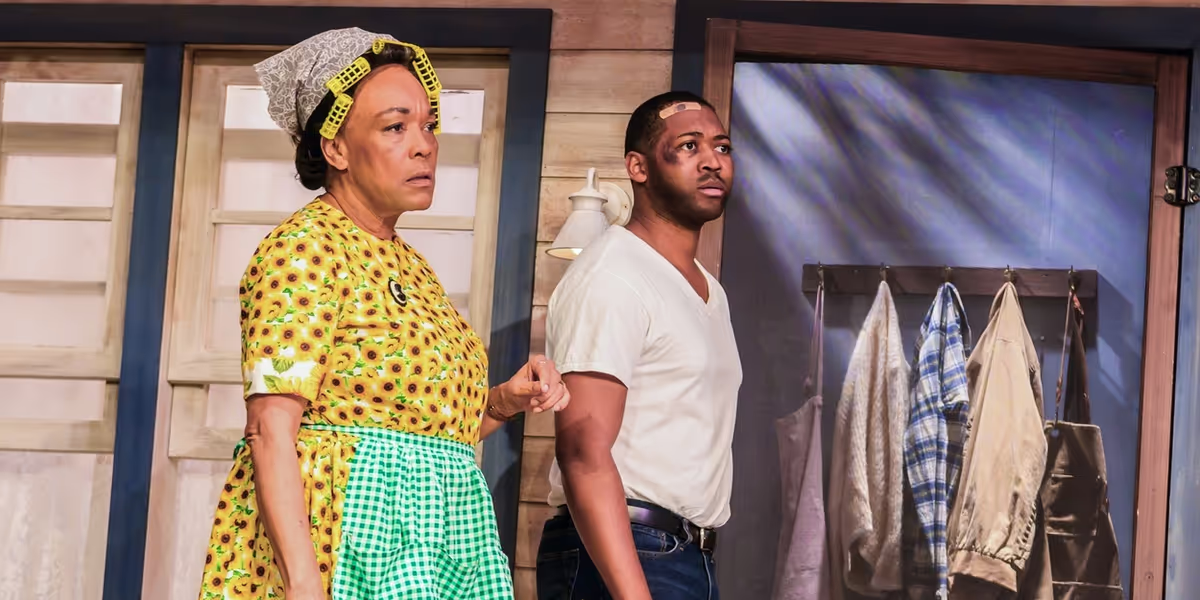
Nestled within Lake Sumter Landing in the retiree paradise of The Villages, Significant Productions (SigPro, for short) have found a new home. Previously tucked behind several neighborhoods and attached to the Tierra del Sol restaurant, SigPro now have their own space in a much more public sphere, ready to welcome guests to the final two shows in their tenth season.

Fittingly, the first production in the new theatre is a world premiere production of Paris Clayton III’s ONLY SOME OF GOD’S CHILDREN or MISSISSIPPI MAGNOLIAS. Having worked its way through several playwriting competitions and having received several readings and workshops, this is the first time the play is seeing a fully realized production. Clayton helms the production as both writer and director, a decision which may have stalled the potential of the piece (more on that later).
In lieu of house music, audiences are greeted by audio of Martin Luthor King, Jr.’s famous “I Have a Dream” speech from the 1963 March on Washington and an empty yard filled with barren flower beds and the facade of a small home. The speech transitions to 1960s tunes, which fade away as we’re dropped into the week following King’s speech. John (Joel Diggs) and Cochise (Herb Newsome) have just returned home from attending the March on Washington. Their families happily greet them - Betty (Avis-Marie Barnes) and Ezekiel (Phillip McNair) await John while Hattie Mae (Jacqueline Lorraine Schofield) seems to begrudgingly accept Cochise’s return. King’s words have galvanized John and his commitment to his ancestral land right; Cochise wasn’t so swayed. After Ezekiel is injured in a sit-in at a local restaurant, Betty begins to push against the idea of staying in Mississippi and yearns to move her family to the perceived safety of northern states. Hattie Mae, a dream-chasing juke joint singer, is frustrated with being stuck in her church choir and is always looking for a good time and a pathway to stardom. As the four adults strain against the confines of their lots in life but fail to act, Ezekiel grows disillusioned with the wisdom of nonviolent protest.
It’s a fantastic premise. All of this is a wonderful set up for a drama that could deliver some compelling historically-based story beats; unfortunately, stilted dialogue and stagnant staging lead to a relatively sluggish two-and-a-half hours. Clayton’s writing aims for the territory of an August Wilson piece but falls somewhat short of the lyrical realism by failing to provide much propulsion to the events. The dialogue has a tendency to slide towards platitudes; it’s not quite a memory play, but it also lacks the immediacy of a kitchen-sink drama. Nothing much happens beyond a few off-stage disturbances at a local restaurant and an on-stage shooting in an ending that seems to erupt out of insufficient tension.
This could be somewhat forgiven if the actors were given more to do than stand and look at one another, but Clayton’s direction gives them precious little else; the one singular (and rarely used) chair included in Joshua E. Gallagher’s set design also means that sitting next to one another for a conversation is impossible. (There is also a severely under-utilized turntable in the center of the stage, though kudos are certainly deserved for how cleverly it is concealed.) The company makes the best of what little business they have been given, continually wiping their brows with kerchiefs to tell us just how hot it gets in Mississippi. There are moments of naturalism, when John is working in the garden while having a conversation, or Betty is hanging laundry to dry while doing the same; but they are few and far between. (It’s also inconsistent; after painstakingly folding a sheet, someone then carelessly crumples it and tosses it into a basket.) Brief interstitials of interpretive dance/movement bridge scenes, but they don’t always connect, while a nominally effective flash-forward framing device gives some closure but goes on for entirely too long at the tail end. Throughout, you can almost feel the actors grasping for meaningful movement, like they want to do more but have been told not to. This results in somewhat wooden scene work. An interesting concept can only hold one’s attention for so long in theory; more dynamic staging is required in practice. An external set of eyes may have caught these inconsistencies, but therein lies the inherent risk of this production's direction: being too close to one’s own work often creates an unintended insularity that stalls a play’s transition from page to stage.
Clayton attempts to touch many topics in MISSISSIPPI MAGNOLIAS (ancestral land ownership, fight or flight, identity, fractured community dynamics, the morality of violence, and repressed love, among others) and few are developed with enough depth. The gradually revealed homosexual relationship between John and Cochise is telegraphed as important and emotionally devastating to both of them, but it remains too unexamined to attain the depth that it’s reaching for. We’re told again and again how close they are - or were - and yet we never see or understand much of it beyond a slumbering embrace in the front yard. What happened between them? When? The relationship isn't so much artfully concealed as it is frustratingly avoided; the writing feels too shy to follow through. Cochise’s drunken breakdown near the end of the first act has him trapped in circular dialogue that never digs deep enough to truly verbalize his isolation. The relationship also seems to stir Ezekiel’s eventual rage, but this is conflated with his frustration at the state of the civil rights movement as he searches for his part in it. A moment of brilliance emerges at the top of Act II when Betty and Hattie Mae go out for a night on the town, allowing Betty to free herself from the confines of her home life for a few hours. Their drunken interactions afterward are not only hysterical (and wonderfully performed by Barnes and Schofield), but also take the exact right swing into investigating what it means to be allowed to enjoy life beyond what we owe our family. Generally speaking, Act II contains better writing, more action, and deeper looks into the characters that were so stagnant in Act I.
But, after all: perhaps the stagnation is the whole point. Forcing the audience to feel the same boredom, frustration, and even anger that the characters feel at the inability to either stay or go is either a byproduct of lethargic staging or a masterstroke of immersion. Either way - for better or for worse - the result is a production that feels as stuck as the characters it depicts.
ONLY SOME OF GOD'S CHILDREN or MISSISSIPPI MAGNOLIAS runs through May 9. Tickets are available at the link below or by calling the Box Office at (352) 753-3229.
Photos courtesy of The SigPro Studio.
Reader Reviews

|
Twisted: The Untold Story of a Royal Vizier Alexis & Jim Pugh Theater (7/18-7/19) |

|
Hadestown (Non-Equity) King Center for Performing Arts (4/20-4/21) |

|
The Shark Is Broken Athenaeum Theatre One (10/15-11/08) |

|
Swan Lake by International Ballet Stars in St. Petersburg, FL Duke Energy Center for the Arts - Mahaffey Theater (3/01-3/01) |

|
Disney Finding Nemo, Jr. Athens Theatre (1/22-2/07) |

|
Disney's Frozen Encore Performing Arts (7/17-7/19) |
|
Deer Tick Revolution Live (11/11-11/11) |

|
Gothic Attitude Gothic Attitude (4/16-1/16) |

|
Ted Swindley’s Honky Tonk Angels Athens Theatre (2/26-3/21) |

|
Golden Girls The Laughs Continue Dr. Phillips Center (11/01-11/01) |