


Review: INHERIT THE WIND at Arena Stage
The Monkey Trial lives again and has something to tell us

The sign of a good play is that it can ring out its truth through different eras and still seem utterly relevant to the moment.
“Inherit the Wind” by Jerome Lawrence and Robert E. Lee (a different one) was written about the already famous Scopes trial that occurred just over a century ago, in which a schoolteacher in rural Tennessee was found guilty of teaching evolution in defiance of a state law. The Monkey Trial was a show trial in itself, bringing a pair of the day’s most famous orators and newspapermen to the site.
“Inherit the Wind” made its bow, however, during the anti-Communist fervor of the 1950s and served as a metaphor for its time.
It emerges now, in a production at Arena State both faithful and fanciful, with its stirring lines speaking to the day’s urgent crossroads. When libraries are told to burn books or close. Where there’s a Noah’s ark and Creation Museum in Kentucky to pooh-pooh Darwin. And Black history is being erased on national historical markers by the current administration.
The Arena is not bringing back “Inherit the Wind” just to show how history rhymes. As part part of its 75th anniversary, it is recalling the time, a half century ago, when it remarkably brought a production to “Inherit the Wind” to the Soviet Union where it was the first American production to be seen there.
So: a 100-year-old trial, a 75th year of the theater, a 53rd anniversary of taking it to the USSR.
Numbers also figure in the co-production with The Feast of Seattle. Whereas the original play requires dozens of speaking parts (it was a small community, after all), this one has 10.
That means the staging by Feast director Ryan Guzzo Purcell is almost like choreography, with actors flitting in as a town’s child, but ending up an elderly lady; the preacher becomes a dowager and then a judge. The bailiff becomes the jury foreman — all in the same scene, as quickly as one can don a coat (quick change costumes by An-lin Dauber).
As for the set by Tanya Orellana, it’s a little harder to peg: Lots of pallets stacked on a ground that seems to be like shifting sand. It gets accessorized to replicate a courtroom (and shows a reason for its simplicity in a show-ending flourish). By being staged in the round in the Fichandler Stage, it makes the audience represent the courtroom observers.
Every nimble cast member plays multiple roles except for the central core — the two battling, larger-than-life lawyers, the accused teacher (Noah Plomgren) and his girlfriend (Rebecca Madeira). Plomgren, for his part, is earnest and credible; Madeira has the toughest moral choices in the work — she wants to defend her man but she’s also the pastor’s daughter. Wide-eyed and vulnerable, her emotional upheaval is felt.
Of the two courtroom forces, there is fanfare for Matthew Harrison Brady, famous orator and multiple failed presidential candidate, a thinly veiled stand-in for William Jennings Bryan.
While the townspeople portrayals — and that of the H.R. Mencken substitute, E.K. Hornbeck (Alyssa Keegan) — are freely gender- and race-fluid, the figure of the ballyhooed Brady is is perfectly suited for the bluster of a self-important evangelist and political leader — an older, respected man clad in white suit and grandiloquence. Dakin Matthews in his white-hair, beard and presence, once played the headmaster on “The Gilmore Girls” and was the local preacher on “Desperate Housewives.”
He’s more like the lawyers who have played the Brady role in the movies — Fredric March in the 1960 film, Ed Begley in the 1965 TV version; George C. Scott in the 1999 version.
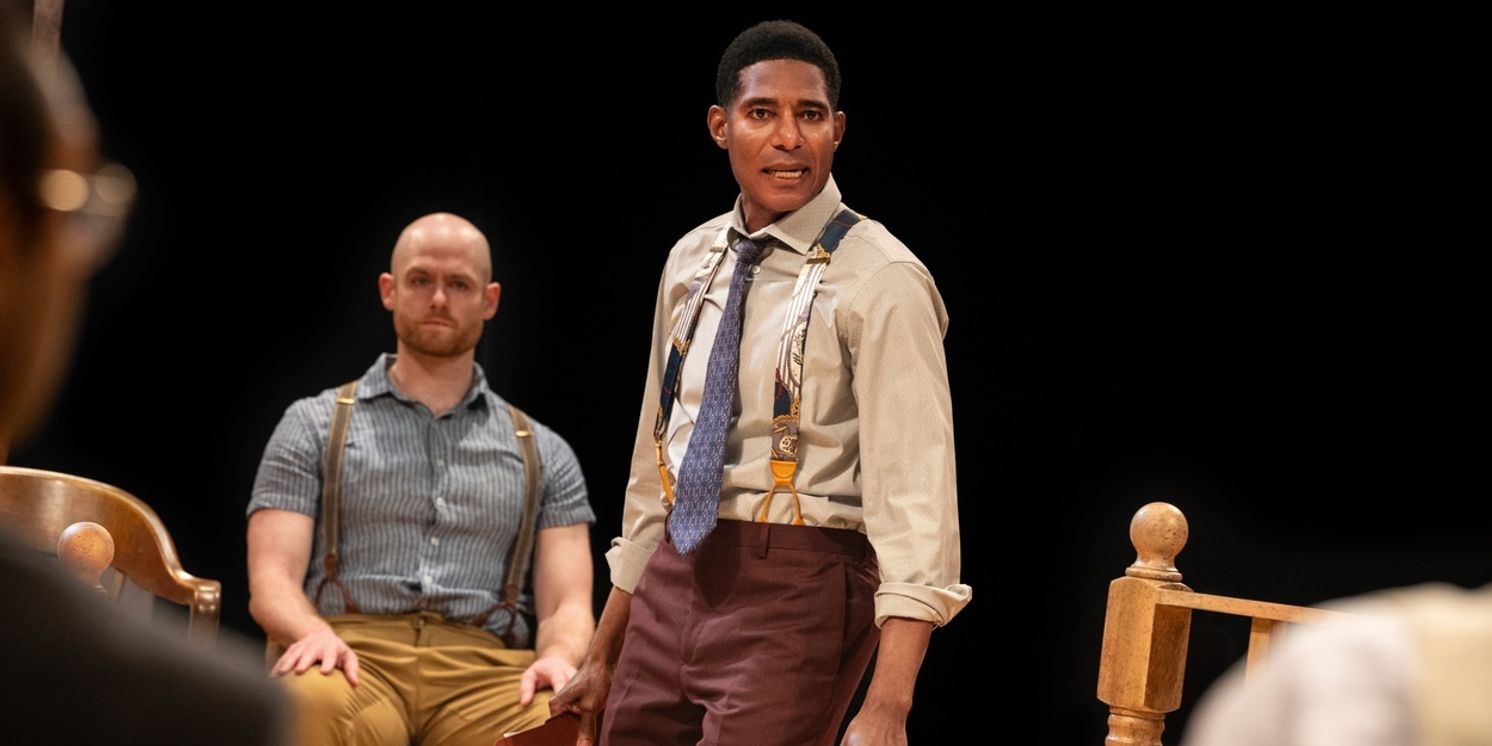
For the lawyer arguing the humanist side, the play’s version of Charles Darrow, Henry Drummond, is nobody resembling Spencer Tracy, though. Instead, Billy Eugene Jones, lean and charismatic, has more the countenance of a dashing youthful leader. It all comes off as Barack Obama vs. Col. Sanders and it’s not a fair fight. But it’s certainly an entertaining, and often enlightening one.
There’s a lyrical touch to the proceedings especially in the first act, when a string-enhanced spirituals are sung and it almost threatens to become a musical (which wouldn't be a bad thing -- Randy Newman took a good stab at the Monkey Trial in a 2017 song, “The Great Debate”).
Once the two lawyers finally get in the courtroom and Drummond has to put up with all matter of minor injustices from the judge, he finally puts the vaunted Brady in the witness stand, where they get down to the issues at hand and the inconsistencies in the beliefs he holds so strongly.
It’s an exchange that illuminates the original classroom battle, reminds one of the Cold War prejudices and certainly underscores the alarming times of today, sometimes so directly you’d think they wrote in some new lines to do so.
Spoiler alert, thanks to history: It’s ultimately a losing cause. But maybe along the way some minds have paused to reconsider things, enough to consider change — even a century on.
It seemed odd in the original play to change the names and other details to deny audiences the actual history of the event. The work is strong enough, though, to make people look it all up again.
Running time: About two hours, with one 15-minute intermission.
Photo credit: Noah Plomgren and Billy Eugene Jones in “Inherit the Wind.” Photo by Daniel Rader.
“Inherit the Wind” runs through April 5 at the Arena Stage at the Mead Center for American Theater, 1101 6th St. SW. Tickets available online.
Reader Reviews
Videos