


Review: ENGLISH at Alley Theatre
What We Gain, What We Leave Behind: ENGLISH and the Cost of Belonging
By: Jonathan Netek Feb. 20, 2026
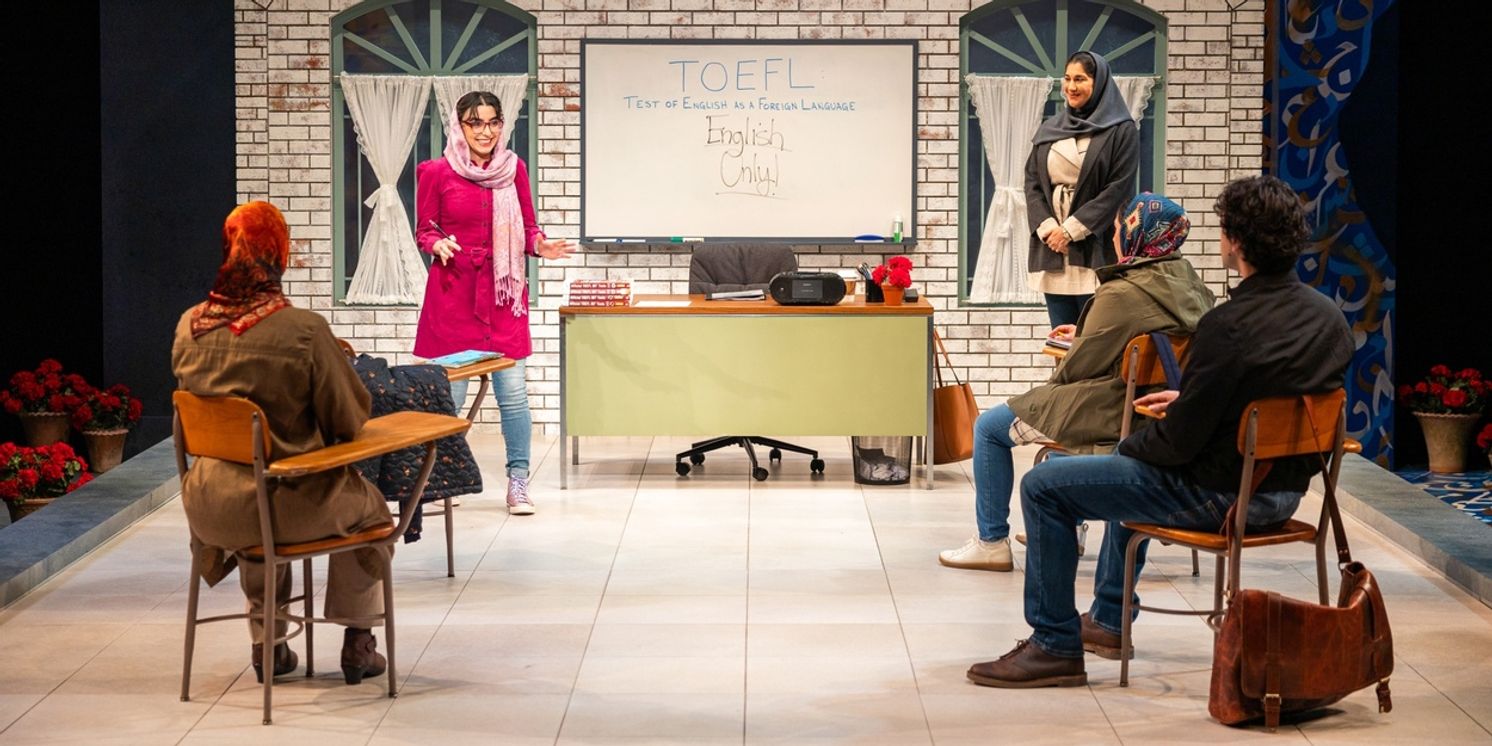
ENGLISH, written by playwright Sanaz Toossi, won the 2023 Pulitzer Prize for Drama and crafts an intimate, devastating portrait of language—as both bridge and barrier. Set in an Iranian classroom, the play unfolds less as a traditional narrative and more as a series of moments unfolding over time. Fluency and identity, ambition and belonging, what is gained in assimilation and what is left behind; these are themes Toossi treats with humor, hesitation, and silence, shaping them into something deeply human. The result is a piece of remarkable restraint that asks us to listen not just to what is spoken, but to what cannot quite be translated.
The play revolves around four students and their teacher, who is preparing them to take the TOEFL (Test of English as a Foreign Language). Each is there for individual reasons, each with a distinct relationship to the language and to what mastering it might unlock in their lives. All five actors are extraordinary, and it is a gift to watch their journeys intertwine onstage. Marjan, played by Jamie Rezanour, is the instructor, newly back in Iran after nine years abroad in an English-speaking country. Rezanour is brilliant as she walks the line between longing for where she was and trying to re-root herself where she is. Her performance is carefully composed while underneath something unresolved hums.
Goli, played by Vaneh Assadourian, is eighteen years old, a youthful optimist, and the last student standing at the end of the class. She absorbs everything, always watching. Assadourian brings a luminous openness to Goli, reminding us that hope is its own kind of courage. Omid (played by Nima Rakhshanifar) is the most proficient speaker and carries himself with easy confidence until we realize there is deception behind that fluency. Rakhshanifar wins us over quickly; when the truth of his circumstances emerges, the shift is audible.
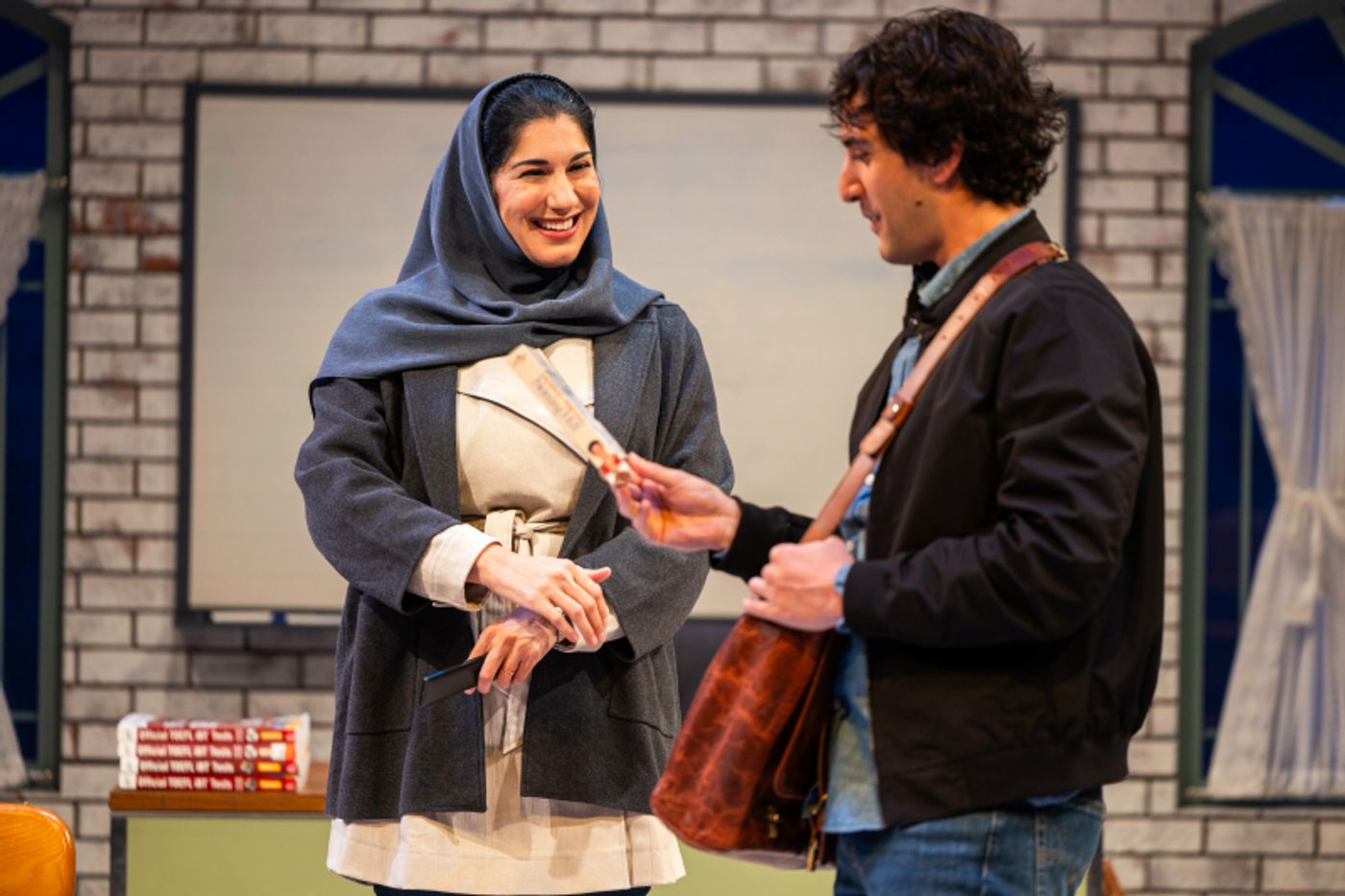
Roya is a new grandmother to her family in Canada. She is determined to learn English so she can communicate with her granddaughter. Pantea Ommi may have the least stage time, but for me she lands the deepest emotional blow. She wants nothing more than to please her family and join them abroad. Ommi’s quiet dignity and open yearning are palpable and heart-wrenching, particularly as she remains blind to her true predicament, placated by expensive gifts sent from an ocean away.
Lastly, there is Elham (played brilliantly by Shadee Vossoughi), who feels torn between two versions of herself: the one confined to a classroom struggling to learn English so she can get into medical school, and the “nicer,” lyrical self that exists when she speaks Farsi. Vossoughi delivers a tour de force performance, allowing Elham’s sharp edges to mask her vulnerability. When her frustration finally cracks her open, it reframes everything. Her struggle makes visible the play’s central question: if language is power, what happens when the language that gives you power is not your own?
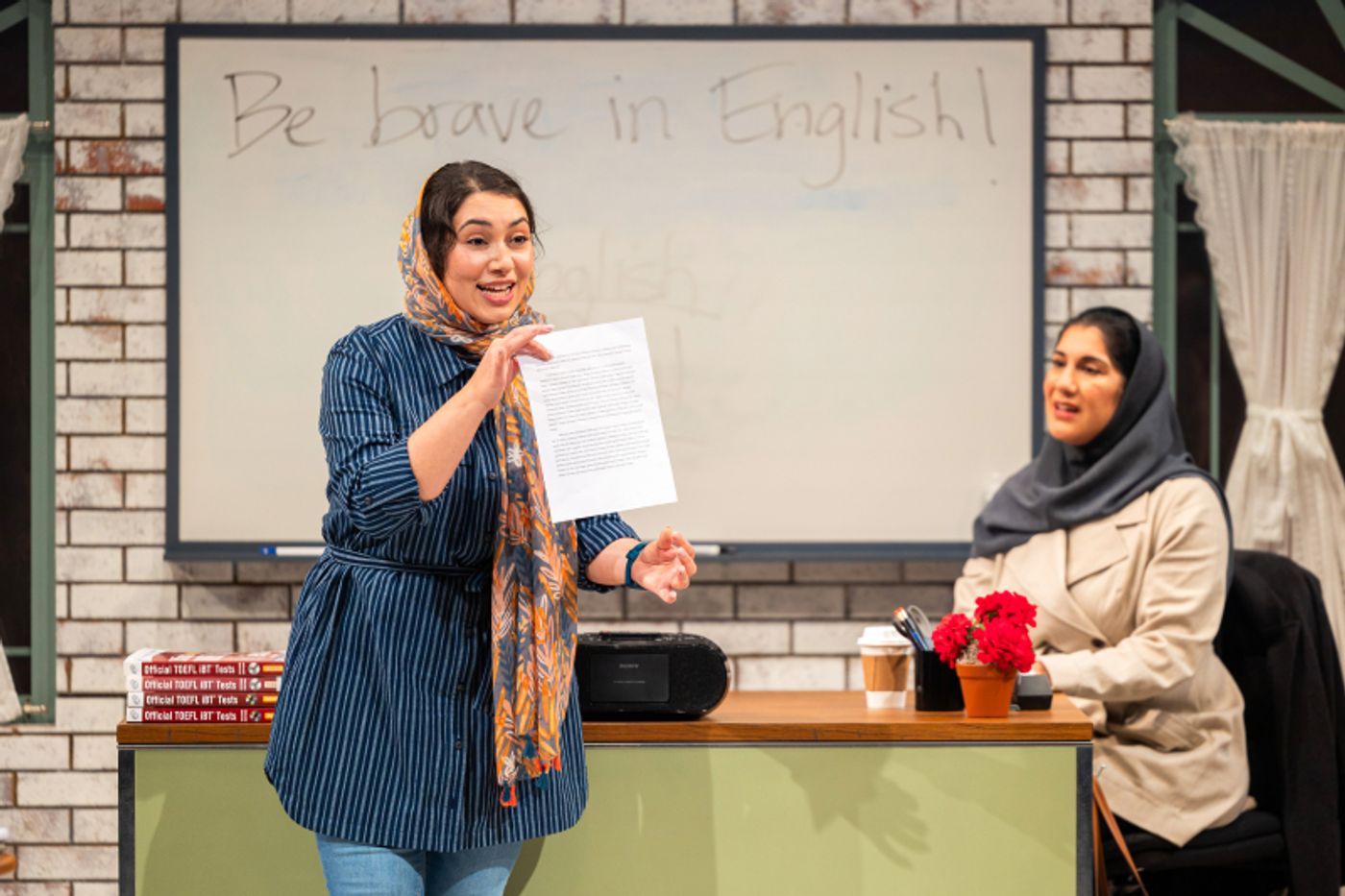
Director Evren Odcikin, a champion of historically-excluded voices, has said he waited a long time to direct this play. It was worth the wait. This production feels like a love letter to his culture, and the bond of trust between him and his cast is evident throughout. The stillness is intentional. The silences breathe. No one pushes. In a play like this, restraint is everything; the drama accumulates quietly until it delivers in spades.
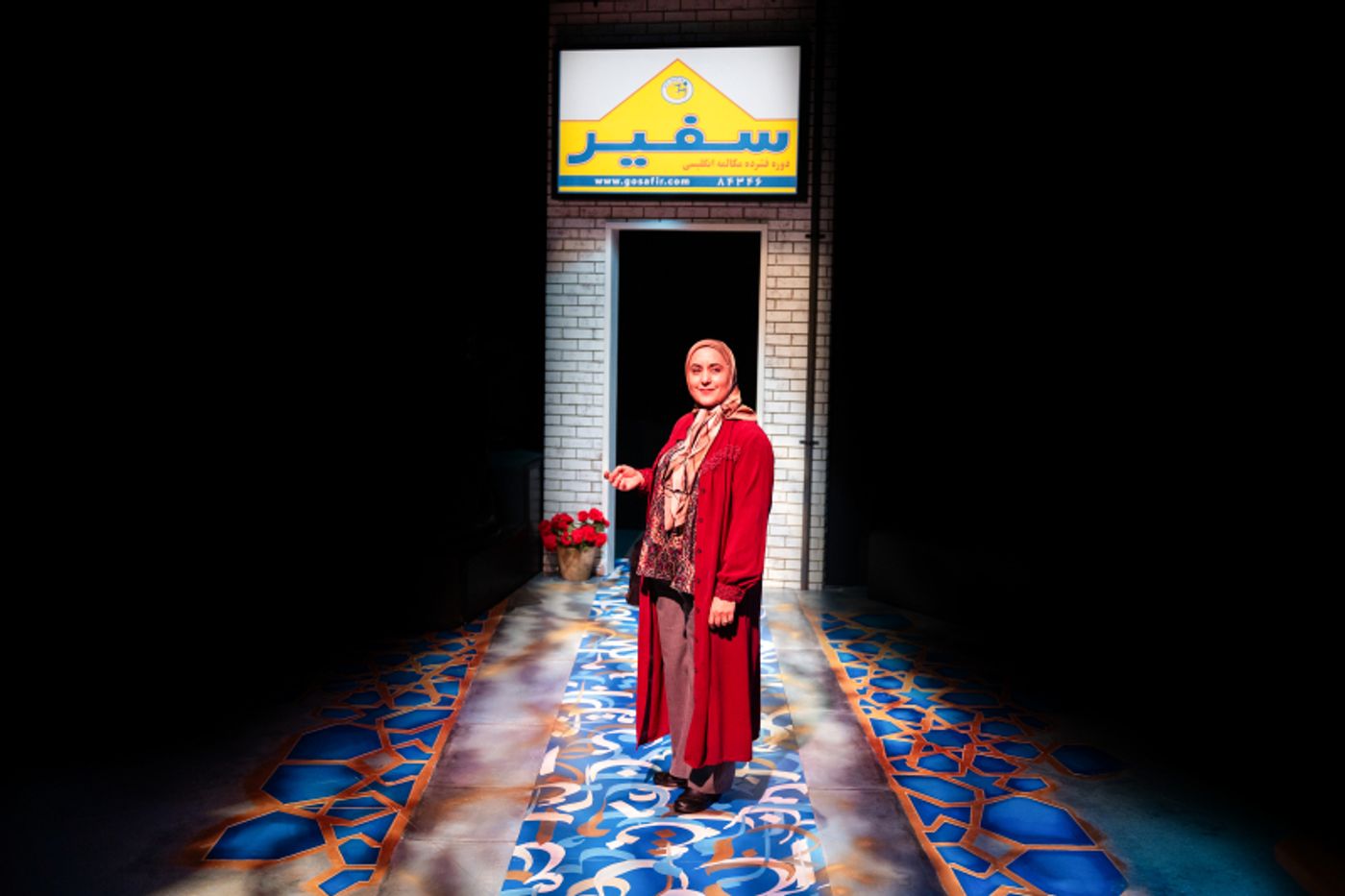
The scenic design by Afsaneh Aayani resembles a Persian fountain, a communal gathering place where people come daily for water, to commune, to gossip, to share stories…and grief. It is a fitting metaphor. Classrooms, like fountains, are places where people gather in transition, on the brink of change. Beautiful calligraphy greets you at the entrance to the stage, guiding us toward the raised classroom platform and climbing the back wall. Combined with a blue-and-gold design, we are transported to Iran while being reminded that this story is unfolding in countless classrooms across the world. Language may be specific, but displacement is universal.
Many years ago, in a completely different life, I designed the cover of a TOEFL (Test Of English as a Foreign Language) prep workbook for Cambridge University Press. The interior had already been written, edited, and produced elsewhere. Our agency was responsible only for the exterior: the front cover, back cover, and spine. These two parts were created separately, meeting only at the final stage. Watching this production, I couldn’t help but think about that division. The outer promise of English versus the interior reality of what it costs. That was in 2005. This play takes place the very next year. It’s wild to think that was more than twenty years ago, and yet the questions it poses feel painfully current.
I rarely get political, even in polite company. But it’s impossible not to notice how many theaters around Houston are programming seasons that respond directly to what we’re seeing on the news, on social media, and in the streets. More than one so-called hot-button topic has surfaced in shows I’ve recently seen and reviewed. Theater has always mirrored the moment while reaching into your chest and squeezing. That’s why I love it. And I have to say I’m here for it. Thank you, Houston theatre, for being brave enough to put truth in front of us to open hearts and minds.
ENGLISH runs through March 8th at The Alley Theatre, on the Neuhaus Stage. Evening performances are Tuesday-Thursday at 7:30pm, Friday and Saturday at 8:00pm, and 2:00pm matinees on Saturday and Sunday. The show is 90 minutes long and does not have an intermission. More information on the theater and the production can be found here.
Reader Reviews
Videos