Interview: Jane Comfort on THE GULF OF AMERICA at LaMama
Jane Comfort and Company will debut a world premiere alongside two existing works at LaMama's Ellen Stewart Theater March 19-22 2026
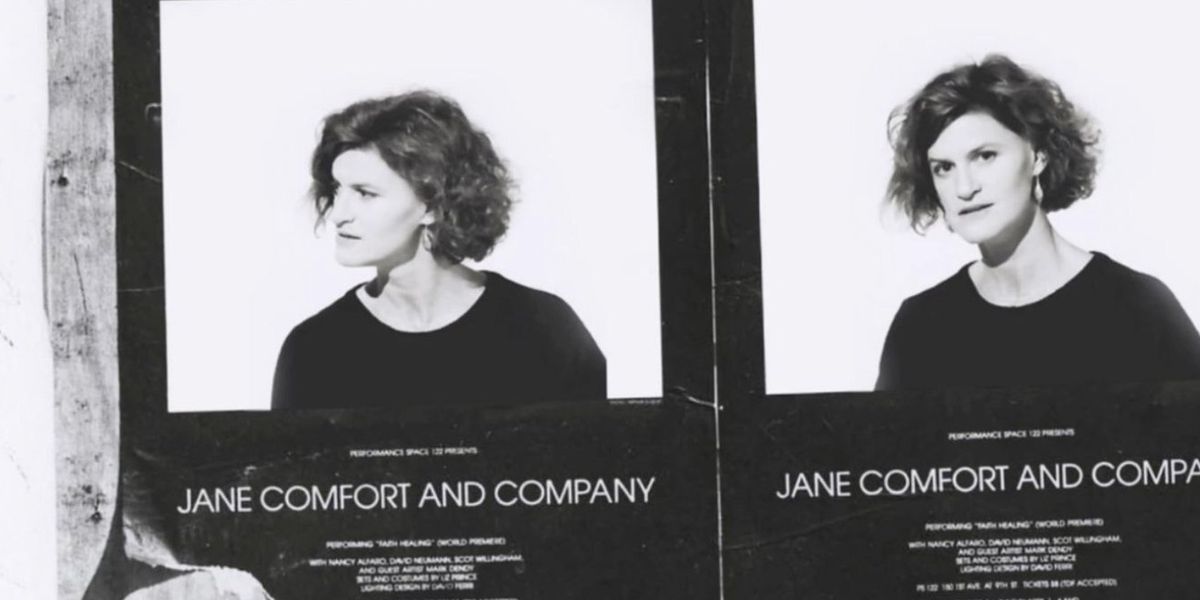
“This is where my first concert was in 1978,” says choreographer Jane Comfort while rehearsing in the studio at Eden’s Expressway in Soho, New York. Nine members of her company gracefully erupt into grounded chaos, extending pressure onto each other in a militant, strained manner. Some dancers wear balaclavas and helmets for the duration of the rehearsal, evoking a feeling of fear-inducing authority.
Choreographer Jane Comfort has been known for creating dynamically truth-telling works, deconstructing and erasing the boundaries between dance and politics for decades. Since her first concert, she has created and presented over 60 dance works worldwide, including being honored a Bessie Award in 2018 for Outstanding Revival of 40th Anniversary Retrospective.
For the first time in over eight years, Jane Comfort and Company will return to LaMaMa to present a world premiere alongside two celebrated theater-works. Known for her longstanding body of dynamic performances confronting cultural and political landscapes, Comfort debuts “The Gulf of America” which faces America’s current immigration crisis, specifically addressing the ongoing turmoil between civilians and U.S. Immigration and Customs Enforcement. Through a collaboration with two-time Obie Award-winning singer and composer Heather Christian, Comfort entangles the audience into the world of chaos, strife, and isolation caused by the government’s actions.
The program also includes Comfort’s Afro-Brazilian inspired “Artificial Horizon” created in 1983 and the radically stimulating “Bites” created in 1996, which examines the concept of scarcity in community. With each work created in three distinct time periods, Comfort’s program assimilates into a confrontational welcome to her choreographic interpretation of our cultural climate and world.
How would you describe the core and roots of your movement language?
I was trained as a dancer, which is when I started choreography. I think of my movement as movement theater, even though I wasn’t trained as an actor or a director. I always wanted to tell a story. I wasn’t that interested in movement for movement-sake; that wasn’t the reason to go into the studio. I think the reason to go in was to make a statement.
How did your earlier work in the program such as “Artificial Horizon” come into fruition?
“Artificial Horizon” is an Afro-Brazilian piece I did in 1983, which is pure movement. I trained with Cunningham and had a child in 1980, and our babysitter who happend to be Brazilian told us about these beautiful Afro-Brazilian classes that are being taught at the Clark Center. When I went to try it, I couldn’t believe how joyful and liberating it was, unlike any training I ever had. There was so much to learn, and the classes had polyrhythms which I couldn’t understand every time. The experience was so joyful, I decided to make a piece. In terms of reviving the work, over the last couple of years, we made a documentary and one of the things we explored was the early work. I was looking at this piece a lot thinking wow, that’s so interesting; I think I want to revisit this. The video we have of the work is from 1983 and the footage is so dark, thank God we were wearing white jazz shoes because sometime that’s all you can see. We tracked the patterns on the floor and tried to pull it back into memory. The dancers finally got off the video, and it’s in their bodies now, but it has been unbelievably difficult to pull back.
How did your inspiration for “Gulf of America” evolve?
This piece has been on the horizon for a while. Last Spring, events with ICE were happening, but it wasn’t what it is now. I decided part of “The Gulf of America” will portray an attack on innocent people. We’re doing fight choreography including real fighting because it’s a structural representation of chaos. I think the structure of this piece is the chaos, which I feel like is what our country is right now. I’m not representing anything other than a structure which has been attacked and is in chaos.
When you’re in the studio creating that chaos, what are you looking for?
In one of the sections we refer to as the “scrum”, you probably noticed how I just said okay, each person chooses what happens in the next five seconds. We’re putting the pieces together inch by inch in a collaborative manner in those moments. When the dancers break out of the scrum, they go into literal fights with each other. The fist fights we did yesterday is where I hope our fighting coach can come in and check them out. Yesterday, the fighting happened three times, and at first, we incorporated five second delays which ran through the groups, and at the end they all have the same delay in terms of timing. They’re stopping and starting again, almost like pushing a pause and play button for a video. There’s a metaphor there. After pushing the pause button once more, there comes a two-minute stare down between each pair of dancers.
How do you coordinate these sections of the work? Do you have an order and sequencing in your head before arriving to the studio the first time?
For the overall work, yes. I had the structure of the innocent civilians dancing peacefully and then having ICE come in already set. And as I told you, as it moved from the civilians dancing to ICE, instead of one by one, it became all at once. The wall of dancers portraying ICE walk towards them, pushing them farther to the wall. I try many different structures, using different ideas to see what works well. It’s very collaborative, and sometimes the dancers have ideas, for example like how to introduce these pauses, which is great.
In the studio, would you say it’s a constant conversation between you and the dancers?
Yes, there’s a lot of “let’s try it and see.” And then the idea of having the stare down at the end of the work was based off an instinct I had. There was a vision of having one person’s balaclava removed and showing a person behind it, just standing.
You’ve created works which delve into such a range of political topics. Are you hoping that the audience leaves this piece with something specific?
I don’t know. I think everybody coming to see our show is already there. I think putting the work out is simply my way of being a citizen. When I think about making a piece, somehow this is what’s the most compelling to me, more so than making arabesques. I use humor sometimes too, but not in this piece. I would say I put all of my energy into making works like this, and it can be incredibly powerful as a result.
How did you curate this specific program for LaMama?
In general, when you go to most dance concerts, there are usually two old pieces and a new premiere. I’ve said for decades that I wanted to do that; however I would continue to create evening length works which took up most of the time. For years, I’ve kept myself to this goal and made this piece 20 minutes; which I’ve never had. When I asked Heather Christian if she could do it, she said 20 minutes will feel like five minutes, and I said, me too! Of course, you get in the studio and it’s suddenly become much more than five minutes.
You’ve worked with musical collaborator and composer Heather Christian previously; I was curious how many processes you’ve gone through with her, and if it’s changed with this work?
This is the first time I think we’ve commissioned her for music. Before, she came on board as a performer. She and company member Sean knew each other from New York University. Heather came on board as a performer for a a piece I made, playing ‘Amanda’ in the revival of Faith Healing/Menagerie Reimagined at the Joyce SoHo in 2010. She also joined for the 40th Anniversary Retrospective in 2018. We were going to end the work with 22 people doing a sign language version of Amazing Grace, and I had a recording of an Irish singer to play as the soundtrack. During the dress rehearsal, Sean said, you know, Jane, I don’t think that recording is so great. What if Heather sang it live? So, I went over to her and asked her, and she said yes. She sang live, which was our first time having musical collaboration. Then she came back for this work, which is fantastic.
How do you work remotely in collaboration for the soundtrack of “The Gulf of America” with Heather?
She hasn’t been around because she has an Off-Broadway piece. I sent her a rehearsal video in December, and she’d create something and send it back. A few weeks ago, we recorded what we had for the fight section with timing. She sent me the full 20-minute track, and yesterday we tried it with the fight, and it ended exactly on the second. I couldn’t believe it. During the fight, I’d also ask her for instrumentation that’s chaotic, and she said, I can do that. I can increase the volume, and cut it into thirds, so if your timing isn’t right, your sound person can start it at a specific section. I don’t think she’s in town right now, so it’s all been emails. That’s our new world.
Being in the studio with your company felt so candid and open, like you created an atmosphere inviting trust and communication.
Yeah, you see what a good group of people they are. Some people are more involved in the process than others, but what’s ironic is all these people playing ICE are the nicest, kindest people and dancers.
For more information about Jane Comfort and Company, please visit: https://janecomfortandcompany.org/portfolio/40th-anniversary-retrospective/
For more information about Jane Comfort and Company performances LaMama, please visit: