



Season 2, Episode 5: Behind every summer is a community that keeps Fire Island alive. This episode explores the history of the beloved Pines Pantry through the eyes of its iconic Pantry Girls, alongside the volunteer firefighters of The Pines and Cherry Grove who protect the island from fires, hurricanes, beach erosion, and an uncertain future.
Interview: Corey Fogelmanis Explores Love and Murder in ROPE
The actor makes his New York stage debut in The New Group’s queer psychological thriller, exploring the dangerous intersection of love, obsession, and manipulation.
By: David Clarke

Photo by Brendan Wixted.
Love, or the illusion of it, can make people do extraordinary things. For Nate Singer, the emotionally vulnerable young man at the center of The New Group’s ROPE, it becomes the motivation for something horrific. Portrayed by Corey Fogelmanis in his New York theater debut, Nate finds himself entangled in a murderous scheme orchestrated by the man whose affection he desperately craves. What begins as a twisted declaration of devotion quickly unravels into a devastating confrontation with the consequences of misplaced trust.
A new adaptation by Gordon Greenberg of Patrick Hamilton’s 1929 play, which inspired Alfred Hitchcock’s 1948 film, ROPE follows two privileged young men who murder someone to prove their intellectual superiority. They then host a dinner party with the victim’s body hidden in plain sight. Directed by Scott Elliott, the production stars Fogelmanis opposite Cameron Monaghan as Garrett Stern, alongside Elizabeth Gillies, Jason Butler Harner, Graham Phillips, and James Waterston.
For Fogelmanis, whose screen credits include Ma, I Wish You All the Best, and My Life with the Walter Boys, and the upcoming The Further Mis-Adventures of Cliff Booth the production offers an opportunity to explore the darker complexities of human relationships. “What made me so excited was the spectrum of feeling that can exist within an act of this magnitude,” Fogelmanis shares. “And then being in a situation where there is no escape. Nate is with someone who is demanding a very specific thing from him.”
Unlike Garrett, whose calculated cruelty drives the evening’s events, Nate struggles to reconcile his actions with his growing realization that the relationship he believed in may never have been genuine. “I think for Nate Singer specifically, it’s probably the willingness,” Fogelmanis explains when asked whether his character’s actions or justifications are more dangerous. “When you see the show, you realize that Nate doesn’t really hold up very well, but it’s that kind of willingness to do whatever it takes to get attention from Garrett and to get the love that Nate thinks that he will get if he just goes along with Garrett’s plan.”
Greenberg’s adaptation places the queer relationship between Nate and Garrett at the forefront, transforming the story’s psychological tension into an examination of intimacy, emotional dependency, and manipulation. “I can’t see a reason why Nate would do this if it wasn’t for that love and that connection,” Fogelmanis observes.
That emotional vulnerability informs how Fogelmanis approaches a character whose actions are unquestionably reprehensible, even as his motivations reveal a more complicated humanity. “I think there’s humanity in the circumstances Gordon has written for Nate. Flawed humanity at any rate,” he elaborates. “I won’t sit here as Corey and say Nate was justified in doing what he did. It was selfish, heartless, and cowardly, but at the same time I can see these moments of susceptibility to Garrett’s charm, the way he wields love and affection to get the things he wants, and how Nate could get swept up in the fantasy of what they could have together.”

Photo by Monique Carboni.
As the evening deteriorates, Nate begins recognizing the difference between the affection he imagined and Garrett’s actual intentions. For Fogelmanis, that distinction is central to understanding their relationship. “From my point of view, I think they’re inextricably linked,” he says of affection and manipulation. “I think the only times that Garrett is affectionate with Nate is when he wants something.”
Beyond its exploration of toxic intimacy, ROPE also examines privilege, class, and the dangerous consequences of believing oneself could be exempt from ordinary moral boundaries. Although rooted in an earlier era, Fogelmanis believes its themes remain relevant. “I think ROPE does a nice job of blending the period elements with a conversation about class, upward mobility, opportunities, identity, feeling like you can share or not share certain parts of that,” he reflects.
The production also distinguishes itself from Hitchcock’s famously restrained film through its heightened emotional intensity. Where the cinematic adaptation emphasizes calculated suspense, Greenberg’s version allows Nate’s increasingly fractured emotional state to become part of the drama. “What I love specifically about playing Nate is that he is very human,” Fogelmanis says. “There’s nothing robotic about the way that he moves through this night.”
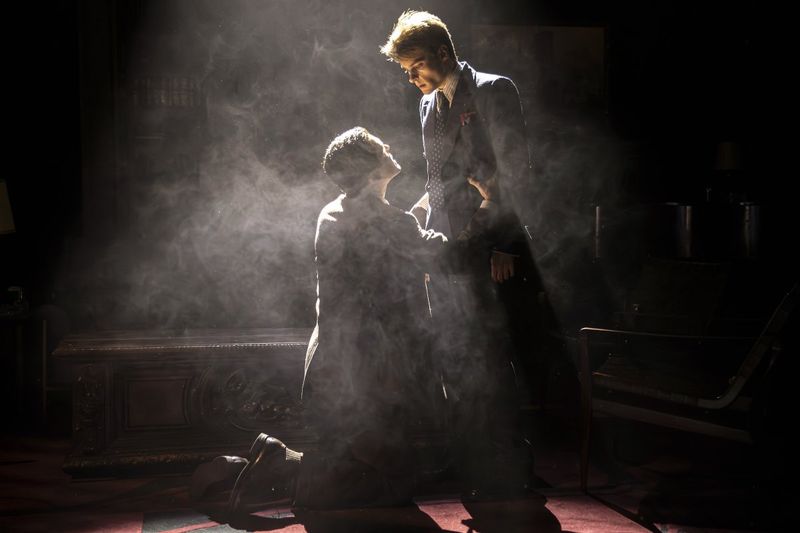
Photo by Monique Carboni.
Having previously portrayed queer characters navigating the exhilaration of first love, Fogelmanis appreciates the opportunity to explore a relationship in which affection becomes something considerably more destructive. “There are elements of Nate that are very bitchy and mopey. Nate is manipulative in his own way,” he admits. “And that’s very fun to play because it’s just different every night.”
That unpredictability has become one of the most rewarding aspects of his theatrical debut. Working under Elliott’s direction, Fogelmanis has discovered new challenges in sustaining a character’s emotional journey throughout an ensemble production. “I think he [Scott Elliott] has given me a lot of tools to live in something for an extended period of time,” he explains. “I feel like I’ve learned a lot and continue to learn a lot.”
For an actor whose career began on Disney Channel and now includes an upcoming David Fincher film alongside Brad Pitt, ROPE represents another opportunity to expand his artistic range. Yet Fogelmanis seems less concerned with reinventing his public image than embracing the work itself. “I’m in a place where I’m really trying to relinquish any sort of control or feelings over what people think about me or understand,” he states. “I just love to do this, and it means a lot to me that I get the opportunity to do it and share things that are important to me with the world.”
ROPE continues its limited Off-Broadway engagement at the Theater at St. Clement’s through December 6, 2026.
Breaking Broadway alerts by text
Get the biggest stories sent straight to your phone.
Broadway news in your inbox
Weekly top stories - unsubscribe anytime.
Weekly top stories - unsubscribe anytime.

|
Powered by

|
Popular episode




Tickets From $70

Tickets From $135

Tickets From $58

Tickets From $67