


Review: WHEN THE CLOUD CATCHES COLOURS, Barbican Theatre
The Singaporean play runs as part of the Queer East arts festival
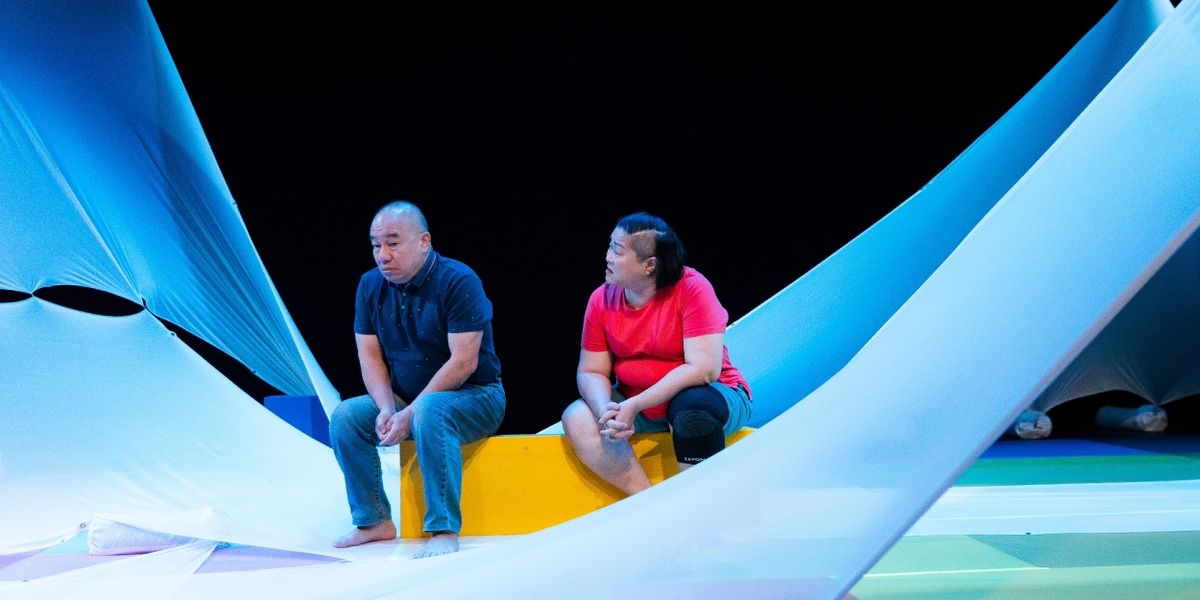
 “It’s not Buddhist to be gay”: from this early line in Singaporean drama When the cloud catches colours, one might expect a hard-hitting, intellectual look at homophobia in the South East Asian nation, which decriminalised male homosexuality in 2023. What follows, however, is something both more profound and more tender, a look at queer attitudes towards domesticity and community through the lens of two middle-aged Singaporean lives.
The lives in question are those of Qing and E (short for Eileena), played by Julius Foo and Judy Ngo. Qing reels in the aftermath of his long-term partner leaving him with only a note, before marrying a woman, while E is the sole carer for her elderly mother, who tries to force a relationship between E and her estranged brother.

Photo credit: Ryan Lee
Both these stories are directly inspired by real queer Singaporeans in their fifties, and Foo and Ngo perform interlocking monologues (in a mixture of English, Mandarin, and Hokkien) lifted verbatim from interviewee testimony by writer-director Chng Yi Kai. Qing and E rarely interact directly, and there’s no clear structure to this show; instead, Foo and Ngo drift around the stage and through non-chronological narratives of their lives, touching on themes political, social, and philosophical.
Sometimes, the monologues do fall into the trap of telling rather than showing their messages. Banal lines such as “safety is important to queer people” could have been illustrated in Qing and E’s words rather than stated outright. There are also some awkward structural moments, where important political themes such as housing for queer people in Singapore, where unmarried people cannot purchase flats until the age of 35, are clumsily inserted into the narrative after mostly unrelated scenes.
What feels more meaningful, though, is when the show instead explores how people reacted to legislative changes on a more personal level. E’s reflections on LGBTQ+ activism, including conflicts with a younger, angrier generation, feel authentic and emotionally resonant without being preachy. When Qing and E do interact directly, it’s to powerful effect, as Qing experiences his deep loneliness while shut off from the world, while E loudly projects her identity externally.
It’s a shame that the segue into the play’s ‘housing’ section felt so jarring, because the idea of domesticity is another strong point in Chng’s script. Legal codes and social norms have made Qing and E’s living situations unstable, but in different ways, and the play skilfully walks the line between the characters’ pride in their queerness and grief at what they’ve lost because of it.

Photo credit: Ryan Lee
Qing and E have complicated and ever-changing relationships with the idea of home, of community inside and outside of the home, and of independence, and these ideas are powerfully visualised through Lim Wei Ling’s understated set design. The brightly coloured stage is draped in a translucent cloth, which is endlessly pushed and pulled around by the actors, variously acting as the homes in which Qing and E reside, blankets to cover them in moments of torment, and trappings for them to cast aside.
In keeping with the general conceit of verbatim drama, things don’t come to a neat conclusion here, but Qing and E have both changed their conceptions of home and safety by the end of the play. This is less a drama and more an exchange of ideas, and the audience comes out more informed and empathetic for it.
When the cloud catches colours is at the Barbican Theatre until 26 April
Photo credits: Ryan Lee






Reader Reviews
To post a comment, you must register and login.