

Review: THE GAMBLER, The Coronet Theatre
Kyoto-based Chiten Theatre returns to the Coronet.
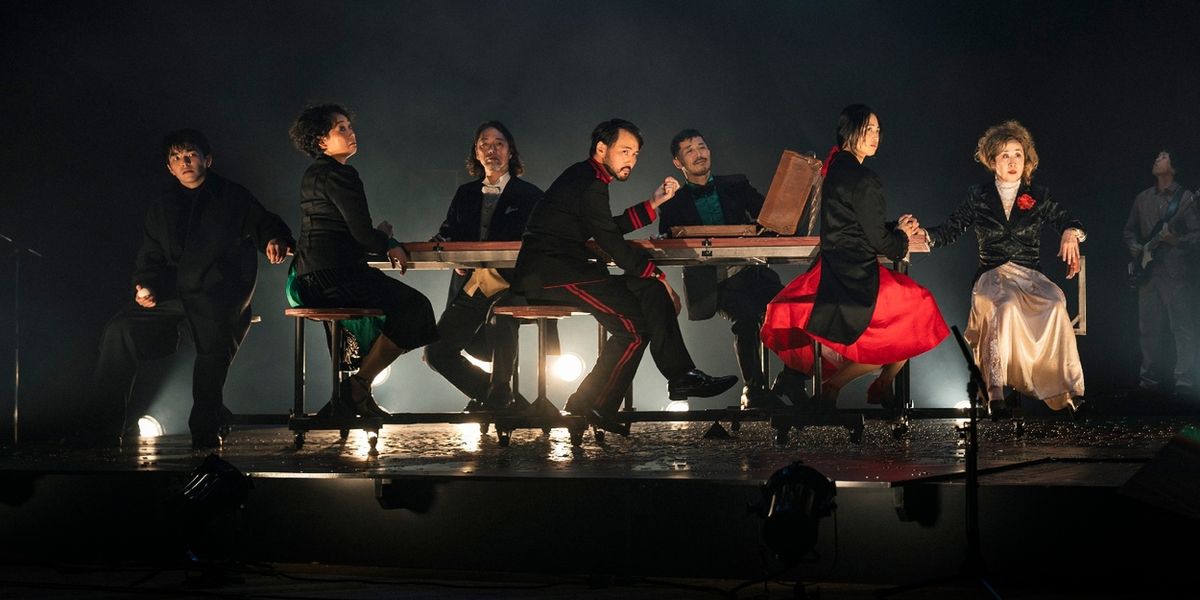
 Japanese company Chiten Theatre returns to the Coronet with an energetic adaptation of Dostoevsky’s novel The Gambler. Directed by Motoi Miura with a translation by Ikuo Kameyama, it’s accompanied by experimental rock trio kukangendai. It’s an entertaining, fascinating production presented in Chiten’s unique style.
The history of the book is in itself intriguing, and Dostoevsky’s addiction to gambling is essentially distilled in it. Written to pay off his debts, it saw the author betting the full rights to his works ahead of starting. If he hadn’t completed it in time, F. T. Stellovsky would have been able to publish him for nine years without compensation. Needless to say, the bet put a pep in Dostoevsky’s step.
The Gambler details Alexei Ivanovich’s ruinous gambling habits. Employed by a formerly wealthy Russian general as a tutor, Alexei falls in love with his employer’s stepdaughter and bets his life away. A thematic analysis of class, greed, social unrest, compulsion, and moral corruption seeps out. Miura takes the plot and explodes it into a long series of statements at a roulette. The performers gather around it, compelled to the table and seemingly incapable of ungluing themselves from it. They spin out of control upon Itaru Sugiyama’s set – a large diamond with the numbered red and black wheel painted on it.
Alexei is in charge of pivoting the counter, anchored in its centre and heavy. The expressionist take begins. Surrounded by aristocrats whose concept of money is only a theoretical game, the boy is the only one forced to struggle. Takahide Akimoto knuckles down, visibly exerting himself as he pushes the rest of the cast. What starts as a quirk becomes a visual allegory for the nature of addiction and ambition. As the music grows frantic and the script repeats itself, their obsession escalates.
Miura’s take, in spite of being wholly original and captivating to watch, falls short when it comes to tangible delivery. Dostoevsky introduces a lot of characters with a substantial amount of backstory and interpersonal relations. It’s a linear, dense narrative, and Chiten’s fragmented experimentalism ultimately loses hold of it. The piece still lands. Its movement direction oscillates between febrile and icy with secure discipline, and the infinite loop of wins and losses instigates a reflection. The insurmountability of the class divide manifests in entitlement and stagnation, echoed by the cyclical motion of the storytelling.
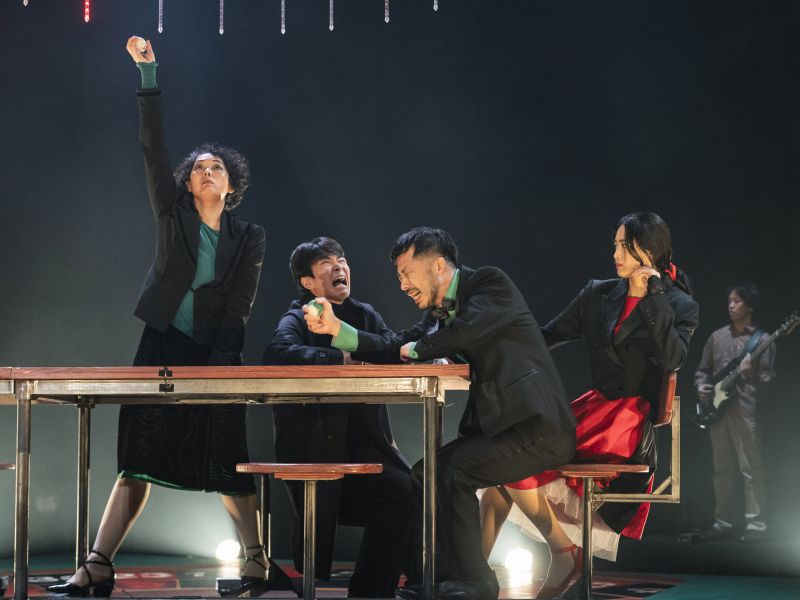
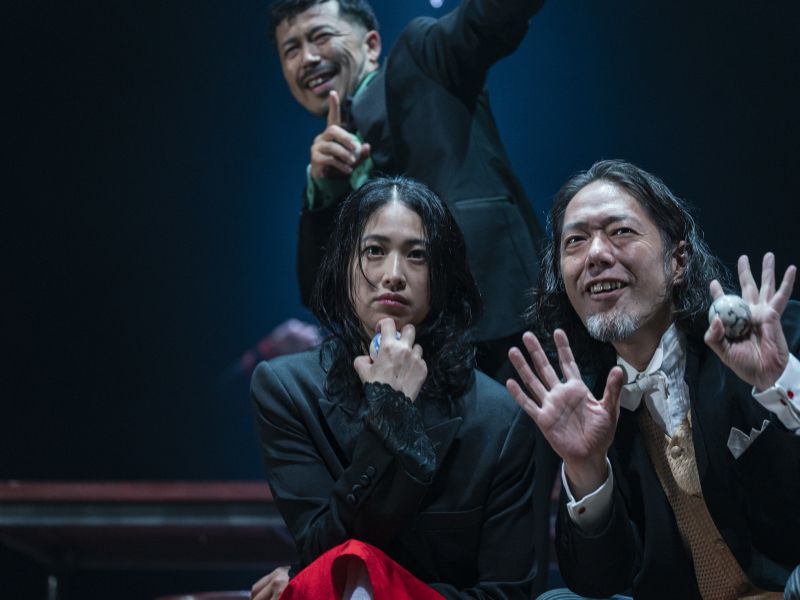
The visuals are striking. The central roulette might be the focal point, fixed in its near-continuous whirl. The company buzzes in waspish bouts of energy, rarely speaking to one another and opting to gossip or confide in the audience instead. They face the stalls unwaveringly, twisting towards the public as if hypnotised. They take the floor in turns, slamming a snooker ball on the table and creating a steady rhythm that’s amplified by kukangendai’s score.
It’s a risky project. The dramatic decentralisation idiosyncratic to Chiten’s work weakens the result, as the demands of the storyline are too overpowering. The adaptation focuses on the themes rather than the active plot points, undermining their importance and impacting the final message. Nonetheless, the ensemble is strong and the vision is thoroughly compelling.
The Gambler runs at The Coronet Theatre until 15 February.
Photo Credits: Shotaro Ichihashi
Weekly top stories - unsubscribe anytime.
.jpg?format=auto&width=300)





Reader Reviews
To post a comment, you must register and login.