


Review: DA VINCI'S LAUNDRY, Riverside Studios
A confused, unfortunately tasteless comedy about forgery and the role of art in modern society.
 The world of high-end art may look like it’s all about sipping champagne at gallery openings whilst exorbitantly priced works hang around you; it’s also rife with crooks. Appraisals are serious business, and there’s a lot that goes into pricing a piece of art. It can all come off as a little made up unless you’re in the know. After all, hasn’t the value of artworks been commonly attributed to the same amount of money a magnate needs to launder?
Keelan Kember writes a morally compromised microcosm where art is money, status, violence, and power. It’s a shame it doesn’t fulfil its potential. Instead, it’s tasteless, continually slipping into a vicious circle of stereotyping and triteness. Directed by Merle Wheldon, it doesn’t rise above commonplace comedy even when it’s at its best.
.jpg?format=auto&width=1400)
With a potentially fake Da Vinci in their hands and a situation that keeps escalating, two art assessors, Christopher and Millie (Keelan Kember and Arsema Thomas), are faced with a choice. Persuaded by Tony (Steve Zissis), an American “fixer” to a wealthy Arab Prince (Fayez Bakhsh), to abandon their ethical thinking, they sell Boris’s (John Albasiny) painting.
When the latter (who by the end comes off as a second-rate Bond villain of sorts) fesses up, all hell breaks loose. While the story is rather predictable, there are worse issues at stake. Stripped of its crass, clownish aboutnothingness, the work is about the state of the affairs as much as it is about morals, but it has very little to say and none of it is original.
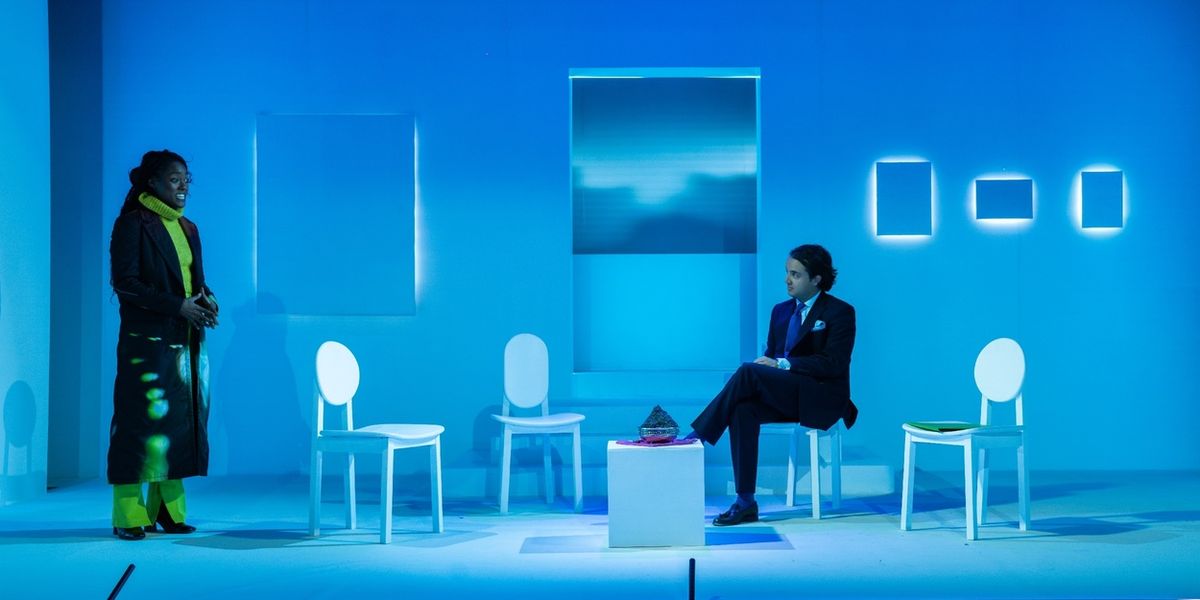
The performances are thoroughly commendable. Thomas stuns in her acid green outfits and rich portrayal. She’s subtle, passionate, and faceted, introducing a young woman who unfortunately suffers from written-by-a-man syndrome. Kember’s need to shoehorn in a romantic plotline as well as a conversation about motherhood for good measure in a play like this adds to the perplexity that surrounds the quality of the material.

At the same time, he is a cracking Christopher. His comic take is more indirect and small than the other men’s, opting for low-key physical reactions and pregnant pauses. He has an excellent back-and-forth with Zissis, who bursts through the scene and takes over. He is an indelicate, loud, crude dogsbody who acts as a foil to Millie’s moral compass.
Deep flaws come to the surface and are most visible when it comes to his character. Trumpian tangents that go nowhere and overly exuberant idiocy cheapen the discourse rather than being the sociopolitical insight they want to be. Tony’s MAGA-voting, Hillary Clinton-hating, anti-intellectualist takes are cheap. His views are the common, lowest-hanging fruit you can easily find anywhere online, but they’re shoved in as uncontested punchlines.
His proud lack of education and principles is weaponised as a narrative point. Kember tries hard to make it a heavily political piece, including overt satire and jabs at the intimate relationship between the UK and Russia, but largely leaves his statements untouched and under-analysed.

We get that it’s a comedy, and it’s meant to be fun, but it truly is only fun in those rare moments when it lets go of its eagerness to be. There are loads of interesting ideas in it, but they’re half-hearted. An exegesis of how the role of patrons has changed through the centuries gives way to nods at various discourses on misogyny, cultural relativism, market manipulation, and the social significance of artists.
Regrettably, it’s all limited to locker room chitchat and shallow crowd-pleasers. The writing could have so much scope: Kember engages a series of paced dialogues that intrigue and excite, but rarely sees them through to any satisfyingly thoughtful endings.
The parody is superficial and the substance is shaky. The plot is thin, with the analytical slant of the artistic industry reduced to preconceived notions that don’t challenge the audience in any form. It looks exquisite, though. Set designer Eleanour Wintour hosts the play inside a white cube with blank canvases on the walls. Colour washes over the scene changes, while light fans out from behind the “art”.
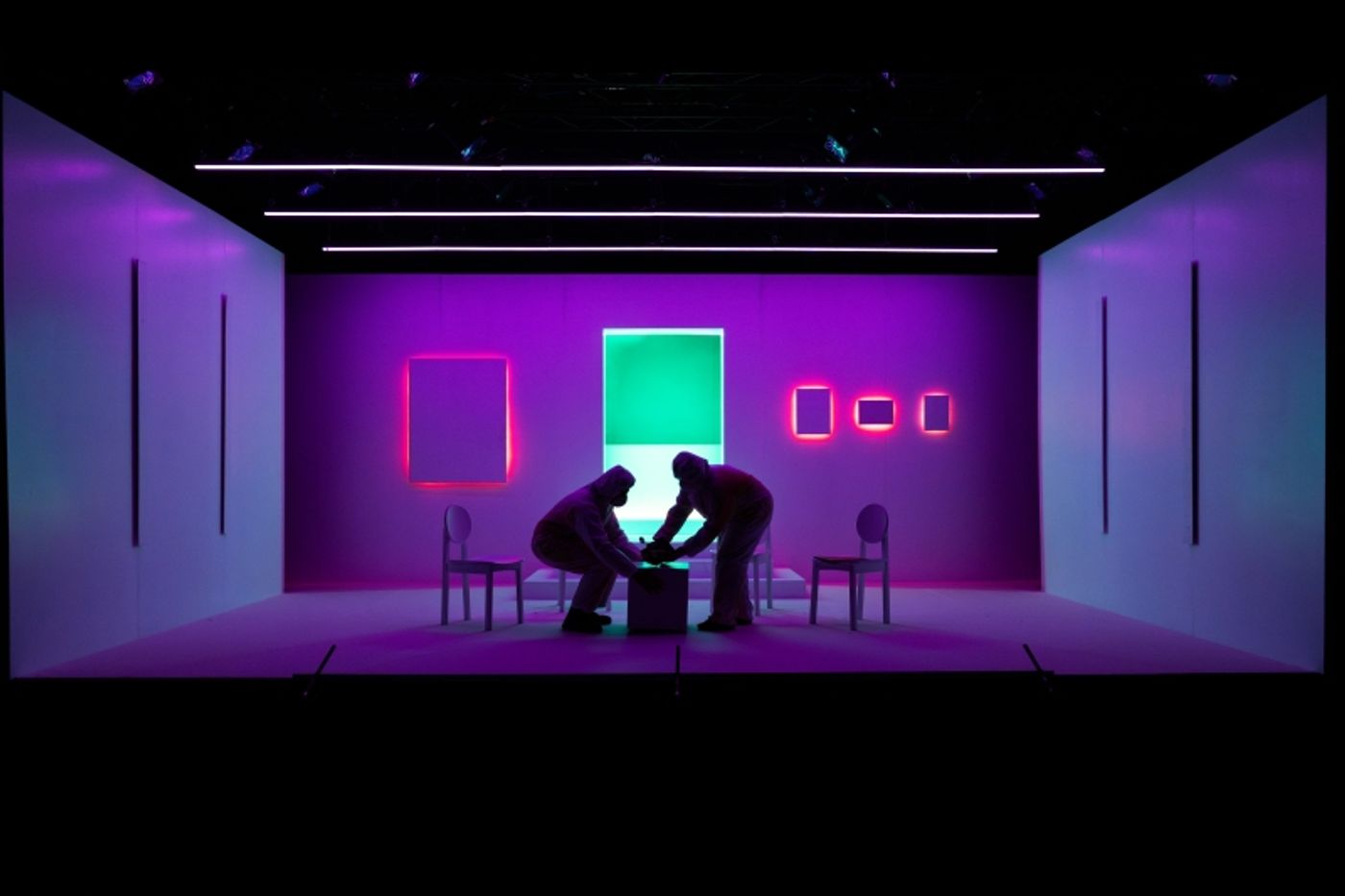
An exit upstage is the chance for visual amusement, with a gold Jeff Koons Balloon Dog and other items appearing to move the action between locations while individuals in full PPE ease the changes along, shuffling chairs around and bringing tables in. All in all, we can’t say that the production is slapdash or anything of the sort, but it would benefit from a nuanced tidy-up. As it is, its purpose is slightly too messy to work.
Da Vinci's Laundry runs at Riverside Studios until 25 October.
Photo Credits: Teddy Cavendish






Reader Reviews
To post a comment, you must register and login.