


Review: BEETHOVEN: I SHALL HEAR IN HEAVEN, Opera Holland Park
This production, landing somewhere between a play and a concert, plays for two nights only at Opera Holland Park
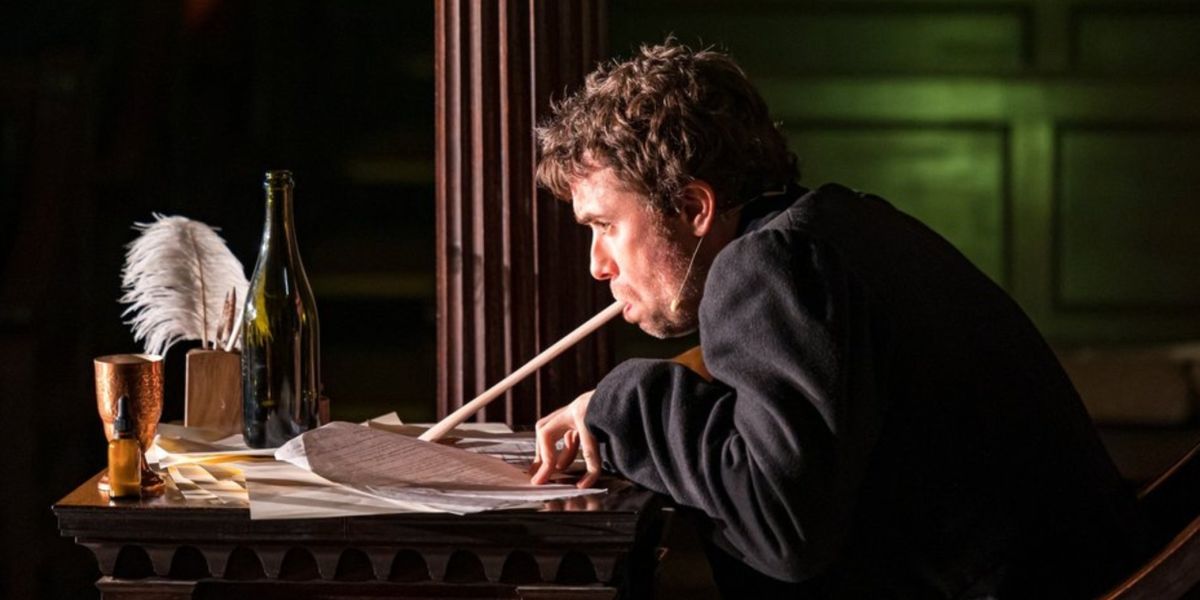
 There’s a line not long into the first act of Beethoven: I Shall Hear in Heaven which strikes me as especially profound, just before we hear the great German composer’s Sonata Pathetique: “sound is feeling made audible”. It’s a deeply poignant sentiment for a composer who was hard of hearing for most of his life to hold, but unfortunately this show as a whole conveys the opposite message: that we need to be told by performers how to feel when listening to music.
The conceit here is what writer Tama Matheson – who’s written plays about several other composers, including Bach and Tchaikovsky – refers to as a “music-play”, a theatre-concert hybrid placing the composer’s life alongside his work. There’s a pianist, string quartet, and chamber choir (who seem woefully underutilised until late in the second act) onstage throughout, punctuating interludes of drama spanning Beethoven’s life with selections from his oeuvre.
It’s intriguing as a concept, but it’s often the case that the scripted drama and musical interludes don’t feel fully integrated with one another. While the musical selections (from across Beethoven’s corpus, as well as that of some of his predecessors, including Mozart and Haydn) are thoughtfully curated, the mechanism of attaching a sad piece to a sad scene, or an upbeat one to a moment of levity, feels too apparent to the audience.
As its title (an allusion to Beethoven's last words) might suggest, the show becomes more compelling when it narrows down the focus to the composer's deafness, and the musical revelations it led him to, in the second act – there's a particularly transcendent sequence involving the famous "Symphony no. 9", a “paean to divine delusion” conducted by Beethoven with his back to the orchestra after he’d entirely lost his hearing. While some of Matheson’s statements about what it is to be an artistic genius can feel generic, it’s illuminating when we see the moment of inspiration behind Beethoven’s work immediately followed by the music itself.
Elsewhere in the show, though, the script struggles to find its way amidst clunky biographical exposition, vague historical allusions to the rise of Napoleon, and some bizarre moments of dark comedy (I found it difficult to feel emotionally invested in the hammy courtroom scene where Beethoven fights for custody of his deceased brother’s son). There’s also a disappointing tendency in Matheson’s writing to resort to cheap jokes at the expense of those with hearing loss.
The script’s disjointedness means it never quite nails down a coherent interpretation of Beethoven’s character – this version of the composer can go from wide-eyed child to red-blooded political idealist, from violently cynical to divinely inspired, in a matter of minutes. Matheson as an actor, however, in the role of the composer, has a compellingly physical stage presence, and is convincing in all of his (somewhat contradictory) guises.
He’s supported by an ensemble of two, who act both as narrators (who deliver biographical details with the austere yet engaged tone of documentary presenters) and as various characters in the composer’s story. Suzy Kohane handles the multi-roling well, shifting deftly from the young Beethoven’s gregarious teacher, to his troubled nephew, to a bawdy sex worker, but Robert Maskell’s several curmudgeonly roles, including Mozart, Haydn, and Beethoven’s father, feel indistinguishable.
The lifeblood of this show is, however, the music itself. When the script loses its way, the London-based Quartet Concrète is there to ground it, and the players are able both to attract the audience’s sole attention and to act as a subtler sonic backdrop when the writing requires. At one point, they seem to almost be actors themselves, coaxing Matheson’s Beethoven into his version of musical heaven. Pianist Jayson Gillham performs Beethoven’s sonatas insistently and almost self-consciously, an approach which works as a kind of personification of the young composer doggedly experimenting with variations on the form.
This is thus a great opportunity to hear the breadth of Beethoven’s work performed in a novel way, and the drama does have its flashes of brilliance. In order to preserve these fleeting moments of conviction, I Shall Hear in Heaven needs to move away from tired biographical tropes and allow the composer’s music to speak for itself.
Beethoven: I Shall Hear in Heaven plays at Opera Holland Park on 8 August
Photo Credit: Opera Holland Park





Reader Reviews
To post a comment, you must register and login.